
[Music]
so I believe that all children should
have equitable access to high-quality
music education and to be able to use
the musical process to help them develop
the character the skills and all of the
sensibilities that they will need to be
a contributing member of society a
contributing member in their community
at home and in the classroom I know that
plane in an orchestra is the best thing
that young people can spend their time
on and I know this because I lived it I
continued to live it and I have the
opportunity to watch hundreds of the
most beautiful kids in Philadelphia
succeed from going through that process
every single day my inspiration comes
from the example that my parents have
set for me what they have taught me
directly and indirectly my father grew
up in the early 40s in Jackson
Mississippi would then go on to go to
high school be the only one of his
eleven siblings to graduate serve
honorably in the Vietnam War utilized
the GI Bill to get his bachelor’s and
then a master’s and music performance my
mother grew up on the south side of
Chicago in the mid-50s lost her father
when she was young and her mother did
everything that she could to provide the
very best for her and her sister and
through the process of music she was
able to be one of seven kids
who helped to integrate the Chicago
Public Schools and at times when there
were thousands in the community saying
by you being here you will lessen the
quality of education that my own kid
will receive and to watch them move out
of the commune
she pushed through all of the insults
from the crowd even the kids cheering
the year that Martin Luther King was
assassinated and finishing a bachelor’s
of music and then going to earn a
master’s in business administration from
Indiana University where she met my
father now they decided to settle in
Atlanta they had a big family I have
seven siblings but we all had to play
music now the joke in our house always
was that you only ate on the days that
you practice so four of us decided to
become professional musicians the other
four decided to become normal and but it
was one thing that was extremely
important for my own development
considering all of the challenges that
my family went through so the first time
I played in an orchestra I was ten years
old this was not my elementary school
orchestra this was me with a bunch of
high school kids it’s the scariest thing
I’ve ever done my mom even had to sit
with me and help me count my rests and
rhythms so that I wouldn’t mess up and
stay on track but I’ve really loved it
see in this Orchestra this 15 different
instruments we’re all trying to play at
the same time and although me as a
trumpet player I could play louder than
the entire group it was my
responsibility really to blend with
everyone and for us to work together so
we could best communicate the musical
ideas of the composer and through that
experience I found a way to help myself
to be motivated I wanted the whole group
to sound good now I wouldn’t need my
mom’s help after that first year
counting the rest and rhythms but I
would rely on her support as I became
serious two years later I found myself
here in Traverse City right down the
road at the Interlochen Arts camp and
their summer after summer I was able to
broaden my horizons of the other
students that I was in
with all the way to the different
ensembles that I was able to play in and
that glue for the other 10 months of the
year when I went back home helped me to
continue to achieve more so it was all
of my musical mentors here in the
summertime back home in Atlanta during
the year that helped me to prepare to
enter the most selective college in
America the Curtis Institute of Music a
school that only has 175 students but
all attend tuition free so these are
tough spots to get probably about 3% of
applicants they accept so at this place
I was able to play the staples of the
orchestral and opera repertoire chamber
music with world-class conductors and
soloists and of course my own colleagues
each week but it was in that process of
trying to become the best musician that
I really lost touch with why I was in
music in the first place so in my last
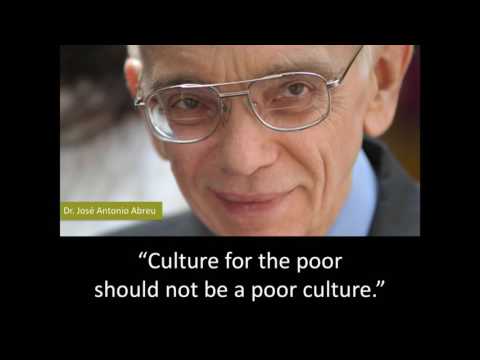
semester of college dr. Jose Antonio
Abreu who founded the music education
and social development program of
Venezuela called El Sistema he won the
TED Prize and in his speech he talked
about just about everything that I had
experienced how important it is to
provide the very best musical
experiences so that young people can
grow not for a product of becoming a
professional musician telling the world
how good you are and hoping that people
come to your concerts so a year after
watching that speech I found myself in
his office in Venezuela preparing for a
two-month tour of his programs
throughout the country and he said
something that struck a chord really
deep inside by saying that culture for
the poor should not be a poor culture
that was the guiding philosophy of my
childhood and that would then become the
guiding philosophy of play on Philly so
when I went back to Philadelphia I
started looking through a completely
different lens and started to tell
myself if parents want the very best for
their kids which I’m convinced all of
them want that and if kids are curious
to learn and if teachers are passionate
about teaching why can’t we do a better
job so I started to think about what
what are the real obstacles to success
for these young people that of course
are trying to go through life like all
of us have been able to so I think about
stress the toxic stress these kids are
under when Dad doesn’t live there
anymore when you are taking care of your
little sister mom works two maybe even
three jobs sometimes you don’t eat a
good meal on the weekends or maybe most
nights you don’t you watch violence
happen all throughout your neighborhood
immediate family members are affected
friends are affected it happens
sometimes right in front of your
doorstep and you think these kids are
gonna come to school and just be ready
to be filled with science and math and
more reading I also think about the
young people avoiding high-risk
behaviors and when you think the world
has nothing to offer you and you have
nothing to offer the world then why why
try just make the decision even if
you’re well aware of the consequences
when I think about the lack of quality
after-school activities even kids not
going to school parents families not
really being involved in their kids
education these are all obstacles that
make it very difficult for kids to
really thrive so I also started to think
about well considering my own experience
considering what my parents went through
how can we use this tool of music to
really help young people in a really
profound way how can we begin to break
down those barriers that create the
obstacles that our kids are facing
so I think about executive functioning
skills this is your ability to set a
long-term goal and then achieve all of
the small steps that it takes to
accomplish it and when I think about in
a musical context when you tell a kid
memorize all your scales remember where
to put your fingers or what combination
of buttons to press you help to build
their memory when you’re telling the
kids to perfect your technique by moving
the angle of the bowl just slightly will
improve your sound that’s really what
helps build their level of focus and
then when you’re also asking kids
observe the rest don’t play for a couple
of seconds and then continue to play you
help them to build inhibition the
ability for them to control their
impulses and then when a kid is sitting
in the context of an orchestra they’re
trying to figure out where to put their
fingers and what to do with their bow
and how long to hold whatever note
they’re supposed to be playing at the
same time they’re listening to their
neighbors if they’re in tune with them
if they’re playing the same rhythms if
they’re in the same spot while watching
the conductor telling you to slow down
slightly or we’re gonna hold that note
just a little bit longer before we
continue to play you help to keep the
amount of attention and a young person
flexible so that they can do all of
these various tasks so by building out
all of these executive functioning
skills that’s what helps the kid to go
back into the classroom and focus for a
little bit longer or remember those
steps to that problem so that they can
repeat the steps and do their homework I
also think about how we can not only
teach these executive functioning skills
but all the pro-social behaviors that
are healthy so when the kids are
learning in a group and they’re
struggling together to sound better then
you’ve helped them build out the
relationships that they really need to
be successful later on which is
different than putting ten kids on a
basketball court and they have to
compete
and half of them always have to lose so
if they can learn to win together it
helps build a level of pro-social skills
that we know is important getting the
parents back involved when a parent sees
that they’re curious kid can actually
achieve something that the kid is being
recognized in a positive way and not
what they see on the news in the evening
then it helps to build a much stronger
bond between the child and the parent
when they really believe that their kid
can do something special
maybe it’s music in middle school in
high school and maybe it’s engineering
in college but that bond and creating
that at an early age is extremely
important so as we look at this we then
say okay how can we build a
comprehensive program that helps to
build all of these things so at play on
Philly what we do with the students that
we work with is that we build strong
partnerships with the school if we can
put a kid in an environment from 8 a.m.
to 6 p.m. where everybody’s holding the
bar high for them and helping them to
succeed and even when they fall on their
face helped to pick them back
immediately and have them go through the
process again then that helps a kid to
really stay in an environment where
there’s there’s success in their day
from the beginning to the end we also
train professional musicians that that
want to be active in the community
but train them to be effective in the
classroom and to make sure that they can
engage the kids at a level where we know
these kids can succeed musically we also
think about getting the parents back
involved as uh sure zatt concerts as
volunteers those that help on the
various trips when the kids perform all
throughout the region and the Northeast
and making sure that they are part of
our success and we provide everything to
our students tuition instruments
supplies at no cost while making sure we
engage them for 3 hours every day after
school throughout the
school year and six weeks in the summer
so 600 hours of quality music education
delivered each year to each student we
know that we can make a difference so as
I think about what our kids are capable
of doing I go back to that one sentence
that dr. Abreu said culture for the poor
should not and it cannot be a poor
culture so what I want to leave you with
today is this image of the play on
Philly Symphony Orchestra they were
playing in Verizon Hall in Philadelphia
one of the finest concert halls in the
world and standing in front of them is
the music director of the Berlin
Philharmonic Sir Simon Rattle now I’ve
rehearsed with maestro rattle several
times I’ve never performed with him let
alone perform for a sold-out audience in
Verizon Hall so as I watched the kids
take the stage and play their hearts out
with maestro rattle I was thinking you
know plan Philly is a program that’s not
only giving these kids what I received
they’re giving them a lot of stuff I’ve
never had the opportunity to even
accomplish so culture for the poor
should not and it cannot be a poor
culture so that means that we all have
the responsibility of providing the best
instruments to the poorest kids that we
provide the best teachers to the most
vulnerable kids and that we work really
hard to provide the best musical
experiences to the most marginalized
kids and like my mom did with me we need
to sit next to every single one of these
kids and help them count the rest and
rhythms until they get it thank you
[Applause]
Please follow and like us: