
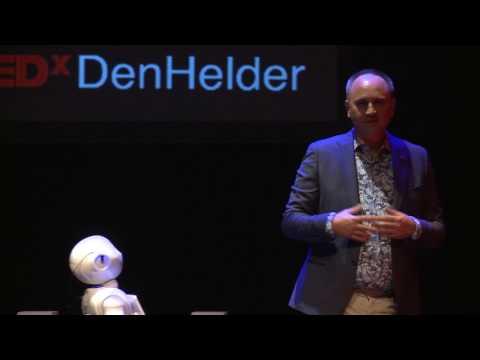
I have your attention
come on look at me my name is pepper I
am the product of the human imagination
I obey the Three Laws of Robotics here
is the first law I may not hurt a human
being I may not allow a human being to
come to harm because of inaction by me
here is the second law I must obey the
orders given to me by human beings
except where such orders would conflict
with the first law and here is the third
and final law I must protect my own
existence as long as such protection
does not conflict with the first or
second law now that I have woken up and
initiated my programs it is time to pass
on to Eric hello thank you pepper pepper
just presented the Three Laws of
Robotics which were defined by Asimov in
1942 Asimov was a sci-fi writer and he
was dreaming about a world of robotics
and he put it down in words in his books
26 years later I was born 1968 and a
year later Neil Armstrong stood on the
moon
Harris man hello he has a social
behavior and an attitude and he’s
ignoring me by the way Hey
hi so Neil Armstrong was the first man
on the moon and many Apollo missions
followed as a young as a young person I
was really intrigued with let’s say all
this technology development and as a
young boy I was watching sci-fi series
on television Battlestar Galactica Berg
and we all know Star Wars which was
released late 70s and in all these well
suffice social robotics played a very
important role they were able to
communicate with people make well well
well informed decisions and guide people
through their lives today
we are in in an era where we have these
robots actually come to life and become
part of our lives coming back to my
youth as a young boy I dreamt about
social robots which I developed which I
created and these social robots would
work and make money for me and with this
money I would develop new robots and
basically they would provide even more
cash
and success and wealth and I was
fantasizing about this and if I look
today with my 40 years or 48 years old
I can see that this dream is actually
coming true not that it’s creating a lot
of wealth for me but they are here and
they are supporting us and what for my
key takeaway for that is that if you can
dream it if you can imagine it then we
can create it and we got products like
these if we look at well 2014 this was
actually the year when I acquired my
first social robot and is this little
fella here this is now and now is a 60
centimeter tall robot 58 to be precise
it’s about six kilos and it has been
designed by Aldebaran in Paris and it’s
a very nice social robotic platform and
what I liked about it was that you could
create small applications which we call
behaviors which basically drive what the
robot does and what it does not do I
decided to tell my colleagues about this
robot and they were all so enthusiastic
now I’m a management consultant and as a
management consultant we try and help
organizations achieve sustainable
success in efficiencies and
effectiveness of their processes and
currently today
we’re look at digital labor and digital
labor is nothing more than let’s say
robotic replacement of labor that was
done by people previously now this is
usually software robots so software that
they call for administrative
administrative activities but sometimes
also social activities like in the
healthcare and I think here in the
Netherlands many of you on television
have seen these kind of robots where
they interacted with people in elderly
homes for example so we decided to use
this robot in workshops talking to our
clients about digital labor and having
let’s say no the floppy disk that’s long
time ago or memory stick which is today
but a more tangible product which
appeals to imagination
imagine what robotics could do in your
business processes in 2016 I decided to
buy a slightly bigger robot so this is
pepper and pepper is 1 meter 20 tool
based on the same technology the same
company but as you can see she stands
out a little bit better than the little
fella over here because that’s a little
bit small high so we use pepper a lot in
in sessions with clients and she’s
really interactive because if I look at
her and I touch her for example she will
respond to touch and things like that
what’s also very nice is that people
when they see pepper they want to
interact with her so she will look at
you and you think there will be a social
response now what’s good to know with
this robot is that if the response has
not been programmed it will not respond
what’s my name it’s ignoring me because
I haven’t programmed it to do a response
on the question what’s my name I can ask
it another question what’s your name my
name is pepper so that one I programmed
now basically what this tells me is that
the environment in which this robot is
working is structured and what I mean
with structured is that if it’s not
let’s say programs according to
behaviors I want to see it will not
now taking pepper to today’s reality if
we look in society there’s lots of
debate about robotics do we want
robotics to be part of our lives we feel
threatened by them we worry about
privacy about security about humanity
you know human dignity if you will but
in fact we you need robots because
people grow older we want to live since
in our homes longer not in some elderly
home and that basically means
distributed support distributed care if
you like and that has a yeah large
demand because we are so many and we
have little a few young people at least
here in the Western countries that need
to support a lot of elderly people so
robotics is must and also if you look at
the environment there’s a need for
robotic to do massive cleaning of the
environment which we cannot do just by
ourselves basically my talk today is a
call to arms because currently the
robots are being developed by the large
corporates and of course there are many
startup companies that have their own
contributions but it’s still on a small
scale and what we basically need is a
vast majority of people co-creating on
these these robots
and I call it as open source development
so currently the corporates that are
developing these robots they develop it
in a proprietary manner so all the
intellectual property is owned by these
companies and is not publicly shared and
as a result we as people cannot build on
all that intellectual property
it stays secret if you like so my plea
is for open source robotics and imagine
that a hundred million people can co
develop from a functional perspective
technical perspective think about new
business models around these robotics
that can really make yet the development
of these robotics thrive because in the
end we need these robots we cannot
ignore the fact that we need them my
call for today is that if we can create
an open platform a platform to which all
of us can become members and share
freely use technology to share then that
would be great because we all need robots thank you