
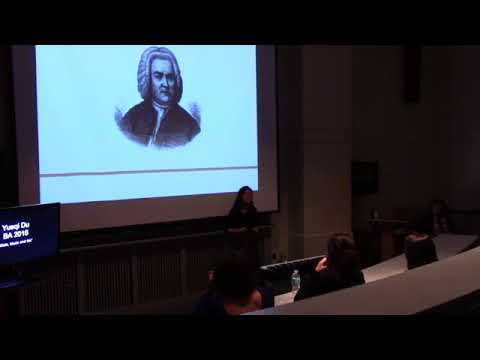
and I’m here today to talk about the
subject of math and music so why are
they related you’re probably asking math
on one hand is very rational and it’s
reason and you have equations numbers
fractions it’s very annoying to most
people but music on the other hand is
very beautiful it’s passionate it’s
enjoyable when you listen to it so why
at all are those two subjects who are
vastly different related well first of
all I’m gonna tell you that if they
aren’t I wouldn’t be standing here
but essentially math is the law of
nature it’s present in everything math
is present in the architecture of this
room
it’s present in your human body it’s
present in the mechanism of this
projector and this keyboard so simply
put math rules and math is also present
in music but how let me just start by
asking you this question does anybody
know who this guy is and he guesses
Shawn now close close he is Greek five
so all right so here’s a hint for those
of you who don’t know who it is
mm-hmm so this is hopefully well known
to all of you in the room it’s called
the Pythagorean theorem which they so
creatively named after the man who
discovered it the Greek mathematician
Pythagoras and if you were really into
watching Disney cartoons when you’re
when you were really young you might
remember this episode so this cartoon is
called that Donald Duck in math magic
land and look at this guy right here
that’s Pythagoras he doesn’t look so
similar with the picture I just showed
you but it’s okay take a look at the
instrument he’s playing that’s called a
liar and see how the strings are
different the length of the strings are
different
on the instrument and that is how they
are able to produce different pitches so
this is how it works and here’s the
story so one day pythagoras taking a
walk casually around town and then he
happened to walk by a blacksmith shop
and he noticed that the when the
blacksmith’s hammer the iron they
produce different pitches and he thought
that was because of the different
weights of the hammer that when it
strikes the iron it produced different
sounds so he ran back home very excited
and formed an experiment
he tied different weights on two strings
and plucked them and surprising me well
not really but they produced different
pages just like they did at the iron
shop and this is what he found so um if
you have a piece of string like this one
right here and you divide it in half
into this one that produces the interval
of an octave and it sounds something
like this
[Music]
so I think that sounds very familiar to
most of you and the first two notes of
that song
that’s an octave and in music we call
that the same note but just played in
different registers and why do they
sound so similar it’s because of this
very simple two to one ratio then it’s
it fits very nicely so it’s very nice to
hear for their human year and if you
divide the string into two thirds that
produces the interval of a fifth and
this is what it sounds like
[Music]
so the first two notes of the theme
sound – Star Wars is a fifth and that’s
also very nice sound it’s me it’s also
because of this ratio of three to two
and if you divide the string further
then you have this string right here
it’s 3/4 of the original string and that
interval is 1/4 and it sounds like this
[Music]
I think the first two notes to the
wedding march is a fourth
so let’s deep dive deeper and look at
the physics so see when you pluck a
string it produces an oscillation
throughout the string and that’s that
can be expressed as a sine wave and this
is what a sine wave looks like so say
this is the graph of a sound wave of the
first base note of this of the original
string that we just saw this one right
here and that’s the graph of it now you
have its wavelength you have an octave
the red curve is the note that’s an
octave above it and it goes through two
cycles while the blue curve goes through
one so the ratio of two to one and now
divide the wavelength further and you
have this purple curve this one right
here and that’s a fifth the red curve
goes through two cycles
well the purple group well the purple
curve goes through two goes through
three so that’s the ratio of two to
three and now flash forward a few
thousand years now we know the piano is
divided into twelve equal intervals
which is known as the equal temperament
scale and it sounds like this
[Music]
and the octave is divided into twelve
equal steps but it doesn’t quite work
like 2/12
see in sound waves it’s not that the
strings are indifferent they are divided
into different lengths it said they’re
divided into different ratios and that
magic ratio number happens to be 2 to
the 12th root and it wasn’t until
mathematicians were able to take 2 to
the 12th root that musicians can tune
their instruments according to the equal
temperament scale and guess who got
really excited ba he got so excited that
he wrote a whole book divided into two
sections whole book on all 24 majors and
minor scales and each set is made of a
Prelude and Fugue so now I have 48 new
pieces to learn thanks ba but the reason
that the equal temperament skill is so
cool is that it allows musicians to play
any song on any key and they would sound
the same so Bach’s Prelude in C major is
one of my personal favorites it’s also
the first piece of the book and it’s one
of my personal favorites of the
well-tempered clavier and I will play a
little bit of it and some of you might
recognize it but here it is
[Music]
so you might notice that there are
different melodies and they’re all made
of broken chords like this one which is
the first measure of the Prelude in C
major and the different chords are
basically the building blocks of the
song and look at the first measure it’s
a very nice C major chord and that
sounds very pleasant to the human ear to
hear but why is that so when you play
the chord on the piano this is what
these are the notes that you play so
instead of going note two notes you skip
each note and that is what you get that
is what you call a triad and look at the
sign curves this red curve is the root
note of the chord C and the blue curve
is the fifth which is G and the green
curve is the third it’s it’s the third
it’s the note e and the red curve goes
through two cycles
well the purple curve goes through three
hence the ratio of two to three and the
green curve goes through two and a half
they all intercept at this magic point
right here and fit very nicely together
and that is what we call a consonant
something that is very that fits
together very beautifully and this
sounds very pretty to the human ear but
recall the second measure which sounds
like this if you forgot
it’s still very beautiful cord but it
doesn’t sound as well spaced out as this
cord right here
the reason is that you have this note
which is a C and this note which is a D
play together this is called a D minor
7th chord and this sound well it’s not
necessarily a bad sound but it’s very it
comes here the sounds are running into
each other when they’re getting to your
ear and this is why that produces a
clash sound so the other take a
particular look at the orange curve well
the other three curves all intersect
very nicely at this point right here but
the orange curve does it it kind of
intersects the other three curves here
that doesn’t fit very nicely that is why
that the D minor 7th chord
doesn’t sound necessarily as nice as the
C major chord but why does this matter
well to be honest it doesn’t it only
matters to me because I love I happen to
both I happen to love both music and
math and being able to find out that
there are very deep deep connections
between those two subjects has allowed
me to look at music and math in a
different way so what I think is really
cool about this is that well music is
very beautiful and passionate and
emotional it has its principal lying in
math a subject that’s completely
different and math something that’s very
rational and you can call it boring to
some extent but it has its underlies the
very important the very fundamental
principles of music which is very
beautiful and emotional and that
discovery almost made me think almost
made music sound more beautiful to me
and take a look around you there are
very deep connections between everything
and I think that’s the beauty of this
world thank you
[Applause]
Please follow and like us: