
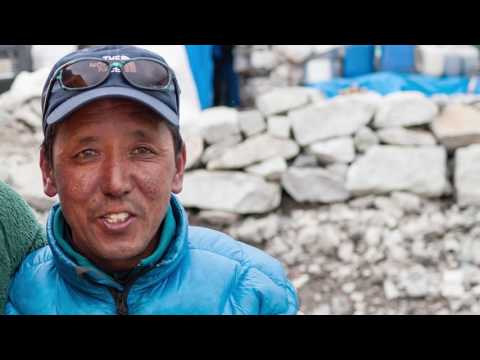
the mountain to the left Mount Everest
you probably heard that this place is
really crowded like 25 50 people at the
same time on the summit not this day
this day on 11th of May 1990 there were
four people that summited and three of
them had already been on the summit on
the way down one of them was my friend
Michael he became the first Swede on the
summit of Everest there was an American
and an Australian so I was a bit slow I
was five hours after them and I think I
was probably feeling the most lonely
person on this planet being all alone on
the summit of Mount Everest
of course happy crying laughing but you
know I knew that you know this is just
half way and you probably heard about
climbing up mountains it’s you know
ascending mountains it’s it’s tough I
think it’s a lot tougher coming back
down again you know I tried to call my
girlfriend you know on the VHF on the
satellite phone back in Sweden and try
to talk to her so I’m on the summit but
she was for the core at the mechanics so
he didn’t answer the phone
so I started climbing down instead and
four years later we did it go on the
mountain to the right which is the
fourth highest mountain
it’s called load sets eight thousand
five hundred and sixteen meters and this
is pretty tricky a lot more technical
time than Mount Everest because there’s
a cooler war leading up 500 meters
pretty steep from the last camp to the
summit and it’s a mixture of ice rock
and snow so we submitted way too late in
the evening took some pictures we know
knew that this was way too late
but we knew that there’s no way we can
get lost because there’s only this cool
are leading straight down to our tent so
we took the pictures and and you know
having a good time up there you know as
good as you can have it was pretty foggy
and this picture is taken
by another climber from Everest actually
but you can see the loads say cooler are
leading up to the summit and when we
descending from this mountain is getting
dark and it’s getting windy really
really strong winds and yes you solving
the picture before I had dark sky
goggles and when it’s dark you know you
can’t use me should have clear glass but
I didn’t so I had to take them off so I
couldn’t really see down and the wind
was really really strong and we were
tired of being climbing for 18 hours
and as he climb on on these Himalayan
mountains you are the rope in between
and I fixed myself into there to the ice
with an ice crew and then I let you in a
belay my partner climbing down and it
took four ages trying to belay him like
20 minutes later 30 meters further down
I get three big pools in the rope and
that’s okay
so it’s undo the screw in the ice and I
start climbing down and it took really
long time and as we were climbing past
each other and we tell and delaying each
other you know at a snail’s pace we both
started to feel that we’re getting
really cold hands and feet and at one
stage when we passed each other I
stopped and said this doesn’t work we
would probably both get frostbitten
fingers and toes so we got two choices
now either we continue like this and
then we’ll probably lose a few fingers
and toes or weeks we skip the rope if we
skip the rope if somebody falls we fall
2000 meters straight down to the glacier
so it’s easy to sit down here and think
about you know how should we what
decisions do we make up on a high
altitude but it’s a completely different
story upon when you were there in the
situation preparing for an expedition
like this is of course essential you
have to be physically and mentally fit
somebody said if you fail to prepare you
prepare your failure and I couldn’t
agree more you have to have the right
equipment you have to trust the
equipment rappelling down in Harwood’s
hole in New Zealand
it’s a almost 200 meter straight
vertical there’s an entrance to a cave
with a single rope all the way from the
top down to the bottom and 200 meters
might not seem that much if you’re
walking on the street but I tell you
through hanging in the top of 200 meters
so you got 200 meters down there in a
rope that is this thick you have to
trust the equipment and you have a
braking device that the Rope goosed goes
through and if you repel too fast this
metal piece will start getting orange
and that’s a very bad sign and if you
then stop the Rope starts to melt so you
have to have exactly the right pace
going down so equipment is important and
the right amount of equipment of course
is as important when we were paddling
stand up paddleboard from from Gatlin to
Stockholm and there’s no real space to
bring your your dog or to bring your
favorite books or your rock collection I
mean we do we don’t take away everything
that’s not necessary
you know these washing labels in in your
clothes do we need to know that it’s 30
degrees hand wash out in the middle of
the baltic sea to know and that weighs a
little bit and breaking the handles of
the toothbrush actually that was before
now we just bring floor tablets and
leave the toothbrush at home I need for
climbing a mountain up and down many
times as you do acclimatizing all these
little things that way if you put them
in a pile will be quite a few kilos in
the end and how can I be 100% mental
focused on the mission if I know I’m
carrying a lot of rubbish we collected
and small nets behind the stand-up
paddleboards on part of the ways we
collected samples of micro plastics and
unfortunately there’s quite a lot of
micro plastics in the Baltic Sea the
longest distance was between two islands
took 16 hours without break and I had
just had to take a picture myself when I
came to that Island I did a few other
rowing projects like rowing across the
Baltic Sea to Finland
and I would get got tired of sitting in
there in the rowing machine in the gym
and how fun is that I mean on a scale
from one to ten the rowing machine in
the gym about – 40 – isn’t it a lot
better to be out rowing in the in the in
the wheel on the water but I didn’t have
a clue if I was going to make it all the
way to Finland I’ve never owned that far
before but I tried I tried I started off
and I think we need to be more open to
failure I mean failure to me is not not
coming up on this summit not ascending
climbing a mountain failure for me is
not coming back down from the mountain
so if we don’t make it all the way well
at ride and I think we need to try more
now at 75,000 strokes with the wars and
two weeks later I arrived in the land of
the Moomin which was quite nice I’m
gonna make you the expedition leader of
an Everest expedition and you are now
the expedition leader and you’re gonna
hire the people around you that are
going to climb the mountain so what
people do you hire climbers yeah okay
okay of course do you hire climbers but
let’s dig it a bit deeper than that you
are still the expedition leader and
you’re gonna hire people for an
expedition to Everest what are the most
important qualities what are the most
important personal qualities in the
people that you would hire to climb on
to the highest mountain in the world
well I’ve done some very unscientific
research and I’ve looked through a lot
of the groups that I’ve been involved in
in throughout the years and and I’m
getting pretty old and I’m come up with
this you need a person
if you check Wiktionary a wacko that
means somebody that is amusingly
irrational and eccentric amusingly
irrational and eccentric did you say
Donald Trump no total duck no so this is
got nothing to do with the people that
you want you don’t want somebody that’s
wacko but the first this just happened
to be these words but this is according
to me the most important personal
quality and what does the W stand for if
you look at the guy standing forth from
the left in the spawn tiny guy in the
green shirt
his name is aperture / and for a
high-altitude climbing Sherpa it’s
important to have been on the summit
because then you’ve easier to get job
and you get more paid up a chapter
hadn’t been on the summit until our
expedition 1990 I was back in 2011 I met
up a Sherpa again 21 years later and he
looked the same didn’t change at all and
I asked up a Sherpa how is gone how Dean
climbing a lot yes every year every year
since 1990 yes to the summit
yes that’s 21 years yes that’s 21 times
to the summit yes
so up a Sherpa actually together with
one other Sherpa he’s been this has the
world record of climbing Mount Everest
21 times and to me I think that’s a good
symbol of the most important quality is
that you have the will that you want to
do it and also could be nice to know why
when the warmth gets weak to know what
button to press on the second word here
the or later the a here I’m going to
take example of a in person we did a TV
series called the own boundaries against
all odds’
TV show where we had 10 disabled people
wonderful bunch of crazy happy shiny
people that were going from the Atlantic
coast of Nicaragua to the Pacific coast
88 days and this was no game this is not
you know not a chartered trip this was
for real and it was the most lovely I
mean we had our ups and downs we had our
fights but we have a lot of nice
memories from that trip a little advice
if you’re going into the jungle don’t
bring two wheelchairs if you see the guy
sitting in the middle it’s called Paks
he’s got cerebral palsy CP from the from
birth on his hands he couldn’t really
use his hands the most wonderful lovely
intelligent one of the funniest guys
I’ve ever met and he was really really
strong but his hands he couldn’t really
use his hands so one time we were
climbing this volcano and it was a storm
we have been walking for 10 hours
everything was a misery started raining
packs were standing there freezing and
soaking wet clothes
shivering and really really cold so I
told him put on some dry clothes in your
attempt and you know I’ll get some warm
food so packs started you know with his
hands that he couldn’t use try to get
his wept off and you know so I came back
20 minutes later and I asked you know
shouted outside packs are you going are
you okay and you know no answer it so
packs are you okay we’re storming that
you know it was feeling a misery and I
opened attempt and he was sitting there
in the water was flooding inside the
tent with mud and water and he was still
shivering and it was it was terrible and
it was a thunderstorm and he was sitting
there and you know and and he turned
around to me as I opened the tent and
like he was sitting in a straitjacket
trying to get this shirt still off after
20 minutes he turned to me and looked at
me with a smile from ear to ear and said
Oscar I think we’re in deep I was
myself pretty irritated at a time that
he chose to be had the right attitude
which is the second most important
personal quality when you are to work in
a group according to my very
unscientific research now their third
letter to C is of course in cooperation
and when sailing across the Atlantic
it’s still my record actually at 85
knots of breeze is Dartmouth maximum
wind speed and that’s not storm that’s
hurricane-force winds of course you need
to be able to cooperate it’s a big
subject there is one thing about working
together about teamwork that I think is
really important and that is trust do
you trust the people in your team as a
skydiving pilot you learn how to pack
your parachute and it’s an awful lot of
parachute to pack it’s like 200 and
something square feet of parachute and a
lot of lines that’s supposed to be in a
very correct order and as a student you
have to call somebody who knows how to
pack chutes and ask him is this okay
yeah it looks okay okay but are you sure
yeah yeah it looks okay and you you know
sort of practice and can somebody else
come and you know you check different
stages of packing the chute and there’s
another option and that is to go to the
people working in there in the in the
airfield and pay them $10 to pack your
parachute so you just take this big huge
parachute and give them a say okay
please pack this yeah yeah I’ll be five
minutes ten bucks no no no no no no five
minutes you know take your time that’s
it let’s say one hour and to me it’s I
think it’s a good metaphor of trust now
who would you ask to pack your parachute
that you’re gonna jump off a plane from
in your class at your work in your
family the fourth letter in my very
unscientific Ulrike and of course we’re
in a school knowledge is really
important
don’t go diving under the ice unless you
know what you’re doing but if we’re
going to climb this mountain you can be
I mean if you don’t have the they want
if you don’t want to climb Everest if
you don’t have the right attitude if you
cannot cooperate you can be a professor
of everything in the world but I don’t
want to be in your team yes it’s
important but it’s not the most
important thing and then of course since
this is unscientific the old stands for
a lot of other things that I have
forgotten now there this
the challenge for me as a leader having
a group that is very different this is
of course picking out making people grow
and try to use the different I mean
they’re an advantage that we actually
are different in the good and it’s it’s
it’s fun because we as I said we had all
have our ups and downs in some Sunday’s
were strong Sundays we week and we
didn’t need to use this and make people
grow and and of course funny situations
occur sometimes when we were sailing
across the lake of Nicaragua I asked you
know if who can steer a boat and it was
one hand in the air and okay anyone else
okay
you work here you steer the boat you’re
completely blind but that’s okay we’ll
probably work out anyway
now I didn’t think that blind people
could steer boat because they don’t see
anything but he heard the waves and he
felt the wind in his face and he had
this little compass watch that he you
know okay it wasn’t dead straight it was
a little bit like this but we came where
we wanted to and I think it’s all right
now when I talk to children I never get
the aunt stick with a question why did
you climb Mount Everest or why did you
take your long board from Stockholm to
Gothenburg for kids adventures is
spotless they ask how far could you see
if standing on the summit of Everest you
know how many birds what I what wildlife
did you see and whatever but they don’t
question why you climb Everest adults do
yes and why I climbed Everest in those
days was a lot of attention recognitions
look at me that driving force was strong
yeah today it’s more about you know the
amplitudes of life that are you know
rainy Tuesday it’s not much happening
it’s not much up or down to me doing
adventurous starts stretching the
amplitudes of life and living a little
bit more when it’s hard it’s really hard
it’s storm on the ocean or you’re
standing paddling
where God knows where and it’s really
down here it’s hard work but then you
get the reward up here you get religious
waking up on a in a tent 3:30 in the
morning with it with the sun shining in
through the tent you have some birds
singing so for me adventurous you know
living a little bit more and we chose on
loads say to actually to skip the rope
and to climb down each other one by one
and eventually we we ended up in our
camp eventually down to base camp and
had a great expedition unfortunately now
my climbing partner is not alive anymore
he committed suicide many years ago the
year before this expedition another
person died on the mountain two years
after this expedition to climbing
friends Rob Holland and Scott Fischer
died on Everest and people died people
died skydiving our friends dying dive
dying and that’s part of life I wake up
every morning almost everywhere I wake
up every morning but I asked myself
almost every morning a question and that
is if I’m happy with the life I’ve lived
so far and almost every day the answer
is yes
I could actually die today and be happy
content with the life that I have lived
so lesson learned from people dying and
people die from cancer and all different
sort of disease lesson learned is to
live a little bit more let’s go up jump
up tape airplanes I just make sure you
trust the one who packed your chute
let’s be wild and crazy let’s not work
too much let’s play hard let’s have fun
let’s go climb a mountain go outside
your comfort zone and live life and
remember if you end up deep and
don’t remember – don’t forget to smile
thank you
[Applause]
Please follow and like us: