
[Applause]
208 million people it’s the approximate
number of adults in the United States
that regularly use the Internet it’s 84
percent of our adult population and that
number jumps to a staggering 96 percent
when you only consider young adults ages
18 to 29 now that’s just us census data
it’s not that fascinating on its own but
what it means is something profound what
it shows is that we live in a time where
each of us all of you have this almost
infinite resource of information which
is available at your fingertips
and this is made even greater by the
fact that it’s not just information its
resources and opportunity to embrace
technology and integrate it into your
community good evening or afternoon if
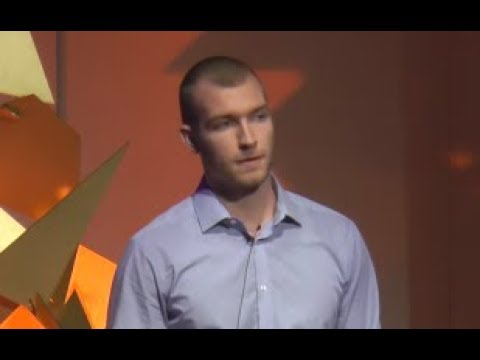
it’s your preference my name is Mason
wildy I’m a sophomore studying computer
science from the University of Kansas
and I’m also the CEO and founder of the
Castella company a small nonprofit that
focuses on producing prosthetic devices
for families in need I started this
company back during my junior and senior
years of high school after a series of
both fortunate and unfortunate events
and it’s really opened my eyes to the
ways that you can use technology to
improve your community and it’s also
allowed me to grow as a person in ways
that I would have never expected it’s
let me lead it’s let me manage I’ve
gotten an introduction to business and
entrepreneurship I’ve gotten to
communicate with people form
interpersonal relationships and get that
taste of engineering that I would have
never gotten anyway else and it’s been a
crazy ride but my experience isn’t
unique
there are hundreds if not thousands of
people across this nation doing
incredible things that would both humble
and amaze to the best of us but their
experiences don’t have to be unique
either as I’ve already mentioned we
already have these resources and these
opportunities waiting at our fingertips
we just need to tap into them and that
that’s what I want to talk about tonight
I want to tell my story I want to talk
about how I went from being a sophomore
junior senior in high school to a
sophomore in college giving a TEDx
speech but I want to focus on my
failures I want to focus on the mistakes
I made a long
that journey and focus on what I learned
so that I can give that out to you guys
so maybe the things that I had to learn
the hard way you can just take for
granted and go out on your life so my
story what is my story well for me it
really began at a very young age because
I’ve always been a tinkerer I’ve always
had kind of that engineering heart
I grew up fixing motorcycles and cars
with my dad playing video games on my
grandparents computer building Lego sets
and disassembling furniture with tool
kits that I was quickly restricted
access to I’ve always been techie for
lack of a better word but the spark that
really moved me towards using technology
to improve communities didn’t come
actually until my junior year of high
school during a Friday night football
game of all places
you see I played safety and if you’re
familiar the job description of a safety
is a lot of fast open field hits and
I’ve given a lot of them and taken a lot
of them in my career but one night in a
mid-october during my junior year I gave
one those hits and it did not agree with
me and during halftime I was carted off
to a hospital and quickly diagnosed with
a pretty severe concussion that took me
out of school for over a month and ended
my contact sport career and initially
this was devastating to me because I
loved football I loved basketball and I
could still run track but 2/3 of my
athletic career were just cut they were
gone now I was exceptionally lucky to
find a wonderful concussion specialist
and she’s out here somewhere but she
helped me make amazing recovery within
just the first two weeks I was regaining
a lot of my basic function I still
couldn’t do school though because of
light and noise and just you know
general mental straight strain so I was
still confined to a dark room really
just staring at a ceiling trying to
sleep away the concussion it was really
just a dark time but that’s when
opportunity came knocking for me see one
of my mother’s friends and co-workers
had a son who’s born with a meiotic band
syndrome which is if you’re familiar
again is a congenital disease or
disorder where you’re basically born
potentially without parts of limbs in
this case his right hands function was
severe
as he didn’t have essentially any
fingers on it and he’d grown up very
well adapted to this condition he was
able to do a lot of things that no one
would ever expect him to be able to do
with that but there were still obstacles
that he couldn’t overcome with
essentially just one fully functional
hand so they were looking for a
prosthetic now prosthetics are really
expensive I mean that’s just on the
get-go and he’s a kid
so he’s growing so you might need to buy
more than one in the course of a couple
years so suddenly that gets really
expensive and it just wasn’t feasible
and and on top of that that prosthetic
devices don’t look cool and when you’re
in elementary school cool is kind of
King gotta be cool so they had found
robohand which was an Australian company
that was building an open-source 3d
printable prosthetic hand and they loved
it it looked kind of like Legos he
really liked the look of it it was fully
mechanical didn’t need electronics they
wanted to get this hand the problem was
that Robo hand was still a very small
organization and most of the production
in the u.s. at least was being done by
third parties who also wanted a lot of
money to build these hands but that’s
where I came in I had a lot of newfound
downtime and they knew me in the past
from helping them with computer issues
and video games with their other kids
and they knew me as kind of that
engineering type and this was right up
my alley and with the beauty of
open-source I could take these files and
do whatever I wanted with them so I
download the file that downloaded the
programs that allowed you to edit these
files and I modified them to fit the
kids hand it took a week and a half of
kind of 10 20 minute increments of work
where I could just focus while my head
was good take a break when I got tired
and it was beautiful I was still taking
my downtime I was still recovering but I
was actually being able to do something
so I got these files done I knew what I
needed but now I needed to print them
and I lived in Lewisburg Kansas which if
you’re familiar with the areas kind of
rural and where was I gonna find a 3d
printer well it turns out the Johnson
County Library has a makerspace with a
public 3d printer just thirty minutes
from my home you gotta go to your
libraries they’re very understated but
they were also a little bit ahead of me
and realizing that embracing technology
could improve communities so I gave him
a call I went up there with a flashdrive
of files and in basically no time I was
leaving with a bag of PLA plastic hand
parts
it was way too simple but then I went to
a hardware store I picked up some nuts
and bolts ordered a sheet of orthopedic
plastic which could be molded into a
gauntlet some nylon strings for the
mechanism and it was kind of just time
to build and this seems like it should
be one of the harder parts it was
actually the easiest part because after
staring at a set of designs for a week
and a half
you kind of know how they’re gonna fit
together and it becomes a lot like Legos
where you’re just kind of plugging them
where you need they they need to go and
within a couple hours we had a working
hand and within probably five seconds of
putting it on the kid was already
grabbing a water bottle and using it and
then he grabbed a pencil with learning
to write with that and as I later
learned he learned he could play
stickball with it not holding a bat but
actually using the hand as a bat which
led to me needing to do some repairs in
the near future but he was doing
incredible things with it and it had all
worked it was remarkably smooth and that
was it project was done school was
starting back up my medical clearance on
my concussion was about to come up track
season life was gonna go back to normal
I’m up here talking to you guys so
clearly that didn’t exactly happen life
didn’t exactly go back to normal
so I mentioned my concussion specialist
she really loved that I was doing
something with my time other than just
sitting in a dark room staring at a
feeling she loved that I was going out
and doing something to help someone else
with this downtime and she had formed a
contact with a Kansas City Star reporter
and that kind of let and that led to a
front page article which then kind of
procured coverage with KCTV 5 and Fox 4
News a bunch of online news articles
picked up the story and it all
culminated with two articles and
separate editions of People magazine so
this small project that I kind of just
started on a whim with a concussion
suddenly had become this very large
thing that a lot of people were taking
notice of and people were calling my
school and they were sending letters
because that’s the only way they knew
how to contact me it mentioned that I
was a student there and they were
sending me money to help my cause I
didn’t have a cause
I was just thinking about track season
so I could she realized that I needed to
do something I couldn’t just keep going
and maybe like okay I could have just
pocketed the money and run they didn’t
know me but that would have been the
right thing to do so I had to think
about how to formalize it and luckily
one of my classmates mother was an
accountant with some nonprofit
experience so I contacted her and we
started setting up a 501 C 3 textile
company I wrote up all the bylaws the
proper legalese and we got it approved
so I all the sudden add up up 1 C 3
nonprofit Dec Stella Company and that’s
really where I am today we’ve since
purchased our own 3d printer and we help
people as they come in it’s not some
booming industry with thousands and
thousands of customers every week or
month it’s people as they come and
oftentimes we don’t even need to build
on the hand because we make it clear
that they can build it themselves if we
help them along the way and it’s been an
amazing experience but what I just did
was I only hit the highlights I only
told you the good things and the smooth
story board style of here’s how
everything went well but there were a
lot of pitfalls and during that
especially the nonprofit side that get
left out of the stories and don’t get
told but I didn’t learn things from
being successful in doing things I
apparently already kind of knew how to
do I learned things from when I made
mistakes so that’s what I want to focus
on and there were really two kind of
categories of mistakes that I made that
I’m gonna lump all of them into for the
sake of time because it’s too many
mistakes to count the first of which was
that I bit off more than I could chew
I’m only one person
and it’s something that’s easy to forget
but you can’t do everything and I was
trying to run track get prepared for
prom college applications general high
school life and all of a sudden now I
owned a non-profit and I was trying to
build a website file tax documents and
just mark it and build hands I was
spreading myself really thin and I
quickly realized that I was running two
days where there would be five things to
do and if I really set my mind to it I
probably could have done three or four
of them but just the fact that there
were five looming on the horizon
intimidated me and I’d only get one or
two done my efficiency was dropping
drastically just because of the sheer
load
work I had to do so I quickly remedied
this by enlisting people that knew more
about the fields I did I had a web
developer help me was a website and I
kept my account and friend working on
the taxes and business side of things so
that I could focus more on my school
life and the actual I guess engineering
side of these hands and it worked
beautifully it quickly adapted to a
point where I actually could handle it
so I kind of rectified that mistake but
it was still a mistake that had a lot of
impact early on the second mistake I
made was that I overestimated my market
you see when I was getting all these
letters these calls all this publication
it seemed like this was this really big
experience and that a lot of people care
and this was going to be big so I formed
the nonprofit and I’m initially kind of
thought hey this should be growing
really quickly this should be a big
thing really quickly but that wasn’t a
case I kind of forgot that I was dealing
in a really niche market of people that
needed essentially one specific 3d
printable prosthetic hand that really
didn’t have that big of a market so
initially I kind of it hit me in my own
ego I thought I was doing something
wrong I thought this wasn’t growing
quick what am I doing wrong and it hurt
my morale and I wasn’t doing as well
again my efficiency dropped because does
this even matter why am I even doing
this and no one seems to be caring about
it but once I kind of got past that and
realized you know what I’m helping the
people that I helped and if we could
live in a world where people didn’t need
prosthetics I’d go out of business but
that would be a better world so I had to
get past that and I did and it
ultimately went it well apparently so
those were my mistakes and I kind of
gained what I would consider three
pieces of knowledge from them and a lot
of them have been things that you’ve
probably heard before but I like to
restate it because these are important
things that I learned from it and that
you need to remember if you try to do
something similar or just apply to your
general life the first of which is to
know your limits you see I’ve always
lived by a mantra of kind of pushing my
limits and I love that saying push your
limits shoot for the stars but a lot of
people interpret that to mean ignore
your limits or act like they don’t exist
and the analogy I’ll use is running
because I’m a runner and that’s easy to
go to for me but I can’t run a
four-minute mile I can’t do it I can
maybe run a seven-minute mile on a good
day so if I went outside right now and
tried to run a four-minute
I’ll put on some running shoes hopefully
I would fail miserably I would get about
half a mile in at a full sprint and then
collapse and crawl the rest of the way
and probably end up running a 9 or a
10-minute mile if I just started on pace
for my 7 I would have run a 7 because I
ignored my limit I did poorer in the
long run now if I know my limit and I
train intelligently I can go from a 7 to
a 650 to a 645 whittle that down and
suddenly now maybe my limits of
four-minute mile but if I just go out
and run for minute miles over and over
again and keep collapsing I might get
there eventually but it’s not going to
be nearly as quickly so you gotta know
your limits and you got to train
effectively with that knowledge the
second piece of knowledge I guess would
be to do your research and this ties
directly into my over estimation of my
market had I gone in and done my
research and known everything I wouldn’t
have been so blindsided by the fact that
I wasn’t as big as I thought I was going
to be if you go in blind you’re
obviously going to be blindsided because
all of your sides are blind but you got
to do something
beforehand to have a lay of the land
before you go in another analogy would
be as a computer science guy I’ll go to
apps if I built an app that took the
current date added up all the numerical
values and then printed the square root
of those that’s kind of cool shows I can
build an app it’s kind of gimmicky but I
made it let’s say it took me a week did
that help anyone if I did that with the
intent to help a lot of people what it
and the answer is probably no and that’s
obviously a kind of an arbitrary simple
example but if you go into something and
you think you’re gonna help thousands of
people and you don’t do your research
and realize that it’s already done it’s
done a better way somewhere else
you could effectively waste a lot of
time on an endeavor that you could have
had better efficiency by putting your
effort into another area and had a lot
better results so you got to do your
research first now both of those pieces
of information tied directly to my
mistakes they obviously would have if I
had taken that advice of myself and
applied it earlier I wouldn’t have had
those two mistakes most likely the third
one is probably my most cliche piece of
information but it’s also the most
important and
applicable to everyday life and it’s to
have fun I know it’s it’s cheesy
I love the cheesiness of it but every
motivational speaker you’ve ever heard
has told you have fun and if you do what
you love you’ll never work a day in your
life but it’s really true because when I
was building that hand and when I’m
working on that nonprofit stuff now it
feels like I’m back building Legos it
feels like I’m working on motorcycles it
feels like I’m playing computer games
it’s all this incredible feeling of fun
and all sudden I look up and it’s been
three hours and it feels like it’s been
30 and I put a lot of effort in I have a
good product
contrast that with doing something that
I’m not having fun
and suddenly I’m checking my watch every
10 minutes wondering alright is this
enough is this good enough when can I go
do something else that I actually do
find fun so you got to find that thing
that you have fun with and that you’re
passionate about to be that level of
efficiency and an add-on to that it’s
easy to say have fun do what you’re
passionate about but what are you
passionate about that takes people a
long time to answer for me I got lucky
and it kind of got thrown on me and I
realized hey I really enjoy this it’s
hands-on building it’s fun I love this
but my other interest which was
mentioned to kind of a my introduction
of AI artificial intelligence I didn’t
really know that until about a year into
college I went through two majors to
research labs and then I kind of landed
on that passion and that’s still
probably kind of early so I was lucky in
two cases there some people might go
years and years trying to find that
thing that really drives them and for me
those two things if you ask me about
them you I’m gonna have to ask you how
much time you have because I’m gonna
start talking faster I’m gonna start
rattling I’m gonna start rambling
because I’m interested in them and I
want to talk about them because it’s fun
to me so you gotta find those things in
your life that you have fun with and
embrace them and turn them into
something to benefit the community so
knowing your limits doing your research
and having fun it’s pretty much all I
got from the last three or four years of
running a non-profit but I think it’s
easily applicable to anything we do in
life specifically in this field so with
that I urge you when you leave here you
probably have something in your mind
something you’ve run into in the past
week month
a year where you thought yes that’s a
bit of a problem I wish someone would
fix that you can fix it potentially look
into that let that let that festering
thought grow into an idea and embrace it
do your research know your limits think
of you’re gonna have fun with it and
then pursue it with that I urge us all
to go out make something and just make
the world a little bit better for it
thank you
[Applause]
Please follow and like us: