
about the physical complications of
mental illness so I think the stigma
around mental illness in the Silicon
Valley comes from the fact that you
can’t see mental illness it’s pretty
much all in your head it’s not tangible
so it may as well be invisible but the
thing is it’s actually a really more
dangerous illness than you would think
if you think about it this way
organisms main goal is to survive they
will do anything to live but mental
illness overcomes this primal
foundational instinct and causes people
to commit suicide so it’s really not
just a psychological problem it’s also a
real biological one now this happens to
everyone at some point where they get so
stressed or so worked up that something
in their body changes and they don’t
feel as well as they usually would for
example last night I was walking around
my kitchen at 2:00 a.m. giving this
presentation to my dog and I could not
breathe and that happens to everyone
once in awhile but then when it happens
over a long period of time that’s what
you would call a mental illness this is
many of you probably seen before the
difference between a brain of a
depressed person and the brain of a
normal person and there is like not
enough biological activity in the
depressed person’s brain because their
brain doesn’t function the same way and
this is what most mental illness
medication presents today what it does
it usually focuses on the activity in
the brain and how to change it and force
it to become more like the mental the
mental health of a normal person’s brain
most mental illness medication today the
most popular one and the safest one is
an SSRI that’s a selective serotonin
reuptake inhibitor and what it does is
well their serotonin in your brain just
floating around and the more you have of
it the happier you are but some people
aren’t able to make a natural amount of
this enough to make them not only just
happy but mentally healthy so what an
SSRI does is it blocks the channels that
recycle serotonin because serotonin is
broken down and then turn into some
other neurotransmitter and it keeps this
recycling from happening so then you can
have more serotonin kind of floating
around in your brain even though your
brain doesn’t really want it to be there
so it’s kind of like forcing your
happiness but it works really well for a
lot of people combined with behavioral
therapy
so but now what we’re trying to do is go
beyond changing what causes depression
and going to why depression is caused or
anxiety has caused or really any other
mental illness in our body any molecule
comes from a gene any protein you have
floating around your body comes from
because a gene expresses that into a
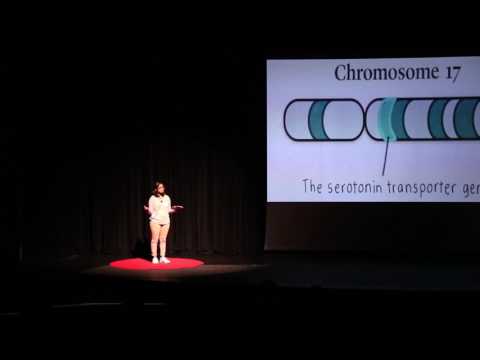
protein here is a gene one of the many
genes that can be related back to mental
illness the serotonin transporter gene
as you can probably tell transport
serotonin from where it’s made in a cell
to your brain but sometimes it doesn’t
function properly
so basically if you think about it your
genes can at least partially control
your feelings now we have to go to
epigenetics to see what we can do with
the concept that genes can affect your
emotions so epigenetics is basically an
external system of genetic expression
that not many people know about because
it was discovered quite recently
actually so you have trillions of cells
in your body and each of them have the
exact same set of DNA but I’ve always
wondered why do some cells turn into
skin cells and some sent into brain
cells and so on and so forth
what happens is there’s a thing called
epigenetics that physically constricts
your genome to expressing only the
things it like the cell wants it to
Express so you have a cell in your brain
other cells send signals to that cell
and say to the gene hey only express
this part and that’s why some part of
your is some cells are skin cells and
some are brain cells and so on and so
forth so there’s the actual blueprint of
your body which the DNA is known as and
then it’s what I would call the interior
designer which is epigenetics so it
controls how the building is built
basically this is why twins some of that
they have the exact same DNA but if one
smokes and the other doesn’t it they
develop cancer because their Abba
genetics are changed epic so imagine
your DNA as a long rope if the Rope is
coiled then you can’t use it and
therefore the Rope is on coil then you
can use it the way the coiling and
uncoiling happens in DNA is methane or a
methyl group and it attaches to the DNA
the more methyl there is in an area the
more coiling occur
so if you think about it you can kind of
throw methyl at a G and if you want it
to stop working and it’ll coil up and it
won’t work anymore and you can do it the
reverse way too by taking methyl out of
this but if it’s that easy why aren’t we
doing that with depression or mental
illness already well people actually are
using epigenetics in different types of
therapy and one thing that they’re
actually using it on is cancer therapy
because cancer is clearly something
that’s not supposed to be there there’s
a lump of cells in your body and you
want it to go away
and the this lump of cells in your body
occurs because there’s something wrong
with your gene and because it’s so
obvious to tell that you have cancer
then it’s easier for a scientist to
pinpoint hey where where did the cell
cycle go wrong in order for these cells
to react the way they do here a bunch of
different types of cancers that have
been treated with methylation therapy in
combination with other types of therapy
like chemotherapy chemotherapy and an
SSRI can kind of be like compared to
each other an SSRI tries to fix the
problem in your brain kind of like
putting tape over a crack in the wall
just like chemotherapy tries to get rid
of the problem but not really cause the
fix the root of the problem and that’s
what we would do with cancer the thing
with mental illness is that you can’t
find one specific gene that targets
mental illness twenty-eight percent of
mental illness is hereditary but it’s
not just one gene in fact it’s not even
just depression or anxiety it’s bipolar
disorder schizophrenia any type of
mental illness you can think of has some
hereditary concept to it so here we have
another another picture of epigenetic
sequence and you can see the methyl
groups on to it and the proteins that
you see there are called histones and
that’s what they wrap around and that’s
what the methylation therapy in cancer
targets and once we find a gene or
multiple genes or just any type of way
to target a specific gene that will
unwrap or wrap a gene that you want to
use or you want to stop from using then
that’s how you can combine therapy and
medication and not just put a piece of
tape over the problem but fill the wall
with plaster more of permanent solution
rather than a rather than a temporary
one
so what um what most people think in
this area is that since you can’t see it
there’s really not much to be done about
it but there’s a lot to be done about it
like when you experience high periods of
stress like during finals or something’s
like the issue in your life that really
can’t be fixed you you get high blood
pressure you have trouble sleeping you
have trouble eating and that’s that’s
normal for everyone in their lifetimes
for like a week or two weeks or
something like that but for some people
this happens every single there of their
lives where they feel caught like
constant anxiety and depression and
that’s what these medications are for
even though you can’t see it it’s
definitely there
and people with depression anxiety are
more likely to die of heart disease or
even more likely to get mumps in their
older age so weakens your immune system
it does everything to make you a less
healthy person which is why preventive
care for depression anxiety is one of
the most important things you can do for
yourself not only just now but in the
long run because there’s no point in
working so hard if you end up not being
mentally healthy enough to enjoy it in
the future what I hope that you all take
away from this talk today is that mental
illness is a real problem it’s not just
in your head as I’ve said many times
before it’s a it’s a problem that can be
treated with medication and there are
innovations being made to make it less
of a challenging task but in the end it
all starts with you realizing that there
is an issue to take care of and if you
take care of it you will be a healthier
person in the long run thank you [Applause]