
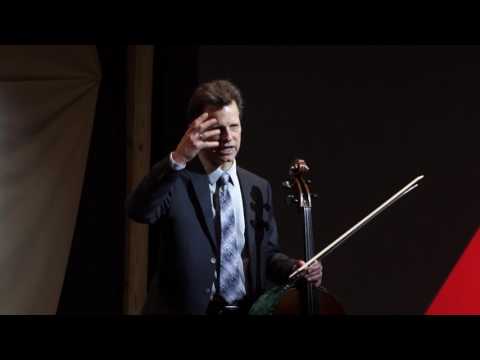
[Applause]
thank you so the cello and thinking
outside the box or thinking outside the
wooden box
better yet thinking outside the wooden
box with four strings or my favorite
thinking outside the 201 year-old wooden
box with four strings so what is it that
makes the cello so magical when a person
hears the cello played at a high level
for the first time and one of the things
is the cello encompasses the entire
range of the human voice a truly unique
quality for a musical instrument and an
example everyone knows what middle C is
here and if we go one and two octaves
below we have what’s called great C and
that’s gr a grea T not GRA te
so great C would be B the very bottom of
the male voice and if we have middle C
but active above and an octave above its
high C and that would be the very top of
a woman’s voice so it’s not just that
the cello can cover the range of the
human voice the cello is also uniquely
capable of covering and conveying human
emotions and feelings and to give an
example the cello can sound angry
[Music]
okay or the cello can convey love
[Music]
not just that the cello is capable of
imitating crying or sadness
[Music]
you
so what is it that makes sound on the
cello there are two principles involved
number one is vibration
number two is friction and they have to
be coordinated in a right balance if we
have vibration without enough friction
we get a sound that like substance and
if we have too much friction and not
enough vibration we get a sound that you
might associate with a young child
learning how to play the violin or the
cello for the first time and this would
be a test of human patience and
endurance
so we could have a
[Music]
right not good so thinking outside the
box what helped me to not only beat an
incurable illness but to really help
play the cello I come from a late start
having started the cello at age 9 and I
wasn’t serious about the cello until
relatively late in high school but in
the seventh grade I started to play the
guitar and I got very serious about it
and in two years I was the lead
guitarist in the first of several rock
bands I played in so with the electric
guitar it’s a different instrument we
have frets we have thin steel strings
and it takes a very very little effort
with the left hand and you have for the
right hand you have an amplifier that
does all the work so I used my skills as
a guitarist to learn how to make sound
on the cello and when the violinist
Itzhak Perlman heard the legendary
Jascha Heifetz play for the first time
he said he couldn’t close his mouth for
a week
he said the sound he made was generated
this incredible heat like a tornado
standing in one place and when I heard
the great cellist Restrepo vaq play when
I was 16 years old this sound blew my
hair back and it was like he had an
electric cello with a volume knob that
went up to 11 so one thing that I used
not only the guitar but also I had
studied martial arts for a while and if
you think about how a martial artist can
break a brick with the bare hand a brick
is stronger than human bone and flesh
yet the martial artist is able to
accomplish this seemingly impossible
feat and it’s all about learning how to
focus the energy of the mind and the
body into a point on the hand where you
can overcome a physical barrier and not
just that a baseball pitcher I had
studied baseball pitcher for a while and
if you look at a baseball pitcher they
can get the ball a go at a velocity of a
hundred miles an hour it’s all about
learning how to
coordinate the energy of the mind and
the body into the points and the fingers
that will release the ball at that
velocity so the cello is strikingly
similar in the sense that it’s about
learning how to focus the energy of the
mind and the body into the hands namely
the right hand so to coordinate that
sound we would need to get the friction
and the vibration right
and then what we add with the left hand
is a pulsating pitch change called
vibrato
[Music]
and this is what brings the cello very
close to the human voice so one other
thing that I used to think outside the
box actually took place 2,500 years ago
before the cello ever existed and this
is the great philosopher and
mathematician named Pythagoras who
devised what we know is the harmonic
series so a young person once asked me
after they listen to me play they said
how do you know where to put your
fingers right am i using the force
no the guitar has frets the piano has
keys it’s all mapped out for you on the
cello how do we know where this is
so Pythagoras came up with the harmonic
series which is mathematical division of
string length and just to give you an
example this is what harmonics are
so every one of those pitches is a
division of string length for the cello
I use for harm on I use seven harmonics
one quarter see the string starts here
at the nut and it ends here at the
bridge that’s the length so if we divide
that one quarter of the length one third
of the length 1/2 2/3 3/4 5/6 and 7/8 so
having known these and memorize these
the way a pool player knows angles on
the board every range every note on the
instrument is within range of one of
those seven harmonics so that’s how I’m
not using the force that’s how I know
where I am when I play the cello so
we’ve made some examples of human
emotions the cello can also imitate
other sounds and this is another unique
quality of the instrument using
pythagoras as harmonics I can imitate
the sound of seagulls right and I can
also physics I have the Doppler effect
the compression and decompression of
sound waves if you were standing on the
side of the highway you might hear
[Music]
okay and if you ever go to the races you
might hear race cars sound like this you
[Music]
so taking one of those vehicles that’s
not street-legal on the road you might
hear this and if you operate that
vehicle at a speed that it’s capable of
you might hear this
[Music]
and then one of my favorites is the
cello is also capable of imitating the
sound of rodent control or the mousetrap
[Music]
so having gone over some of the lighter
features of the cello I’d like to play
something written for the cello by the
great master Johann Sebastian Bach and
these are to go vods from his suite
number six in D major
[Music]
[Music]
you
[Music]
[Music]
[Music]
[Music]
you
[Music]
[Music]
[Applause]
Please follow and like us: