
I had an early start with coding and my
dad played a big role in that
he was electrical engineer at Bell
Laboratories which was the mecca for
telecommunications research and
development for many years he taught me
about binary numbers when I was a little
kid and he gave me a kit that I could
assemble together to add and subtract
binary binary numbers using wires and
mechanical switches one day he brought
home one of the earliest programmable
calculators from work a Hewlett Packard
97 it was a seven hundred and fifty
dollar marvel back in 1975 that’s the
same as three thousand dollars in
today’s dollars
I remember painstakingly tapping in line
by line the instructions for a lunar
lander game like following a recipe and
if I made a mistake I had to start all
over and then I got to play my first
computer game I wrote my first computer
program using punch cards and then my
dad took me into work so that I could
run the punch cards through the massive
mainframe computer there and by massive
I mean that it took up an entire room
and then out spat the drawing that I had
programmed in eighth grade our math
teacher acquired an Apple computer for
the class a very early Apple computer
that was connected to a cassette player
wrote data out to a cassette player for
those of you in the audience who may be
too young to know what a cassette player
was it’s equivalent to did it to today’s
thumb drive she taught us how to code
using the basic programming language and
I remember writing these long messes of
code all tangled up with go-to
statements back in those days we would
write out our programs longhand on paper
and then take our turn at the computer
to type in the program and run it now I
can guess what you’re all thinking
your
ah so that’s how she got into
programming it all makes sense but you’d
actually be wrong I decided in that
eighth grade programming class that
coding was kind of fun it was fun like
solving logic problems is fun but that
it wasn’t really intellectually
challenging that it wasn’t very creative
and that if I had to do it all day I
would get bored also I just didn’t
really know what it was good for I
didn’t know what it was good for besides
solving the toy problems they assigned
us in class and maybe writing computer
games which did not interest me so I
decided at the age of 13 that coding was
not for me so in some sense this talk is
for current day reincarnations of my
younger self to help explain a bit what
coding is good for and how you can
change the world if you know how to
program
everywhere we turn we hear about the
importance of stem we hear about how
valuable a skill coding is but we don’t
hear so much about what you can actually
do if you know how to code so that’s
what I’m going to talk about let’s talk
about what coding is good for let’s talk
about for example what you can do to
advance the field of medicine if you
know how to code there’s a company
called cardiogram it’s one of many
companies doing truly exciting work that
sits at the intersection of wearables
medicine and computer science now when
most of us think about wearables we
think about devices like the Fitbit or
the Apple watch we think about tracking
how many steps we take during the day we
think about tracking our sleep at night
we think about tracking our heart rate
when we exercise cardiogram has built an
app that also tracks your heart rate and
people who use cardiogram use it for the
same reasons that many people use
wearables and fitness apps the
cardiogram app on their watch tells them
how their heart rate changes during the
course of the day based on what they’re
doing it turns out
your heart rate goes up when you eat
spicy food did you know that it also
turns out that your heart rate goes up
during stressful situations for example
when giving a talk in front of a large
audience the cardiogram app on people’s
watch tells them how their heart rate
yeah I had seen that already so the
cardiogram app will measure your heart
rate 200 times per day and it has
hundreds of thousands of users many of
those users have agreed to share their
heart rate data back to cardiogram for
use in medical studies the team at
cardiogram is using that data to screen
for issues with the heart they’re trying
to learn how to tell the difference
between a healthy heart and an unhealthy
heart and they’re doing this for a
condition called atrial fibrillation in
collaboration with medical research
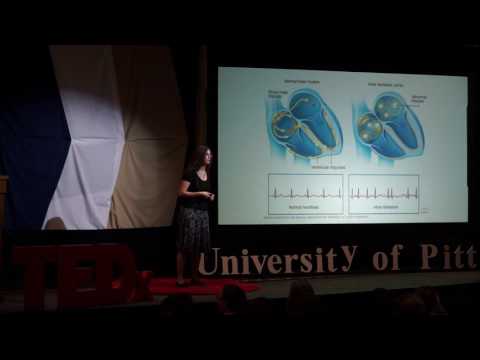
researchers what is atrial fibrillation
an atrial fibrillation electrical
conduction in the heart becomes
disorganized the upper chamber may beat
300 to 500 times per minute compare that
to a regular heart rate of 60 to 100
times per minute the lower chamber may
be at a normal rate but irregularly
atrial fibrillation is treatable but it
often goes undiagnosed because many
people don’t feel any symptoms
the team at cardiogram oh and every each
year a hundred thousand people a hundred
thousand strokes are caused by atrial
fibrillation and for me it’s personal
because two of my family members have
this condition the team at cardiogram is
writing software to learn how to tell
the difference between the variations in
heart rhythm for a healthy heart versus
the variations in rhythm for an
unhealthy heart they’re using a
technique called deep learning to do
this many of you may have heard of deep
learning recently it’s been in the news
a lot it’s
a technique that’s being used to solve
many other very hard problems last year
a team of computer scientists use this
approach to write a program that beat
the world champion in the game of Go for
the first time the team at cardiogram is
also using a trio is also using deep
learning but to screen for atrial
fibrillation
they’re already able to correctly detect
atrial fibrillation nine out of ten
times so that’s medicine how about
another field like education
how can software engineers transform
education did you know that there are
over 1.2 billion people learning another
language and at the majority are doing
so in order to decane access to better
opportunities unfortunately a language
education is expensive and inaccessible
to most I duolingo we wanted to change
that so we built an app targeted
language education we created duolingo
so that everybody could have an
opportunity to learn another language
it’s completely free and it’s accessible
to anyone anywhere in the world there
are more people actively learning a
language on duolingo than there are
students in the United States public
school system it’s being used by some of
the wealthiest people in the world like
Bill Gates and Hollywood stars and at
the same time by public school students
in developing countries and by the way
duolingo is located right here in
Pittsburgh it was created down the
street by Luis von Ahn who’s right there
a professor in computer science and by
his by Severin hacker who was then his
PhD student that’s right duolingo
started out as a student project here
are some statistics there are a hundred
and seventy million people using
duolingo to learn another language about
half of our users are using duolingo to
learn English because for many people
English opens the door to new
opportunities and maybe the pathway out
of poverty to a better life
the top five languages that people are
learning on duolingo are English Spanish
French German and Italian duolingo has
69 language courses in all and we’re
working on 18 more we recently launched
our first African language Swahili in
collaboration with the Peace Corps and
now we’re working on Japanese people
have been asking us for Japanese for
years it will be available on duolingo
in May now the common request that we
get is that people want to practice
conversation the idea is if you’re an
English speaker learning French
we should pair you up with a French
speaker learning English and maybe the
two of you can kind of teach each other
it sounds like a really elegant idea and
we’ve tried it and every time we’ve
tried it we find that most people don’t
like it because they’re embarrassed to
speak in a foreign language with another
person so instead we decided to work on
something called conversational BOTS the
idea is that you can learn to speak
another language just by talking with a
bot that is smart enough we think this
can be the future of language education
learning a language by talking with a
bot that is smart enough smart enough to
adjust its love of conversation to the
user smart enough to gently correct when
appropriate smart enough to understand
broken English broken French or broken
Spanish and smart enough to remember and
build upon previous conversations we’ve
built the first version of this a basic
chat bot that can talk with you in
French Spanish German or Portuguese you
can have simple conversations on
ordinary topics like going shopping
finding a roommate ordering coffee or
going to a basketball game now here’s a
short video to show how it works
hola como estas
kayvyun Konoe say a mis amigos primero
de la Ola al Roberto
Berto esta ocupado el esta comiendo que
esta comiendo Roberto
correcto Roberto esta comiendo Pisa
as you can see we designed we designed
this to look like a familiar messaging
app so that it looks like so that it
feels like you’re chatting with a friend
while learning a foreign language
without the anxiety of making mistakes
the BA corrects you gently corrects you
when you make a mistake by showing you a
better answer and it gives you hints if
you get stuck those are just two
examples of what coding is good for
there are so many others that I could
have talked about I could have talked
about how it’s being used in the art for
computer animations and special effects
how it’s being used in the humanities to
reconstruct the social relationship
networks of historical figures about how
it’s used to build apps for local
communities in government and
Pittsburgh’s own steel city code fest a
week-long hackathon that happens every
year in fact it’s starting this year on
Friday I chose to talk about just two
areas medicine and education to show how
coding is being used for social good I
hope this helps open people’s mind to
the power of coding and I hope that
everyone here will help spread the word
learning to code is more than just
solving problems it’s more than
stretching your mind it’s more than
opening the door to new job
opportunities it’s a chance to change
the world and to make the world a better
place
[Applause]
Please follow and like us: