
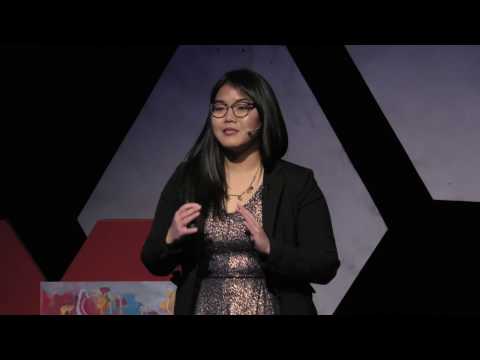
okay well hello everyone my name is Jane
C as I was introduced and I am an artist
and growing up I’ve always loved to draw
faces I draw faces all day every day and
but while I was trying spaces I was so
immersed in drawing a perfect face that
I never questioned what factors
determined to me what a perfect face was
and then about two summers ago maybe
three i was a freshman long time ago i
was studying abroad in oxford and was
deciding to take a weekend trip to
london and while i was on the bus the
lady sitting next to me is actually an
art professor in the vicinity and we
talk about art conversations seem to be
going well and then I show her some of
my work and the faces and she stares and
she looks at me and says why do all your
faces look the same you know why are
they all love you know white women who
look like they’re beautiful models and I
really didn’t know how to answer that
question and so it’s just an awkward
long ride the rest of the way to London
and then you know I came back to the US
came back to resume my studies and sort
of put that question in the back of my
mind until I took a race aesthetics and
analytical class and my professor asked
me the exact same question and this time
the scientist in me emerged and tried to
find the source of my bias e toward this
one type of beauty and how I could
change that so going back growing up
I’ve always loved magazines i collected
Bob since the two thousand millennial
issue every time I go to a different
country i buy so many magazines that it
almost exceeds the 50-pound luggage
limit and you know you look at all these
covers they’re all beautiful women but
they all share that same type of look
and features and even The Huffington
Post reports that in 2015 80.2 percent
of models cast for the cover were of
white and then I go back to my education
as an artist and growing up from
elementary school middle school and
onwards there was this emphasis on
Western art
and in these beautiful paintings by da
Vinci Renoir Vermeer there’s always this
emphasis on white beauty as the ideal
subject to portray in the art world and
lastly even in my own Asian community
every time I visit my grandma she always
had these whitening skin kits for me
saying that Oh Jane you just put this on
every day and night and in two months
you’ll be as beautiful as a pale
supermodel and you know I it was a lot
of pressure and it wasn’t only me you
know even the New Yorker estimates that
anywhere from 150 to one-third of women
in Asia undergo the knife for cosmetic
reasons to gain more Western features
some examples I know personally are high
nose bridges double eyelids and you know
skin creams to whiten the skin so just
to look like these Chinese and Asian
celebrities you see here you know and
all these influences resulted in me and
creating a painting with a face that
looks like this this is a very good
example of a lot of the faces i drew
growing up and although i think all of
these faces are lovely what is wrong
with this none of these faces look like
me the people around me or any of you
guys in this audience and from this I
realized not only was my work lacking
diversity it was also lacking an
appreciation of the people I see every
day and so going back i made this
hypothesis that i looked and thought
okay what I grew up with shaped the
artwork I made and the beauty ideals
instilled in me and the way I wanted to
change it was look at the people around
me look at photography of other cultures
and races and draw them and practice my
hand at them in order to expand my
aesthetic values to people of all color
so this sort of experiment started about
a summer ago I was in Shanghai China a
little selfie of me in the bustling
streets there and next to it I put an
example of my default why ideal face
just for comparison and I was shadowing
in a Chinese hospital and the nurse
asked me hey Jane can you draw a picture
of me and I thought no big deal faces
are my thing I love to draw faces and I
sit down I draw an oval and then from
that point on things
harder I draw her eyelids incorrectly I
make her nose bridge too high and too
Western and I can’t get the pigmentation
of her skin correct with the colored
pencils i have and so I realized it’s
hard for me to draw people of color
because my hand is so practiced in
drawing supermodel western faces but you
know through practice I keep pushing
myself to actively ask people around me
to let me draw them reading more papers
on analytical aesthetics as a concerns
race and you know over time I’ve been so
in love with the subject that I’ve been
given the opportunity to curate a show
on this particular subject and at by
curatorship I mean I challenge artists
in this community out of state or one
even out of country to draw people of
color and to write down the challenges
associated with it and this March will
all put it into a gallery space and
exhibit these awesome works and thoughts
that these artists have had about it and
in my own development as an artist I’ve
been really happy to see how I’ve
learned to appreciate the aesthetic
quality of all kinds of people and a
people around me and how my art has just
become more interesting to me overall
and I just have so much fun looking at
people’s faces and thinking I want to
draw the space too and so as you can see
from all of this what we grow up with
and what forms the basic building blocks
of our understanding really shapes the
way we think how we perceive others and
ourselves and you know for me how I
create what I do create and how we all
create you know work and so I think that
from this it is so important for us to
go back to these building blocks and to
question them to analyze what is feeding
into the way we form our understanding
of ourselves in the world around us and
I think by doing so we can all make a
180 and the way we think and life will
become not only more interesting but
more colorful as well thank you [Applause]