
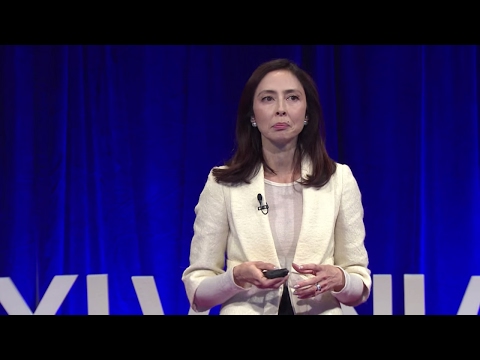
I’ve never been too attached to things
it might be because one Christmas
morning when I was 2 years old
cyclin Tracy devastated my hometown of
Darwin it was the worst hurricane in
Australia’s history destroying nearly
70% of homes including my own my three
sisters my mother and I were evacuated
to Sydney leaving behind our father with
many of the men of the town my mother
carried only a briefcase of important
documents like birth certificates and
some family photos how do you represent
the past when all you have are fragments
it’s particularly relevant standing here
at the museum because it’s museums that
do just that they retell the past
through art and objects art is often the
only thing left of great civilizations
and Society’s art lasts and museums
protect that past oddly enough my life
is all about objects today I’m the
director of the Hirshhorn Museum and
sculpture garden a Smithsonian
Institution museums began really in the
19th century transitioning from royal
and court collections into much more
publicly accessible institutions seen
here is an image by Thomas strewth a
contemporary artist who captured in
photographic form visitors at the Louvre
that first generation of museums in the
20th century we saw many more museums
open many of them private institutions
named after their founders such as the
Whitney Museum or the Guggenheim Museum
in New York but what does it mean to be
a museum of the 21st century many
museums are taking their cues from
artists here you see an image of
Theaster gates and his black monks of
Mississippi they led a procession
through the Hirshhorn galleries calling
out artists names and calling attention
to works it was this activation of the
collection and artworks that really saw
a new kind of engagement and that’s what
we see today
museums transforming themselves from
institutions that were once just
collections into engaged civic spaces
and its artists who are helping us think
about that artists are all about ideas
that’s what they spend their time doing
in fact when we think about where we are
today it’s very much an ideas economy
and when we think about this transition
that we’re all feeling from analog to
digital I often think of the cloud as an
example an analogy where once we might
have stored our photographs and files in
a cabinet in our office or home today we
store them in the cloud a thing we don’t
know what it looks like we don’t know
where it is and we certainly don’t know
who owns it so this is the transition
from the tangible to the intangible that
I think artists can really help us
grapple with one of the most radical
examples of this is French artist Marcel
Duchamp it’s hard to imagine but this
work was created a hundred years ago
it’s called fountain he placed a
ready-made as he called them factory
made urinal in a gallery and called it
art in this way he transformed the very
definition of what it meant to be art
this object was not made by
it wasn’t even touched by him other than
the signature which was not his
signature that he placed on the urinal
so you can see that he opened the way
for another kind of definition invert
and by that another definition of
creativity paving the way for an
appreciation of photography as art and
perhaps even beauty in the everyday one
artist who always thought about the
potential for technology in the future
was nabbed in Peck he lived most of his
life in New York in 1968 he talked of a
paperless society and six years later he
wrote all about the electronic
superhighway then in the 1990s when
President Clinton started to talk about
the information superhighway namjoon
said that he stole his idea and then
namjoon went on to create robots to
create a satellite connection between
Paris and New York for an exhibition
opening and many other things you see
here his TV glasses that he invented in
1971 predating Google glass by many
decades he was always thinking about the
impact of technology on our daily lives
a way way is another artist who uses
technology but social media in 2008 when
he learned of the sitch one earthquake
and in particular the many children that
were killed during this time he sent a
team to do research to gather up more
than the 5,000 names of all the children
who died and then he put them on his
blog using social media as a form of
political dissent the blogs were then
shut down by the Chinese government that
perceived an implicit criticism of the
government buildings and government
contracts used to build those buildings
here you see the names of all of those
children that I Weiwei then transfer
and into an artwork Yayoi Kusama she’s
88 years old this year but in 1965 she
began to create infinity mirror rooms
because she wanted you to experience the
cosmos in a small room made from
low-tech mirrors and lights
she created a virtual reality of you
amongst the cosmos and here ólafur
Eliason in a project known as the
weather project for the Tate Modern in
London many of the projects in these
large industrial spaces have offered
artists another kind of public
engagement much greater than they would
have had before and here in the weather
project Eliason creates the outside
environment through light and mist
inside the museum it created a sense of
wonder for most people who visited but
the important thing was that you had to
[Music]
Oh
[Laughter]
you are here so am i maybe millions of
from
so you just saw a project by Doug akin
we commissioned him at the Hirsch on to
think about a video projection and he
did just that he treated the round
architecture of the her Shan as a scream
for projecting his video over the years
others have always thought about the
potential of new technology they either
use Second Life to create real estate
through which they saw to museums or
collectors or even internet art that
only existed in the Internet and here
with Doug Aitken’s project like a
liasons of the Tate it was very much an
experience you had to be there and so
what can we learn from artists about
being in the 21st century it’s true that
a lot of the images I’ve shown you here
are about ideas and experience in many
ways artists today are thinking about
this very carefully
in fact more so than about objects or
hardware or anything like that so what
of the long horizon the next generation
I offer you an image here of art lab the
her Sean’s education program especially
for teens it’s a free program privately
funded that allows teens to make with
new forms of technology whether it’s 3d
printing the sound booth that we have or
imaging and using new programs this
creates a safe space for them to be able
to experiment with new forms of
technology because it is through the
marriage of creativity as well as math
and science that will be the skill set
needed for the 21st century using
museums as a resource to connect to art
ideas and creativity
is the profound new impact that we can
have in our society thank you
[Applause] [Music]