
used to love listening to the gospel
singer Mahalia Jackson in particular
Maggie Leah’s rendition of the song how
I got over she starts singing how I got
over how did I make it over you know my
soul look back and wonder how I got over
and I’d look at my grandma and start
laughing and say girl why you’re crazy
and she looked at me and say baby one
day you’re gonna get it
I still start laughing and she said Lord
we’ve been falling and rising all these
years but you know my soul look back and
wonder how I got over now I should have
known getting over sometimes means being
a little bit uncomfortable as you can
see when I was a little girl and my
birthday party that hat was pretty tight
and uncomfortable and it still should
have been in some indication to me that
getting over means sometimes you’re
going to fail however I said it all of
the time failure is not an option
K through 12 I attended private Catholic
schools I graduated from college with a
degree in aerospace engineering I’ve
worked at three fortune 500 companies I
even have a master’s degree from New
Mexico State University in industrial
engineering I am an excellent problem
solver that is when everything is in a
step-by-step approach now when things
are ambiguous I don’t know about you I
don’t really like that and why do I like
this step-by-step approach what all
starts with science class who remembers
the scientific method
you know step one you asked the question
step two you state your hypothesis
you’re educated guess
step three you conduct your experiments
step four you analyze your results in
step five
you have your conclusion if only life
worked like that right well in case you
don’t realize it it doesn’t quite work
like that and you have to graduate from
your fix way of doing things and two
with Carol Dweck calls a growth mindset
and sees challenges as exciting
all right challenges are exciting maybe
one two but after the third time I don’t
think so I just want this to be over I’m
still growing but I want it to be over
and then you say okay I’m going to
embrace this growth mindset challenges
or exciting failures only feedback then
you’re so you say to yourself well maybe
there’s a limit to my capabilities and
you’re going back and forth
oh the growth mindset the fixed mindset
Oh what am I gonna do I just want a
mathematical equation give me some
formula to solve and I’ll be okay but
then you settle it I’m gonna totally
embrace the growth mindset but then you
realize failure is still real and then
socially and emotionally it’s quite
challenging so I invite you to let go of
your reason reason the things should be
a certain way so for anybody that’s in
the engineer in this audience let it go
let go of your reasons and I want you to
use your imagination imagine you are
superstar employee you’re crushing all
of your goals you’re getting performance
raises and promotions but then you walk
into your annual performance review
your manager sits down and then you sit
down and he or she slides you a sheet of
paper you pick it up and you’re in a
state of shock
it reads during this performance review
year you’re receiving a needs
improvement you’re in a state of shock
I’m a superstar what happened
am i an impostor
am I not technical enough is this
because of my age are they just trying
to weed me out and then I asked myself a
set of questions Engineering is
male-dominated how much is this about
race or gender as an african-american
woman I asked myself the question if I
express my disappointment soo boldly
will I be labeled angry socially and
emotionally failure is challenging and
if we go through this social emotional
will that’s given to us by castle this
all kind of emotions you go through you
become self-aware
what are the facts versus my emotional
response one of my strengths what are my
weaknesses how do I manage relationships
when I feel like a complete failure can
I recover and for me I’m sober hard on
myself am I alone is it just me did I
miss the mark and then I discover this
story of three extraordinary
african-american women
through the movie hidden figures it’s
the story of Katherine Johnson an
amazing mathematician who did all these
calculations by hand and there’s
Dorothea Vaughn who not only say I am a
leader but I’m going to lift other women
as I climb and advocate for them and
there’s Mary Jackson the first
african-american woman at the time at
NASA who is an aerospace engineer this
happened over 30 years ago these
challenges these unconscious biases they
were facing so I’m thinking to myself is
this a thing of the past we’re not quite
there was a recent report call ignore
potential and it’s a collaborative
roadmap to increase the number of
african-american women in engineering is
written by the Society of Women
Engineers the National Society of black
engineers the Purdue University School
of Engineering and education and the
women in engineering proactive Network
this report highlights that in 2006 the
number of African Americans with
bachelor’s degrees with 5% and 2015 the
number was down to 4% and if you think
about african-american women the number
is even lower so what’s going on there’s
something beyond academics and it feels
like a hole in the middle what many
systemic factors that go in to it the
first factor is role models you can’t be
what you can’t see if I think about my
own engineering career and background
and undergrad I had no female
engineering professors and graduate
school I only had one
and if you think about it when you’re
feeling isolated you want to look up to
someone what better way than to see
someone who looks like you we can
understand your experiences there’s also
the stereotype threat when I walk into a
situation am I dealing with an
unconscious bias that I’m not even aware
of someone has measured me against a
stereotype that they think that I should
fit into that’s biculturalism do i
assimilate and lose myself to fit into
the dominant culture there’s pay
inequalities when I graduate from
college I didn’t negotiate my salary I
was just happy to get a job and then I
discovered while working in the field
for about three years and I receive
about an 8% raise and my male co-workers
said do you think you deserve that race
but it turns out that 8% only put me at
the average of the bell curve I had no
idea and there’s this feelings of
isolation and belonging is there some
standard of engineer that I’m supposed
to be am I supposed to be super-smart is
there some grading skill some
expectation that I don’t even know now
there’s not all hope is lost the report
highlights ways to move around this have
professional organizations like the ones
mission in this collaborative report
have resources and then I discover one
of the big factors discussed in his
report it’s social capital now I must
admit I’m an introvert so connecting
with lots of people really scared me at
first okay so I was like where is the
notebook or a report on how the meeting
interact with people because somebody
tell me where that report is what do you
mean how many people do I have to meet
let’s see maybe three and I’m just over
analyzing over analyzing now after I was
laid off in the field in engineering I
decided that I wanted to address some of
this systemic factors I wanted to become
an advocate I was pretty ambitious
everybody because I’m in an introvert
and I
I worked at these big companies so now
I’m out on my own and I have to advocate
for myself and speak up and say what my
value is and I’m like well how do you do
that so the first job that I had after
engineering corporate I worked at at a
small line profit and if you ever work
the non profit is more like
entrepreneurship you have to do lots of
jobs and I’m still looking for the
manual the process document to tell me
what I’m exactly supposed to do and
again I fail and in 90 days
I’m fired now I’m thinking okay I can’t
get past these failures what’s going on
the first thing I do is to call someone
that I met and I didn’t even call her
for a job I just called because I need
to someone to talk to and she was the
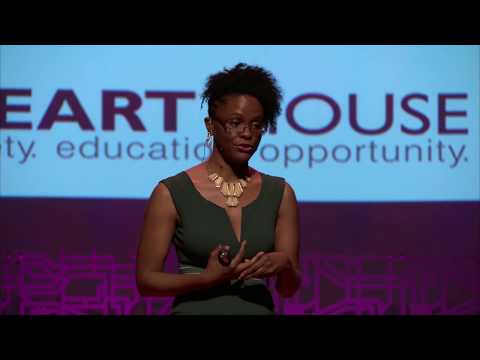
CEO of harthouse and she said well come
to her house on a Monday and on Friday I
was fired
so the Monday I go to her house and now
I have a new job this is social capital
at its finest now I walk into Hart house
which is an after-school program that
provides safety education and
opportunity to refugee and
underprivileged children and I’m
thinking that I am you know I’m saving
the day I’m impacting lives but the
students of Hart House they speak over
15 different languages this is a global
community and they teach me many things
about myself I become aware of my own
unconscious biases I can’t believe I
have any what well it turns out a
student comes to me the students are
over 60% of students or Asian students
and the student comes up to me and says
miss Alicia can you help me with my math
homework
now there’s an Asian student and I’m
looking like why do you need my help
you’re supposed to automatically be
smart and math and sciences I didn’t say
it out loud forgive this is in my head I
didn’t say it out loud I didn’t I didn’t
say it out loud and I said okay you know
like what’s wrong with you help me what
is wrong with you I’m telling you I need
to help and then I eventually helped
them and I also discovered because I
went to private schools again I clearly
think I have no privileged tendencies
well turns out these a lot of
to Zora and Dallas Independent School
District and they all don’t have equal
access to resources so you see I’m in
private school of my career and I’m
thinking well access the resources why
don’t you have a book why don’t you have
a computer and I had to understand the
environments they were coming from so
you see when you experience unconscious
biases about yourself you don’t be are
always aware of the other people have
the same kind of biases now you’re gonna
love this one now we talked about
failure and social and emotionally how
it impacts us so I go in and I’m having
a bad day and I clearly I taken a few
acting classes so I thought I could
pitch in to some seven and
eight-year-olds that I got it together
so I walk in the students like hi miss
Alicia how are you doing and I said I’m
fine they come student comes back um
what’s wrong with you and I said nothing
I’m fine soon comes back listen I don’t
really know what’s wrong with you
but don’t come back here tomorrow until
you get it together now I am the teacher
you are the student this is not fair
this is not how this is set up I’m
clearly not getting an Academy Award for
my performance so I got it together now
the next form of social capital I was
able to build is a former coworker
that I’d work with said hey Alicia I’m
on the board of a high school academy of
engineering and biomedical sciences I
think you should come and join in so I
walk in and I said they were looking for
a boy chair now everything in me said
volunteer this is growth mindset and I
was like no you don’t know what you’re
gonna be doing you need to see a
document of the requirements and now get
out of my head and I say I’m gonna
volunteer now afterwards I’m thinking
what did I just do
I’ve been on a board before but I don’t
really
know what I’m doing and I realize we
have to have this thing called executive
presence so earlier you talked about the
report ignored potential so I was able
to have an executive male mentor through
the National Society of black engineers
the executive director agreed to be my
mentor
now he said yes but I’m still in my head
okay
I need to send this long letter and say
why he should be my mentor but he had
already said yes and I’m still trying to
analyze like when am I gonna get out of
my head right and as you discover these
things about executive presence we all
need executive presence because we’re
the CEO of our careers and when you
discover your executive presence it’s
the way you act in response a failure
it’s how you communicate and then how
you appear when you look good you feel
good and you interact with it and after
a while if you’re building more and more
social capital you eventually meet some
great people and you occasionally get a
nice note and says miss Alicia are nice
you know and so I move past the I’m
trying to be perfect and pretend to be
something I’m not when it can clearly
see through it and then it becomes an
amazing experience
now what would make you continue to move
forward after failure the comfort can be
found in the words of poet John
Greenleaf Whittier who once said for all
the sad words of tongue or pen the
saddest are these it might have been let
there be no more hidden figures
no more ignore potential no more
wondering if life after a bad
performance review means it’s
career-ending my grandmother is no
longer with us
but if she would here I would give her a
great big hug because I know that
getting over sometimes means I had to
cry my way through the midnight hour but
notes here is all that bad instead you
won’t have to wonder what might have
been because you continued to rise even
after failing you