
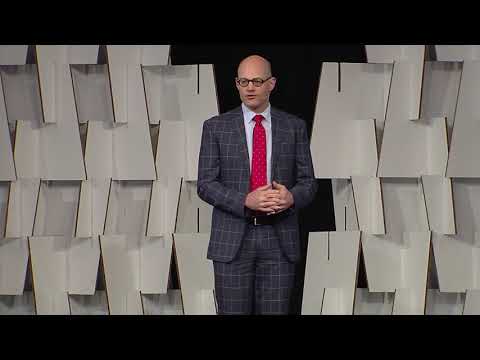
right now in America we are spending an
awful lot of our time fighting with each
other we fight on Facebook and on
Twitter we fight in the streets of our
cities and on our college campuses and
all of this fighting with each other
would be bad enough if it simply made
people miserable or if it spilled over
into occasional violence as it does but
the reason it’s a crisis we need to face
is because from our local communities to
the halls of Congress all of this
fighting is preventing us from meeting
the real challenges that face us
and the challenges are not waiting
around for us storms of increasing
intensity threaten our coastal cities
wildfire sweep across northern
California and the Pacific Northwest
destroying crops and homes and
businesses opioid addiction has brought
communities in West Virginia and
Kentucky and Ohio and across the United
States to their knees the challenges are
ongoing we are fighting with each other
and we need to come to terms with that
reality I don’t have a silver bullet
that will solve this problem I don’t
think anybody does
but what I want to share with you is a
way of thinking about our relationships
with each other that can give us the
opportunity to move forward out of the
current morass in which we said and to
do that I want to share with you a story
from my own family about a conversation
many years ago with my father and then I
want to talk a little bit about what I
think we can derive from that story and
then say a bit about how that can give
us a way of thinking differently about
how we connect with other people now and
into the future so please allow me to
head back about 40 years to the summer
of 1979 I was an 11 year old boy and I
was headed off for a four-day kayaking
adventure with my father we were headed
to the Delaware River on the border
between New York and Pennsylvania to
spend four days together and I was
really excited about it my father built
it up I was the youngest of four kids
this was a chance for just the two of us
to spend some time too
and he talked about how we would camp by
the side of the river and cook our own
food and live off the land and I was
excited about it and we headed up in the
first stop on a trip like that is at the
outfitter shop and you go there and
that’s where you rent your boat and you
get yourself a map and for the younger
members of our audience a map is a
picture of the earth stamped on a dead
tree if you haven’t thought of inventing
Google Maps yet that’s what you have to
use so we got that equipment we got that
gear we put it all on the Outfitters
truck and he drove us about 60 miles up
the river and the outfitter was a guy
about 10 or 15 years older than my
father an immigrant from Germany and
they spoke together in German a little
bit and then they switched back to
English so that I wouldn’t be left out
of the conversation and we spent about
two hours with this guy all told
including that 60 mile drive and the
whole time my father was chatting in a
very friendly way with him engaging him
and and I could see knowing my father
well that he was really working to make
a connection so that this guy felt
comfortable with these two strangers
hanging out in his shop in his car for a
couple of hours and the whole time I was
baffled and to explain why I was so
confused I need to tell you a little bit
about my father’s story so he was born
in 1926 in Berlin and the first part of
his childhood was very happy he was from
a very prosperous family his father was
a successful attorney and his early
childhood was full of happy memories and
in 1933 with the rise of the Nazi regime
everything was turned on its head for
his family and all the members of the
German Jewish community and from then on
life became a nightmare and he and his
mother and his sister eventually escaped
came to the United States his father did
not get out and ended up dying in a Nazi
camp and I knew all of this history and
I could not understand how my father
there with a man who was precisely of
the age where he could have been
directly involved in those events I
could not understand how my father could
be so friendly could be working to make
a connection with him to make him feel
comfortable with us as we spent time
together and I knew also that my father
did not like to talk
about this time in his life it was as
you can imagine quite painful and so I
really didn’t want to ask him about it
but you spend four days together in a
boat on a river and just about every
thought that enters your head will leave
through your mouth and so I finally
asked my father about this
how could he have reached out in this
way to this man and my father did what
he often did which was he answered my
question with a story and so he took me
back another 40 years to November of
1938 a night that we all now know as
crystal nacht and for those of you not
familiar with the history on that night
Nazi troopers and paramilitaries and
thugs set out in cities across Austria
and Germany to torment the German Jewish
community they smashed the windows of
Jewish owned shops they torched
synagogues they attacked Jews and
rounded them up hundreds died that night
and hundreds more died later from the
consequences of that night and my father
said on that night he was at home with
his mother and his sister his father was
out of the country on business and the
phone began to ring and most of the
calls came from other members of the
Jewish community friends neighbors
checking on each other seeing how people
in their community were doing but he
said some of the calls that night came
from non-jews from clients of my
grandfather and business associates who
were reaching out to find out how the
family was doing and to ask whether
there was anything they could do to help
and my father said I know that most
Germans at that time were supportive of
the Nazi regime either actively or
tacitly others were just not
sufficiently concerned about their
neighbors to bother to reach out but he
said I also know that some German
non-jews reached out to us at great
potential risk to themselves and their
families to offer help and he said when
I meet an individual German if I don’t
know anything about their story I have
to assume that they’re among the people
who did the right thing because if I
believe that we are all truly equal and
I would expect that treatment from them
that assumption that I am innocent until
proved
otherwise then I have to offer that
presumption to them so at 11 years old
that was a lot for me to take in and
frankly I have spent the last 4 decades
trying to make full sense of everything
that’s packed into that story and so
what I want to do right now is just
unpack a little bit of what’s in there
and talk about how I think it helps us
find a way forward so the first thing is
I want to say that I was left with an
understanding that we have an obligation
active obligation to treat others as if
we really believe that we are all equal
and I want to call that the Walter
Seligson principle the idea that this
isn’t just an idea we repeat but
something that has to shape the way we
treat others around us all the time so
if we take that seriously if we take
that principle seriously what does it
mean the first thing I think it means is
that we have an obligation to ask
whether all the other people around us
have an equal opportunity to shape the
future of our communities if we believe
that each of us comes into the world
know better than anyone else with no
more right to rule or lead or decide
than anyone else then we have to be
asking whether the other people around
us are really in a position to have an
equal opportunity to shape the future of
our community the non-jews who reached
out to my family were saying that they
weren’t going to accept that others
around them were denied that equality so
we have an obligation to think about
that and once we dwell on that for just
a moment we realize that’s just another
way of describing democracy the idea
that each of us ought to have an equal
share in shaping the future of our
community so that’s an active obligation
we have and once we recognize and accept
that obligation then we see that we also
have to start asking what are the
barriers that others around us might
face to really assuming that equal share
in shaping the future of our communities
so for example if I know that there are
children right now growing up in
communities across the country that are
because of opioid addiction in a
position where children are not getting
the care they need the nurturing they
need the educational opportunities they
need that is some
I have to take account of if I know
there are children living in cities
where due to old water systems their
likelihood of it being exposed to toxic
levels of lead as children with all of
the cognitive and emotional consequences
they’ll likelihood that they won’t
graduate school and instead will end up
in prison
if I know that I have an active
obligation to address it we live in a
world where we are aware of these
challenges these realities that prevent
others from share for sharing equally in
the opportunity to shape their
communities we have an obligation to
address it once we recognize that
obligation we can start to think about
how we have to interact differently with
our fellow citizens so for example I
know an awful lot about the barriers
that I have faced in my life I know an
awful lot about those faced by my
friends and my family by people whose
lives are pretty much like mine but I
know very little unless they do some
work about the actual barriers in the
lives of people who are not like me who
are living in different circumstances
different parts of the country who have
different backgrounds different belief
systems the only way I can actually
undertake my obligation to ensure that
all of us have an equal opportunity to
shape the future of our communities in
our country is by listening to others
with different experiences not seeking
to engage them so I can persuade them of
my point of view but learning about what
their realities are what they face on a
daily basis what their family situations
are like what it means for them to live
in their communities I may hear things
that are unfamiliar to me that are even
unpleasant to me but I can’t really
think I am undertaking my obligation to
treat others equally if I am NOT doing
that work and once we recognize that
that we need to start listening to
others in different ways
we also recognize that we have an
obligation to take the comfortable ideas
that we have sat with for years
the political parties we belong to the
political perspectives we bring the
ideologies that sound right to us and
always have we have to be willing to
subject those to question if I’m
listening to others and learning
something about their experiences
but just clinging to the ideas I brought
in in the first place then the exercise
is pointless and I am not actually
respecting their full equality their
full dignity I have to be willing to say
that the things I brought to the
conversation might not survive the
conversation then I might change through
the interaction learn and ultimately
come out with different views so that is
putting this principle into action
taking the full equality of others
seriously it involves listening it
involves work and it involves a
willingness to suspend some of the views
that we have sat with for years and that
are deeply comfortable to us so can we
really do this
can we actually put this into practice
does this require us to be Saints to
live in some way that humans just cannot
and I think the answer is no I think we
can live this way and I say that because
I’ve seen it and I’ve seen it in
particular from young people and I just
want to give you one example of some
college students down at Western
Carolina University I’ve gotten to know
through the organization I lead Campus
Compact these are a group of students
who work together in a nonpartisan way
to register students to vote in advance
of the 2016 election they registered
folks they led events that got people
interested in the election they did a
lot of turnout work in a nonpartisan way
they were very excited because they felt
like they’ve gotten many of their peers
involved in the political process and
the run-up to the 2016 election and I’m
the day after the election they felt
terrible because they thought this would
be a happy culmination a celebration of
our democracy and what they saw instead
was that the same people who were
yelling at each other before were
yelling at each other afterward but
instead of sitting there with their
dejection they decided to work together
to envision the possibility of
continuing to make change in their
community so these same students
Democrats and Republicans they got
together and they said can we identify
an issue that we can agree on enough to
continue our work and they hit on an
unlikely one which was the incarceration
of juveniles based on being tried as
adults in the court system and they
found that the conservative students
didn’t like that idea because they
thought it was government overreach
they thought that where families and
churches and communities should be
helping to set young people back on the
right course now this was the government
stepping in and taking on that role
liberal students saw the mass
incarceration state at work and they saw
racial injustice they came at it from
different perspectives but by listening
to each other they discovered they
shared a common concern they went out
and they started to reach out to
legislators they recruited a Republican
member of the state legislature to
co-sponsor a bill that bill made it
successfully through the Republican
legislature in North Carolina was signed
into law by the Democratic governor and
there are now young people in North
Carolina whose life chances are enormous
Lee better because those students and
others who agreed with them worked to
make change they did it not on the basis
of already agreeing with each other but
on the basis of a willingness to find
agreement discover common ground not
seek to change the views of everyone
else based on their own but to learn
where they had opportunities to move
forward can we really live like that I
think if my father could look in the
eyes of a person who he knew might have
been involved in the murder of his
father or millions of others and treat
him with dignity and respect as a fully
equal human being I think we can get it
together to listen to each other to work
together and to find common solutions to
our shared challenges thank you very
much
[Applause]
Please follow and like us: