
need to transform the way we teach and
the way we learn we need to infuse our
teaching and our learning with the
spirit of exploration we need to figure
out how to do that at planetary scale
and I’m here to tell you that we can use
technology to make that happen
but before I tell you all that I want to
talk a little bit about how I ended up
caring about this I ended up doing this
I was my academic history is as a
geologist an astrobiologist I study the
history of the earth the history of life
and environment on earth what makes the
earth habitable and the prospects for
inhabited worlds beyond our own and for
20 years that’s what I’ve done and then
about five years ago my son who was then
11 years old said to me dad you know all
this earth history and astrobiology
stuff you do in aliens and all that
that’s really cool but what’s it really
doing to improve the future of the
planet what is our future and I was
taken aback by that question like a
child’s question like that often does
and I started thinking what am I really
doing that actually makes the future a
better place in my professional life and
I thought about well as a professor what
do I do more than anything else that
affects the future it’s my teaching and
I ask myself am i and are my colleagues
are we teaching as well as we need to
because the challenges that my son and
our other and our children face in the
future are of immense scale they’re of
planetary scale their unprecedented
problems their problems we’re only going
to solve if we have a planet of problem
solvers are we teaching our kids in a
way that’s going to accomplish that and
I decided – no we aren’t we aren’t
really doing that very well we aren’t
taking advantage of technology to do
that as well as we could and so I
started doing a number of things that
led to the creation of a center the
center for education through exploration
where we’re trying to do just that
figure out how we can use technology to
improve the way we educate at planetary
scale so the focus of that Center is the
mantra for that Center is as follows we
want to transform learning from mastery
of what is known to exploration of the
unknown we want unpack that just a
little bit what do I mean by mastery of
what’s known if we’re outside and ask
the average person what’s educational
about what’s learning all about odds are
that very high on the list of things
that they would say is well it’s about
knowing a lot of stuff it’s about
mastering a lot of facts a lot of things
we already know
that’s that’s very true that is part of
it for most of human history that in
fact was the essence of what it meant to
be a learned person my father was a very
smart man a very learned man and what
did that mean among other things it
meant that when we had arguments at the
dinner table he had facts at his command
that could just you know pound any
argument I might make so that that was a
mark of being an educated learning
person but today the world is changing
we have information at our fingertips
today when we have arguments around the
dinner table you know my kids pull out
this thing and they have all the facts
of their command far more than my father
ever had and so more and more education
and learning aren’t so much about
mastering facts they’re about learning
how to work with facts instead of fact
masters what we need to produce are more
and more kids and adults who are
explorers who are able to make use of
information able to tell good
information from bad and use that to
navigate the unknown future this has
always been necessary but it’s becoming
more and more necessary we need to
produce people who can ask questions
solve problems innovate and persist not
simply who know vocabulary and rules and
equations and I don’t mean to apply the
vocabulary and rules and equations
aren’t important they are but they’re
less and less important compared to make
use of all that stuff now it should be
easy to teach this way because we’re all
born as explorers all of us every one of
us learn most of the important things in
our life for our day-to-day lives by
exploring by trial and error we learned
by doing and yet somehow when we get
into formal education that bright-eyed
baby becomes this guy and there’s a
whole bunch of reasons for that but
fundamentally the way we try to engage
in teaching the way we do our teaching
especially at large scale especially the
college level is too passive and too
much like this so that guy may have
shown up in class with all the
enthusiasm of that baby
but after 15 weeks of three hours of
this kind of thing no matter how
brilliant the lecturer was after 15
weeks you ready to be done and you’re
probably interested in learning about
something else other than whatever that
subject was so we know how to solve this
problem any of you who are parents of
inquisitive kids our parents who’ve
nurtured inquisitive
is in there kids knows how to do this
you learn by doing
right that parent they are teaching that
child how to solve a puzzle is teaching
in a very different way than a lecture
mode of teaching the child is exploring
the child is figuring things out by
trial and error the parent is there as a
tutor as a guide not as a lecturer
telling the student telling the child
what to do so we know how to do this we
know this is small-scale the challenge
is how do we do this at massive scale
and this is not any kind of new thing
right so parent we all know this as
parents there’s a lot of research now
that shows that what’s called active
learning as far superior to to lecture
type learning and this is ancient wisdom
Confucius said I hear and I forget I see
and I remember I do and I understand
there’s nothing new in any of this the
challenge that we have that’s new is how
do we do this at massive scale
so I’m here to tell you the technology
is a large part of the solution and you
may say well how is technology a part of
the solution for teaching better at
scale because this is the face of what
we call online education today right you
open up your computer you’ve got your
learning management system everything
nice and tightly arranged you’ve got
slim
you have slides that are basically your
PowerPoint slides from a lecture you
have a nice little video clip of the
lecturer does have the virtue that you
can pause it and go get a cup of coffee
you go to the bathroom and come back but
other than that there’s zero advantage
over the lecture essentially what we’re
doing right now in online education for
the most part is we’re taking that not
very effective mode of lecture teaching
and we’re virtualizing it and so we end
up with a not very effective mode of
online education and this is not to say
that all align align education is bad a
lot of it can be very good and of course
it’s better than no education for sure
but we’re not taking advantage of what
the computer can do because the computer
can do a lot more than serve up slides
and serve up little video clips in a
nice tidy organized way um
so how’s the solution well I would
assert to you that we are in the black
and white silent movie stage of the use
of mass communications technology for
education we’re the equivalent of 100
years ago putting a movie camera in
front of a stage like this filming and
saying ah I’ve made a movie and yeah
you’ve made a movie technically but fast
forward a hundred years once you have a
camera you can have two cameras you can
multiple cameras you can now have
different points of view you can edit
and splice together and get a very
dynamic kind of thing you can go outside
the theater you can into more realistic
locations you can go outdoors you can
create special effects you can do all
sorts of things that the movie industry
has figured out how to do the movie
mystery has mastered the medium so that
now we can have something like the
Martian which is dramatic storytelling
no different than that theatrical play
but in a way that transports you to a
completely different realm and context a
completely different mindset
gives you an experience you could never
had in the theatre and does it at
massive scale across the whole planet
the art of narrative storytelling has
exploded in the last hundred years it’s
a massive industry now compared to what
it used to be with that Raqqah
productions because the technology has
been mastered for the goal of dramatic
storytelling same thing has happened
with video games many of you in the room
a remember pong right I remember as a
little kid sitting my parents living
room playing pong right and so in our
lifetimes video games have gone from
pong to something like halo and the halo
is already not the state of the art
right immersive dramatic narrative
driven games that have a lot of the
qualities of movies but with the
interactivity and and addictiveness
frankly of that kind of the kind of
interactivity that you have in video
games
they’ve evolved dramatically the medium
has been mastered right to the point
that movies and video games are now
converging so we don’t do anything like
this in education for the most part
right we have because we’re taking baby
steps for at the very beginning of this
so let me give you a sense of what we’re
trying to do in our Center and we’re
taking baby steps because we’re just at
the early stage of this so here is a
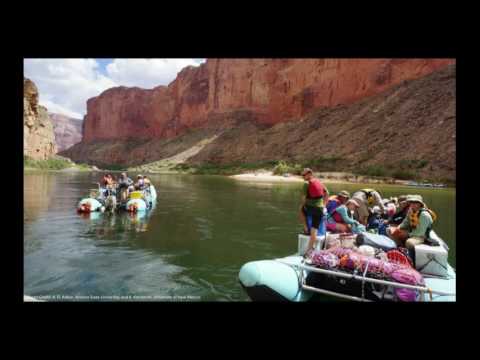
fantastic educational experience this is
a river trip down the Grand Canyon to
run every year by Carl Carl strim was
you can see here maybe right here one of
the he’s probably the greatest living
Grand Canyon geologist every year he
takes about a dozen advanced
undergraduates and graduate students
down the Grand Canyon two-week river
trip fantastic learning experience that
almost nobody on the planet will ever
have most people will never even go to
the rim of the Grand Canyon let alone go
on a river trip down it from a master
geologist learning about the history of
the canyon and what it’s all about so so
as an example can we take an experience
like that and can we virtualize it in a
way that is far more gripping engaging
that is taking a bunch of photographs
and a bunch of text and some video clips
and so we did that we’ve we’ve done a
lot of experiments involving together a
lot of technology to do to produce
things like this experiences like this
you’ll you’ll see a video of here in a
second I hope yes you will so a 360
degrees spherical environment with
high-resolution imagery with lots of
media layered in here’s a little video
clip of going down the river but we have
a lot more media than just that I love
this these are gigapixel images this is
about a thousand megapixel images
stitched together that allows you to go
across the canyon in great detail from
one side to the other and we didn’t do
this for one location we actually went
on that two-week river trip with some
technology and so we have a dozen or so
locations and you can hop to any one of
those and tour along the Grand Canyon
we’ve done a whole bunch of these we’ve
done a good 20 of these in different
stages of production now these virtual
field trips vft asu.edu if you want to
play with them I’m going to taught us a
lot about what you can and cannot do
with this we’re also now playing with
virtual reality to take you to places
that no human has ever gone before
essentially in this case a virtual field
trip into the cell working with a
technology partner called smart Sparrow
so here you’re diving into a cell in a
VR system and you can see the cell
structures everything is rendered as
realistically as we could possibly can
as much details we can load into the
technology and we actually have
interactive learning experiences built
around this where you have a game-like
sort of thing where you go around having
to figure how to make the cell work and
you learn by doing how some metabolism a
cell structure actually works so we’ve
we built these sort of things at what
we’ve learned through all that is
they’re really cool but they’re they’re
not they’re not quite what needs to
happen yet so if I were to put you in
the bottom of the Grand Canyon
first you’d look around – wow this is
really cool and then about 10 minutes
later it’s like okay we’re gonna get my
lunch how am I gonna get out of here
what am I supposed to do while I’m here
right you need a guide right it’s not
enough to have the g-wiz the experience
you need a guide and so we’ve turned to
games as the guide and what I mean by
that was there’s a lot of research that
shows that that digital games can be
very useful for learning and why is that
what’s going on with digital games well
the deal there is that in a good digital
game or a good game of any sort you’re
getting a lot of feedback you’re
learning you’re learning what’s right
and what’s wrong in the context of that
game you have a tutor essentially behind
the scenes in the rules of the game in a
digital game that the rules can get very
complex and so we want to be able to
master that for education instead of a
digital game that’s teaching out of
shoot aliens effectively we wanted
digital games that actually teach you
something interesting so I’m going to
walk you through some very quick
snippets here from a project called
infinite scope that NASA has funded us
to work on where we’re trying to teach
both authentic science content but also
the process of science which is the
process of exploration in a structured
way
so in infinite scope in this in this
this small world activity and fit scope
we’re trying to teach students where are
the small worlds in the solar system the
asteroids the Kuiper belt objects the
near-earth objects so we’re teaching
solar system structure and in order to
do that the students have to learn not
by being told but implicitly they have
to learn something called Kepler’s law
which is that objects further away in
the solar system move more slowly than
objects that are closer to the Sun in
the solar system so the students and to
make it a little more game-like you game
also has the goal of motivation so we
borrowed Ching except instead of
geocaching we have a stroke Ash’s hidden
on these small worlds you’ve got to find
your astro caches on these small world
that’s your motivation what you do
though you go through this exploration
process first you observe you’re here
you’re in the middle of the solar system
the Sun is looking out I don’t know if
you can see this but you see the little
dots skirting along here
those are the planets this is the
wandering stars planet in Greek is
wandering star that’s where it comes
from so there’s the planets and the ones
that are moving faster are closer and
the ones that are slower are further
away but you the student doesn’t know
that at first you find out by trial and
error by having this godlike view where
you can pick up a test object and place
it wherever you want in the solar system
and see what speed it moves out compared
to the object you’re trying to whose
location you’re trying to identify so
here we’ve placed that object and you
can see this the tracking object and the
test object and the object you’re trying
to track and you compare their speeds
and through trial and error you learn
this rule and you figure out where these
different kinds of objects are you get a
lot of it at a adaptive feedback so here
in this case these guys are moving at
very different speeds this test object
was not placed a very good location and
you get feedback that tells you this is
kind of given the way the game in this
feedback we have also two layered
feedback that tells you that helps us
coach the student the learner the player
to success and learning along the way
what’s going on and we throw in
authentic data as a reward so at the end
when you’ve found one of these objects
then you get to zoom in at very high
resolution this is the highest
resolution data that we that we have of
Pluto and you get to zoom around there
to try to find your astro cache which is
hidden somewhere on pluto and so the
student has to do this this is aimed at
middle schoolers the middle schoolers
have to do this for a good number of
objects in order to succeed in the
entire thing and collect all their Astro
cash coins that are hidden there which
then the teacher can figure out what to
do with so this is not the first digital
learning game I don’t mean to say that
this is the first one and this is aimed
at middle school so it’s relatively
simple but what we’ve done here that is
relatively new is we’ve taken a fairly
sophisticated gaming engine and done
this and we fed it through a website so
this is not doesn’t require some big
download this can run on any web browser
and because it because that’s key to
making this at scale right because we
want to reach everybody or at least
everyone who at least has a web browser
a device of some sort and this is being
built to run on AI devices as well so go
to infinite that education you can
download this right now we just made
this public actually earlier this press
release you can find on the
you website so I want to bring this to a
close I want to bring up one other very
important thing perhaps the most
important thing that happens when you
start about using digital technology for
teaching and elevating the way we teach
and I want to do this by way of an
analogy so my daughter my 13 year old
daughter is a dancer and when she goes
to dance class and her dance teacher
evaluates her dancing what does she
value 8 she doesn’t look to see does my
daughter finish the dance I mean she
does look at that but that’s not the
important thing the important thing is
to see how she moves how she does the
various dance moves that’s the
evaluation now think about an education
when we evaluate students in education
what are we evaluating mostly well did
they finish the course and they get a
particular grade and I would assert to
you that that’s kind of analogous to
digit did my daughter finish the dance
if what we really care about are the
skills of asking questions and solving
problems and persistence and innovation
we should be about those things and yet
for the most part we don’t certainly not
directly what does have to do with
teaching digitally well a digital
platform that lies behind in a digital
game like I just showed you is
collecting very rich information about
what the student is doing at every step
along the way there is deep information
there about the way the student is
thinking the way the student is solving
the problem the hypothesis the student
is forming and so on and so on and so
the digital medium allows us to really
transform has the potential to allow us
to really transform the way we assess
learning the way we evaluate the the
very thing that we’re evaluating when we
evaluate students and that’s a potential
that is completely untapped right now
and we’re just starting to learn how to
do it but I think that’s actually
potentially most profound part of
transferring the way we teach into rich
problem-solving activities online and so
I’ll just close with this so this isn’t
just a bunch of ideas we have a whole
course that we developed here at ASU a
number of years ago called habitable
worlds that implement that where we
learned a lot of these principles along
the way so we implement allowables and I
could show you a lots of data that shows
that this kind of teaching has is
turning out to be effective but I love
this quote and I get we get lots of
quotes like this at the end of the
course I was able to open up my mind to
topics I’ve always scared me science and
math and I learned that I could enjoy it
and that I
capable of doing it microphones being on
not being scared learning how to enjoy
learning that you have the capability to
do something you thought was hard these
are all the qualities of exploration and
that’s what we’re trying to imbue in our
students and we can do it thank you [Applause]