
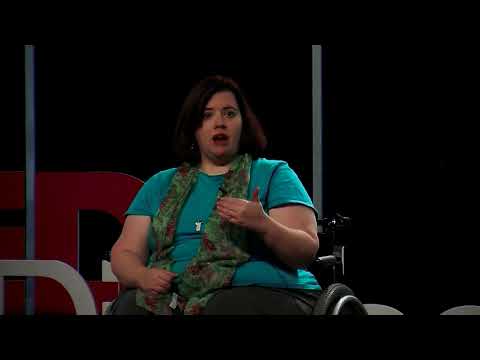
[Music]
good morning before we get started today
I want to ask you a question just give
me a show of hands how many of you when
you first meet someone that has an
obvious visible disability kind of feel
a little awkward like you’re you don’t
want to offend you’re not quite sure
what to say it’s okay to be honest I
guess what I’m holding up my hand I’ve
been in that same situation I get it now
that we’ve got that out of the way let
me introduce myself my name is Jamie I’m
a wife of fur baby mama I’m a
scrapbooker small business owner I
supervise a team of interns I’m an
auntie I am a college graduate there’s
many things about me I hold many many
hats
I’m also obviously a person was with a
disability I promise I did not buy this
really expensive prop to make myself a
really good houseguest because I bring
my own chair right here’s the thing
throughout my lifetime of being a person
with disability I’ve often encountered
situations with people from the
able-bodied world who are trying to say
something nice they’re trying to engage
me they’re trying to relate or they’re
just trying to be helpful but what they
say or do is not actually communicating
what they think they’re communicating so
today what I’m going to do is share four
scenarios with you that are the most
common situations that I run into as a
person with disability now I don’t share
these to shame anyone or and I don’t
want anyone to stew or worry about it
this is more of a way to help make
connections a way to help communicate to
show you that this is what people say
this is kind of what they’re
communicating and then we’ll talk about
maybe a better way to communicate what
they’re trying to say before we get into
those four scenarios I do want to make
it clear that I can’t and I’m not even
gonna try
to represent all people with
disabilities we are a diverse group did
you know that according to the 2010 u.s.
census eighteen point seven percent of
surveyed people identified as being a
person with a disability think about
that in all of your different audiences
and the people that you interact with
eighteen point seven percent that’s a
pretty large group while we’re a very
diverse group though we are all human
and we all deserve to be treated with
dignity that’s a common thing that we
all hold whether you are disabled or you
are not disabled now let’s get on to
those first those four scenarios you’re
gonna see me interact with four
volunteers and we’re going they’re gonna
say the different comments or do the
different actions that people do to me
and you’ll see how I tend to try to
respond I’m I’m too nice to respond with
snark or meanness I don’t believe in
treating people rudely so you’re gonna
see how I respond and then we’re gonna
talk about different ways to maybe
communicate similar ideas or better
ideas in a better more efficient way
first let’s talk about that first
scenario actually no I didn’t what do
you ask I’m just curious
oh okay I get that question a lot here’s
the thing I don’t care if people know
why I’m in a wheelchair I’ll tell you
right now I was born with spina bifida
but if someone just comes up to me that
they either just met me or they’ve not
even introduced themselves and they just
ask so I’m curious why are you in a
wheelchair think about that they’re
asking my medical record what if I
walked up to you and said so how’s that
cholesterol
how much do you weigh how is the results
of your last exam
not only is that really awkward and just
inappropriate it’s none of my business
that’s the kind of thing that you wait
until you get to know the person and you
get to know them as a human being before
you learn that about them if you want to
know about if you want to know something
about somebody I like it when people ask
my name ask me my taste in music the
first thing you need to know about me is
it my medical history unless you’re a
medical professional and well will be
behind closed doors that you understand
the difference let’s move on to that
second scenario in this situation this
is another thing that happens to me a
lot you’ll you’ll see what this happens
Jamie I just want you to know that I
don’t see your disability I’m sorry you
see it that way but thank you I
understand what you’re trying to say I
either get patted on the shoulder or
patted on the head by the way
because I’m clearly a puppy dog that
sounds great
what people are trying to say when they
say that is that they see me as a person
that they don’t see the disability first
but the sheer fact that they need to
tell me that says that they saw the
disability first and that makes them a
really bad liar that’s like telling a
person of color that you don’t see color
it just makes it obvious that that’s not
actually true again this is a time when
you can just see me as a person and
instead of saying that you don’t see my
disability keep in mind that a it’s not
true and be the disability is part of
who I am
it is not my identity it is not what
defines me in any way shape or form but
how I choose to react to it and how I
choose to react to the
situations around it shapes my worldview
and it shapes how I respond to the world
its its shapes how I choose to respond
to all of you that makes it part of who
I am so instead of telling me that you
don’t see my disability see me as a
whole person see that as part of who I
am and realize that another thing you’re
communicating with that is that if you
tell me that you don’t see my disability
you’re telling me that it’s something to
be excused or even something that you
want to ignore
that’s not seeing me for me that’s not
helpful that’s not kind its dismissive
let’s move on to that third scenario
okay that’s pretty much all I get out
with that one because there’s no nice
way to be like yeah you’re crazy okay
that was rude but you get the point
completely different situations someone
that says that kind of kind of thing to
me or anyone else with any kind of
visible disability they’re simply trying
to relate that’s all they’re trying to
do they’re trying to say I get you I
hear you I see you but that’s not what
it communicates it communicates that you
don’t really understand the situation
it’s one of those things if you actually
got it you wouldn’t say that if you were
in a wheelchair for a lifetime it does
not compare to if you sprained your
ankle and we’re in it for a week in two
ways for one thing my situation is
permanent but it’s also given me the
ability to adapt so something that would
have been an incredibly frustrating and
traumatic experience for you all of a
sudden went from walking to having to
manage one of these things just
completely different experiences if you
want to relate to me with a common
experience relate to me and something
that you actually can understand
say we’re at the same event why are you
at that event what brought what brought
us both to that event
what’s our common interest there what
are we in the same life cycle are we in
the same spot in life season in life
talk about that are we both small
business owners there’s so many
different commonalities that we can find
as people that that we can make those
connections and truly relate instead of
trying to relate on topics that we just
have different understandings of now
finally we’re gonna go with the fourth
scenario and this one is more of an
action than things that people say to me
and it’s something that I even knew that
was coming and help people who need help
if you come up and just start pushing
someone in their wheelchair think of it
he was behind me and he just was decided
he was gonna be helpful and just pushed
me I didn’t want to go anywhere I’m
perfectly fine right here thank you
there was no need to push me let me tell
you a story when I was a kid I don’t
remember how old I had to have been
probably fifth grade I was coming out of
a fitness center where I had just
finished swimming lessons and my mom had
gone to go take the car to bring it up
to the curb so it would be less the less
of a trip for me and I was going down
the sidewalk and all the sudden this man
just came up and started pushing me and
I said oh no thank you I’ve got it he
chuckled and continued to push me so I
grabbed my wheels and said Oh No thank
you not thinking he didn’t hear me no no
thank you I’ve got it
he continued to push me and at this
point he started pushing me away from my
mother who was directly in front of us
that was startling at best that’s the
polite way of saying it I was in fifth
grade I
scared I’m almost 40 years old and I
still remember that I still remember the
sounds I still remember everything about
that incident I truly believe he wasn’t
trying to kidnap me he was just trying
to help but here ignored my repeated
nose and he grabbed my body without
consent now you’re probably thinking
wait you thought each I thought she said
he grabbed her wheelchair if I bury who
who just demonstrated if I had grabbed
his belt and started helping him walk
I’m not touching him right I just
grabbed him got up in his personal space
and took control of his body without
consent it’s the same thing this is part
of me with these different situations I
think it’s important to remember to not
just not help treat me and other people
with disabilities like you would anyone
else ask first and it’s up to them to
say yes or no quite frankly they may say
no just because they don’t want to be a
bother but it’s up to them to accept I
know I’m perfectly willing to hand off
my burden if I need it after these four
scenarios I want to share two harsh
truths but they’re important about this
topic first of all no means no and I
think also I will say those of us with
disabilities we have to be clear of what
we’re communicating
I know I’ve often said oh no I’m sorry I
got it and that communicates the idea of
I actually kind of need help but I don’t
want to bother you if I mean no I need
to say no thank you I mean I’m not gonna
be mental you know I’m not gonna be
angry about it no thank you
you know we live in the south we should
be polite but ultimately no means no the
second truth is that what you think is
being helpful may not actually be as
helpful as you think
it could be annoying it could almost be
dangerous or it could just be not
necessary so keep that in mind so ask if
they want help and ask if there’s a way
that you can help keep that in mind that
it’s not necessarily what they need if
you’re in a store don’t assume that just
because I’m sitting in a wheelchair that
I need you to do something for me an
elderly person or I especially think of
the moms with that are trying to juggle
a toddler and a baby all at the same
time I always offer to help them because
I’m like can I reach something for you
because you know only two hands there’s
so many different people that need help
find those people we all want to be
helpful but always ask now that we’ve
looked at these four scenarios I want
you to go away today with thinking of
the ideas of looking instead and looking
through other people’s eyes instead of
putting yourself in their shoes I want
you to think about ways that you maybe
have communicated and then find these
new ways to communicate I’m not trying
to give you a list of don’t say this
don’t say that because that drives me
crazy it makes me nervous I don’t know
how to communicate I don’t know how to
deal with people in that situation but
just think about what you’re saying and
think about what it’s actually saying
and ways to do it a different way as I
said look through their eyes not putting
themselves not putting yourself in their
shoes or or your but in their seat
either way I hope that you’ll take this
talk today and not only change your own
ideas and your own behavior but you’ll
help other people understand thank you
[Applause]
you
Please follow and like us: