
hope everyone’s doing well today I’d
actually like to start off with a bit of
a video to kind of encapsulate what our
team’s worked on in a bit of the
personal drive that kind of uh gone here
today
I remember this car ID from when I was a
kid I always looked forward to it and
where I would end up
[Music]
[Music]
[Applause]
[Music]
[Music]
[Music]
on the long days and we can’t get the
model to run or the brakes don’t
function or and everything is just going
wrong I just think about my grandparents
who would you see today this distance
was not a barrier
[Music]
[Music]
[Applause]
thank you everyone so let’s imagine for
a second let’s imagine we could
transport from San Fran to LA in just
under 30 minutes from Toronto to
Montreal in under 25 or maybe you want
to move from one side of the island of
Bermuda to the other and just other two
minutes
[Applause]
so what stops us why can’t we do this
today well there’s something we’ve
learned to live with to deal with
something that is the culprit it is drag
it is something that resists our flow as
we move through these mediums of air or
water okay so let’s look at some old
forms of transportation ways we’ve
innovated technology allowing us to
expand communicate and share our ideas
now these technologies have great
benefits in their own you have the road
which is inexpensive you have a rail
which can sometimes be environmentally
protected immune to the weather you’ve
got the air which has a great advantage
in speed and then water of course is one
of the most energy efficient of these
options moving Goods and people over
long distances but then why not take the
best aspects of these really take a step
back and say how can we use these and
think about drag and really create maybe
something a little bit different and
this brings us to the Hyperloop
something that’s been using technologies
for the last hundred years integrating
and combining them in absolutely new
ways Elan musk came with a proposal a
hypo baltha a way to feasibly integrate
these in other ways and the results came
as a tube a vacuum tube a low pressure
environment something that won’t create
drag an air cushion something to
levitate on top of minimizing any
friction on the floor and shooting this
capsule at very high speeds with very
little resistance to this energy so how
do we build this can we create this
cheaply effectively and that was the
question that’s been investigated in
this project so thinking about just the
track
the track actually is quite and can be
quite easily constructed you could have
prefabricated pylons place a set
distance away and put prefabricated
structures within these pylons that
would allow all the ground assembly work
to be done with standard construction
equipment once you have these ground
structures you are done the entire
ground assembly and all that needs to be
done is build a connection a bridge and
structure between these pylons we then
create fabricated tubes prefabricated
with the idea of putting solar panels on
top absorbing energy naturally and
latent ly throughout the day so these
solar panels the solar panels they
create an opportunity to allow the
system to be self powering to have more
abundant energy than it was required to
operate allowing almost 24-hour
autonomous operation and by using
regenerative braking within the tube you
can actually regenerate a lot of the
energy electrically as you slow down and
this brings us to the challenge
so Elan musk he realized this was would
be a big project and he took a very
different approach and decided to
challenge the world and students and
companies to say how can we actually
build this and made it an open-source
idea allowing us to work and collaborate
with other people to create this now he
challenged to build the actual pod he
would and his company SpaceX would work
on the tube construction this way teams
could focus on making the pod much much
cheaper accessible and functional so
that the only real cost would come from
the tubing water we’ve heard about this
challenge and when I was told that this
was something that Waterloo is gonna try
to attempt I was a hundred percent off
for it it sounded zactly down my alley
and my interests were all aligned but we
have a unique case with what we’re doing
here and this is what allows us to
you what we are doing this is the case
of being bound realists in certain
aspects particularly at Waterloo they
have a unique unrestricted IP ownership
allowing students and any individual
working with the school in this way to
take their idea and have ownership and
not have that obligation with the school
they want to support these ideas and
grow them without having you feel
blocked SpaceX will summated open source
allowing everyone to work on it to share
ideas and to continue to collaborate in
new ways like never before and then the
rotational team environment this is a
very unique aspect of what we do I want
to lose because we actually have to move
between place to place or job to job
between four months at school and four
months of work now this is an
interesting dynamic that we have to do
it as great talented students might not
be there there’s four months but it’s
great in that regard because we get a
new talent we’ve never had people every
turn you lose about 60 to 80 percent of
the team to swap with a new 60 80
percent and this brings us to the first
prototype to abuse one and just a little
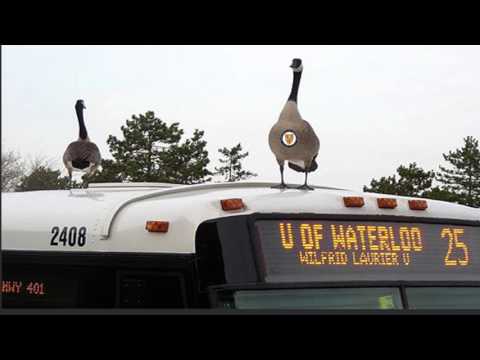
bit of a knowledge about the goose the
goose is a very our symbol for Canadians
and for particularly us and Waterloo in
fact I think there happens to be more
geese than there are students as you can
see from this image of East going to
class
so I think they really are kind of
iconic in the area and we felt obligated
to represent it and this comes to our
first prototype the water loop goose won
a levitating Hyperloop that one go
through with minimal drag and
demonstrate the technology here we have
the air caster levitation a way to lift
on a small cushion of air only about a
millimeter thick eddy current braking a
way to use magnets to slow down without
physically touching the rail allowing
for no wear and tear allowing for no
heating on the pod a redundant friction
brake system to make sure that we have a
mechanical fail safe when things go
wrong for low speeds specifically a
lateral control module a way to
stabilize on the rail with contact and a
drive mechanism a way to drive through
and taxi through the tube as necessary
if emergency stopped or if other
maintenance was required and finally a
geodesic shell a way to deal with the
compression waves of the air better a
way to interact with a good structure
for our pod and this brings us to
competition one and a place where we
actually got to demonstrate this
technology and work with other teams to
see it as a reality this was the first
test track we created it was a 300-foot
track allowing us to test at low to
medium medium speeds I probably took
about seven thousand cups of coffee but
the students pulled it together and we
put it in in pieces into a reality now
we actually this is a few moments before
actually about a week before we had gone
to competition and the team was finally
assembling the last parts of the pod
bringing it in to a nice opportunity to
demonstrate everyone’s hard work we made
it to competition we’ve worked together
and we demonstrated
what our design would have been now
something unique happened at this
competition something I didn’t expect on
this level and what happened was because
of the open source nature of the project
instead of everyone concealing their
designs and being scared that everyone
was going to take their ideas people
were open people shared what they
struggled with people shared what they
were doing now and insight blew up into
everyone’s minds everyone felt like they
had now learned this new set of
standards and a new set of practices
that would work better for the pod our
team has now grown for the last two
years rotated moves and different pans
almost three hundred hands of students
have worked and passed the torch onto
this pot I now bring you to the goose to
our latest design our way of actually
improving upon what we learned building
upon our new talent in our rotation and
creating our next iteration for
competition – it comes with a carbon
fiber shell as we had rotated students
to happen to know more about carbon
fiber a unique trait of our group we
added more suspension into the
levitation module being able to deal
with inconsistencies in the track or
vibration at high speeds we added a
simple single braking system making it
mechanically failsafe taking aspects of
both making it lighter simpler to build
and we improved our lateral control
module in a way that needed no contact
we found that when when you are moving
these at 100 meters per second they had
a very high chance of deteriorating or
melting away we needed no contact to
really achieve the high speeds we were
hoping for
in fact these wheels what they have is
they have magnets embedded inside of
them magnets that essentially allow not
only lateral stability but thrust we can
actually now counteract the drag that we
were generating or even if it is a very
minor and maintain a relative velocity
as we go through the pod this brings us
to
our concept of the future the GU sex the
way to connect cities in the real way
this would be an experience allowing
humans to really get the most out of how
they can connect how they can transport
and how they can eventually eliminate
this barrier I want to end this with a
bit of a message and I think water loop
in itself has brought together a bit of
this idea of creating open-source and
working with different disciplines and
different ideas by allowing this idea to
be unrestricted and boundary-less it has
allowed the technology to accelerate
faster than anyone’s predicted and it’s
allowed when people from around the
world to bring the best ideas together
by creating less of a barrier we can now
make sure that people are now
interacting directly just as dr. Susan
had talked about the oxytocin this
aspects as it increases as you interact
with other people truly being in person
and creating less of a barrier of
distance will allow us to really
establish better connections with each
other I want to thank everyone who’s
helped us get to this point and I want
to thank you for listening
[Applause]
Please follow and like us: