
Translator: Leonardo Silva Reviewer: Claudia Sander
Have you ever thought to give attention to a poster could change their lives?
I always thought so.
Always walking in the school,
I watched all the walls, all the murals,
always looking for opportunities, a chance to discover something new.
And at the end of my first year of high school, I saw that poster,
who spoke about the Olympiad Neuroscience.
I was impressed.
“Neurosciences.”
I did not even know what they were neurosciences, in the first year of high school.
So I took a picture and I decided, when I got home,
seek to know what were these neurosciences,
available to high school students.
The neurosciences are several areas that study the nervous system.
So to neuroscience, we know
how the process works to move the little toe,
or understand how we learn, or meet conditions.
And I was totally excited
to know that I could study a little more about it,
since I was fascinated by science.
I decided to engage me and start studying on their own this fascinating area.
The first thing I started doing was to design,
and I started drawing neurons.
Neurons are nerve cells
who participate in this fantastic network that is the nervous system,
I could learn more.
I started to draw, paint, color,
but it had not yet aware of what neuroscience really studied.
And then I discovered that neurons not only have that forminha,
that looks like a star and have an axon, right,
it would be this long extension,
but it has several forms.
It has one that looks pear, has one that looks like a tree,
and I was, “Wow, I do not know anything.”
And I also started studying diseases that affect the nervous system,
and studied Alzheimer’s, Parkinson’s,
disorders such as autism, amyotrophic lateral sclerosis,
and I began to be intensely emotional and deeply …
I sensitized enough
as minor changes and relationships between cells
can affect an entire organism,
and this can lead to both family as pro oneself.
I also studied the anatomy, how the brain is organized,
and discovered that certain parts of the brain seem to seahorses,
the hippocampus, which is an area where the initial form memories.
And there was a course in neurosciences I discovered this,
for high school students,
and I was, “Wow … … hippocampus seahorse”.
And I was therefore impressed and marveled at it.
Also, another brain structure looks like Mickey Mouse.
And I was also equal to Mickey on: “Wow, I never realized!”
IT IS.
Also, I’ll talk about a disease that I studied, called Parkinson,
which is a condition in which, in this case, the patient loses neurons
this area that I said, Mickey, which is the midbrain.
And in the midbrain, we have an area that is well escurinha,
which is where neurons are participating in the initiation of movements,
What is the black substance.
Only when a person has Parkinson’s, this area is less dark,
which shows the loss of these neurons
and with this loss, that person has difficulty moving.
So understanding how these cells are organized
and understand that this may cause major diseases
and try to diagnose it, alone, in the high school,
looking for books and trying to figure out,
pretending to be a doctor to find out it was amazing.
It was, it was very interesting.
It was one of the areas that caught my attention.
The competition is not that proof …
the competition this Olympiad neurosciences
It is not that proof that we have to read the question and respond.
Were major challenges.
One of the tests was the neuroanatomy of proof,
where we had real brains
and we had to identify with alfinetezinhos,
what was that area and find out what was the function.
I crazy, but …
(Laughs)
But the first race I did, I hit almost every issue,
but it was very interesting
because we had several parts of the brain, and deep areas,
and try to identify what was that area,
or what could happen to a person
if that area were not working very well,
or understand how the processes that maintain sleep
or storing memories.
I participated in the 2015 Olympics in Rio de Janeiro,
and won the first place in this competition,
and I could participate in the national Olympiad …
(Applause) (live)
Thanks.
And I could attend the National Olympiad and won the second place.
The first is the participant who represents the country
the international Olympiad.
And at the time I was not satisfied and wanted to try again
to see if I could reach the top spot in the following year
to try to meet other young people and understand,
or participate in new challenges in the field of neurosciences
and also not only the question of neuroscience,
but also meet other stories;
because it is not only the people here who have problems,
but other countries have problems,
or have engaged young people,
ready to discover new areas, new knowledge,
create friendships and create bonds that would last for life.
So I attended, in 2016, the Olympics of neurosciences
and won the first place again, making me twice champion of Rio de Janeiro.
(Applause) (live)
Thanks.
And I participated in the Brazilian Olympiad and won the first place,
may represent Brazil Denmark.
(Applause) (live)
At the time, we had problems with money and passport,
but, with the support of many people from Brazil,
I managed, with much effort and dedication
and the understanding of the people that it was important …
they did not know me personally,
but several people engaged, were motivated to help me
to realize that dream.
And that was one of the reasons that enabled me
able to reach in Denmark and join the competition.
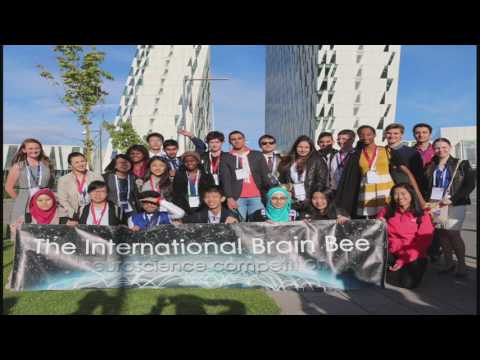
The International Neuroscience Olympics was amazing.
It was an opportunity I’ve been in contact with other young people
which also experienced situations like me.
Had young people not able to reach the international Olympiad
to be able to participate,
We had young people who were late,
but all engaged, studying,
looking for content, and animated,
with several different types of reactions, with different cultures, with languages.
I had young people who do not [speak] English,
because, in international competition, the official language is English.
I had young people who spoke French, had young people who speak Ukrainian …
So did several languages and all trying to unite in a single language
and trying to communicate, trying to exchange ideas, swap stories.
Oh, I’ll talk a little competition.
The competition was a little more complex than that of Brazil,
and this is one of the scenes of the competition.
They were the questions orally, for everyone who wanted to see,
and we had to write a paper which was the right answer.
And the girl picked up the pieces of paper
and professional neuroscientists were sitting watching all participants
and discussing the issues.
For example,
they took all the papers and said:
“Oh, who hit? Brazil, Australia, Romania …”
and you did not hear your name and you was: “Oh, I messed up,”
or “Oh, I hit it!”
It’s very good.
But it was quite challenging and it was all in English,
you had to focus on language learning and neuroscience in English …
But it was a very enriching experience.
We might as well know … yeah.
This one is another proof, which is the anatomy of proof.
There were several pieces and we ran the tables and looked there,
and I had a certain little time to try to figure out what it was that area
and look under the microscope and see that those cells were.
And had cells inside your brain that you have never heard,
They were there and you had to know what was that cell.
It is quite challenging.
And this is a most traditional, and then we had to read
and we had very hard times to be able to answer the questions.
We could also go in the Danish Medical Museum,
know a little of the history of medicine there,
understand how they worked surgeries at a time when he had no alcohol.
So people opened the brains of people with them agreed.
And then they showed the equipment
and we could learn a little more about it.
So, enrichment, and challenge, it was also cultural.
And we saw anatomical parts too, was well enriching.
Yeah, I thought fantastic.
I just I put two little pictures.
My mother and I took many pictures, but, well, I just choked two.
And we could also join the Neuroscience Forum of European Societies
and meet other young neuroscientists.
In this case, it’s not exactly neuroscientists,
but we are very young youngsters, learning neuroscience.
And I could meet some young Brazilians
who were there in Denmark presenting master’s and doctoral work,
and be able to discuss with them their work was really cool.
The work I was more discussed about Parkinson,
because he was mad at Mickey, right?
(Laughs)
So, I started talking about moving because …
I talked about everything, but so was the one I asked.
And what I could learn from all this is that it is important to take a step,
because if I had spent the hall
and had ignored that poster,
maybe I would not have in-depth studies in neuroscience,
maybe I would not be here now, talking to you,
trying to convey a new idea for you.
But I do not. I saw that poster.
And even when they saw the poster, I could have left the photo aside
and have not sought, have not discovered what it was,
or, having discovered what was Neuroscience,
I have been afraid
and have not been studied to find that other things were more important.
But I grabbed the challenge.
So I want to leave you that important
not leave for later what we can do now.
So it’s always good we believe in what we have within us,
and take another step, and follow in his footsteps.
So I followed my step
and thus I could, and grow, because I grew up in various ways,
I could encourage others to also grow.
I could, with my story, to touch the hearts of many people,
of young people who thought for a moment that I wanted to be,
be me exactly.
And I said, “You do not have to be me, you have to be you,”
because you are great.
It’s just you believe in your potential and fight,
no matter what the odds, the barriers that we face,
but believe what is within us and move on,
take a step and another step towards victory.
Thanks.
(Applause) (live)
Please follow and like us: