
you
well good evening it’s a pleasure to
here this evening talking to you and
while we may not be able to avoid the
upcoming solar eclipse I’m here to talk
about avoiding an eclipse of a different
sort what we call the Eclipse of nature
actually and how we can do that through
conservation education and the concern
we have for disappearing wildlife and
natural resources out there
simply put conservation education is
instructing individuals as to the wise
use of nature international resources
and through conservation and education
in three simple steps we can help
empower individuals and avoid nature’s
eclipse so the three steps are simple
right we can provide training provide
opportunities and provide resources and
when we think about providing these
things often we work in conservation
education in areas where we deal with
students we deal with educators we deal
with professionals conservation
professionals and community members and
often our programs are what we call
inter-institutional and where we form
partnerships not only with institutions
in the United States but also when we
work internationally form partnerships
with institutions in our host countries
and that’s very important so that we can
become equal stakeholders and have an
equal vested interest in the process and
the outcome in areas that I’ve worked a
lot of them have a lot of things in
common in specific geographic areas and
this is where a lot of conservation
efforts are concentrated globally they
have several things in common first of
all they’re areas where we have what we
call very high biodiversity a wide
variety of life forms on the planet very
high cultural diversity with a lot of
different cultural groups where we have
large
numbers of what we call endemic species
species that are found nowhere else on
the planet where we have large
impoverished and disenfranchised
populations of individuals and where we
have widespread habitat destruction and
where in those countries often these
three simple steps are lacking so what
I’d like to do for the next several
minutes is we are doing a lot of
traveling this evening I see right in
space and time okay so we’re gonna go on
another trip we’re gonna go on a virtual
trip for the next few minutes to a few
of these locations and I’ll just
highlight a few examples of the
different kinds of conservation programs
that I’ve had the great privilege to be
involved in over the last years I was
thinking how many years has that been
about 25 years so here we go right
starting in Central America in Guatemala
okay and then we’ll move to two areas in
Nicaragua then we’ll move to South
America to Venezuela two areas in
Venezuela and then back to Central
America to Panama so we are doing a lot
of traveling in the next about 10
minutes so okay we’ll start in Guatemala
in an area called wash Achtung
and wash Achtung is a very significant
ancient Mayan city right in the ancient
Mayan civilization it is believed to be
this is one of the pyramids in wash
achtung it’s believed to be home to the
oldest Mayan astronomical observatory on
earth so this is a remarkable area and
it also has high biodiversity high
cultural diversity and large numbers of
endangered species and most people never
make it to this remote area of wash
achtung because they typically stop at
an area called tikal I don’t know if
anyone has heard of tikal tikal is one
of the most famous central american
archeological sites there is is one of
the largest in Central America is home
to the famous Mayan pyramids so people
you
we stopped there and they never make it
to these more remote locations so we
decided that we would work here in
Washington infer these programs for this
one in particular I worked with st.
Louis University in University of
Missouri st. Louis and some of these
institutions will sound familiar to some
of you and also Wildlife Conservation
Society in Guatemala and we put together
a program of field conservation methods
for advanced students University level
students and those individuals that were
either going into conservation or they
were already conservation working
professionals throughout Latin America
and provided a month-long field program
for them so here’s in addition to
fieldwork on a daily basis is one of our
professors from st. Louis University
working with students on ecological
modeling when certain computer programs
allow you to be able to predict
extinction probability and he’s working
with them on this but where our
education programs don’t really stop
there because one of the most
significant things that we do in my
opinion is when we go into these areas I
always like to go in and get to know the
local community and work with the local
schools so one of the components of our
field programs is that our students then
develop a set of conservation activities
and lessons for the local schools and
here we are working in the local primary
school in Washington and our students
get very creative so they’re given free
rein I guide them on development of
their activities and lessons but they
have the opportunity to be very creative
with what they present to the students
and this is a group that came in that
presented their conservation program for
the local school kids in Wausau tune
and then very creative they said we want
to go back a couple of days later and
we’re going to dress as tourists and
that’s why they have the hats and the
sunglasses on and ask the students to
talk to them and we relate what they had
learned from their presentation
and act as though they were their tour
guides for this significant area in what
the what we hear from teachers when we
go into these areas that is that our
time spent in these schools is
significant to the students it helps
give them a sense of pride in their area
that we care enough about them to go and
learn about them and spend time with
them it also helps instill sort of this
sense of ownership and building
relationship with nature and natural
resources that we know is integral if we
want to save those resources in the
future okay
in Nicaragua a different example of a
conservation program and conservation
education program I worked and lived in
Nicaragua for some time and I worked in
an area called Bosa was– and it was
dedicated as a biosphere reserve by
UNESCO the United Nations some years
back because it is home to about 20,000
indigenous people the mosquito and the
Mayan indigenous groups still live in
this area in six tribal territories and
it is a biosphere reserve because of the
indigenous populations and also it’s
considered to have some of the most
pristine tropical forests until you get
into the Amazon in South America
it’s a remote area in Nicaragua on the
Honduran border so this is the cocoa
River and that’s the only way you get to
some of our remote sites where we worked
was three days by dugout boat getting to
some of the remote locations where the
mosquito people live and our goal here
was multifaceted we worked with the st.
Louis Zoo directed this program we
worked with the Missouri Botanical
Gardens st. Louis University the Nature
Conservancy and USAID and put together a
program to help the mosquito and the
mayanna people develop a conservation
management plan for their tribal lands
and so different components of this
program
highlight a couple was this is one of
our field people and she helped train
the indigenous people to be able to in
field conservation techniques and then
we employed the indigenous individuals
to work on programs with us so they were
actually participants in the development
of their own conservation management
plan in addition st. Louis sue worked
with the local schools in these tribal
villages and developed conservation
education workshops for the local tribal
teachers and then conservation education
materials for the kids to use and again
here’s one of our field people working
with one of the older individuals in one
of the tribal areas and the kids in that
community still in Nicaragua in an area
called Ometepe and Ometepe is an island
in the middle of lago nicaragua one of
the largest lakes i think that we have
in the world and there are series of
islands located here and this is its
houses two volcanoes this is one of the
volcanoes this is volcano concepción in
this island called Ometepe we have
what’s called the Ometepe biological
field station and in this area I worked
on a month-long field conservation
program for university students from the
United States so I took university
students down for a month they learn
field conservation methods and again in
this case we wanted to do community
education and so we did it a little
differently this time it was really what
I considered to be true community
outreach we went into the local
community on the island and people found
out that we were at the field station
and that our students were doing
conservation they were working on field
projects and they got really excited
about the opportunity to come to the
field station they’ve never been there
before so we’re got out that we were
going to invite people to the field
station and have
a day where they could engage in
conservation lessons activities we play
games we usually play soccer we have a
meal together and so my students then
set up displays and talk to them about
different aspects of conservation so
there were so many people from the
village that wanted to come we actually
hired a cattle truck and drove around
the island and picked up families right
brought them to the field station for
the day they got to spend the day with
us and then we took them all back home
at the end of the day okay
moving to South America a slightly
different take on conservation education
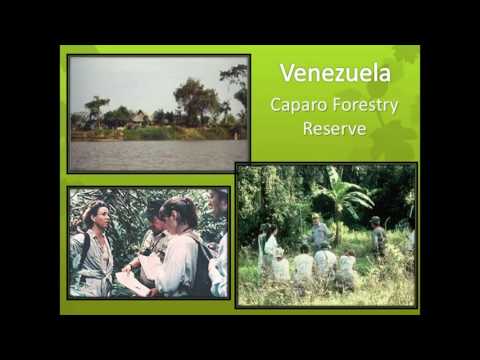
in an area called the Caparo forestry
reserve it houses a very important
biodiversity reserve this is located
close to the Colombian border in South
America and this is the Caparo River we
have pristine rainforest lots of
endangered species and for some years I
lived and worked in Venezuela and I
worked with the individual you see who’s
talking to the students there Miguel
ilianna he’s from the University of the
Andes in Venezuela he and I developed a
program for university students from not
only the United States but Venezuela as
well so we had a cross-cultural
month-long experience for the students
in which they learned conservation field
methods okay so they got to learn not
only from university professors in the
United States from Cleveland State
University different institutions but
also from professors in Venezuela also
in Venezuela but in a different area of
Venezuela and that’s not a student or a
teacher or community member it’s a
community member it’s a different one is
anybody know what that is by any chance
Andean Condor yes it is Indian condor
andean condors are arguably the largest
most robust bird of flight on the planet
right they’re enormous and unfortunately
they’re becoming endangered they’re
threatened in
most of their range especially in this
area in Venezuela where I lived and
worked so one of the components of one
of our conservation programs was working
on andean condor conservation and so we
coupled Cleveland Metroparks Zoo we
coupled with conservation organizations
in Venezuela and jumped on board with
andean condor breeding and
reintroduction programs back into the
Andes Mountains in Venezuela and here we
are that’s a few of us standing out
there with binoculars so we’re a bawling
right watching condors the remaining
condors they’re they’re bred at this
site and then they’re released through a
slow soft release program back out into
the wild and then they’re monitored
there and there were so few condors left
when we started getting involved with
this program that we thought it was
really important to develop a
conservation education component to that
and I took a slightly different angle on
this I started working in the Andes
Mountains still but in a zoo okay called
chorros de Mia’s zoo and this is from
inside the zoo and it overlooks the
highest point in the Venezuelan Andes
Mountains pico bolivar it’s a beautiful
setting and this zoo is one of the most
heavily visited zoos in the country and
I’ve mentioned several zoo so far and
what zoos have become is centers of
conservation right education centers
research centers conservation centers in
our st. Louis Zoo is no different in
that regard so this is heavily visited a
lot of visitation and that sets up the
perfect opportunity to be able to
educate people about conservation
efforts so I worked with the local
agencies conservation agencies in this
area and zoo personnel and we developed
a set of displays and conservation
materials for the visitors that they
could implement for zoo visitors and one
of those components was an education
program dealing with andean condor
conservation and the breeding and
reintroduction of
Hertz and coupling that with the
historical significance and cultural
significance of Indian condors because
they are very symbolic in most of
Central American Andean countries okay
and lastly moving to Panama to Isla
cologne and working with the no bay
people in this area and this is an
aerial view of Isla cologne
it still has pristine tropical forest a
large indigenous population mangrove
forests very important for reproduction
of aquatic organisms lots of endemic
species that are found there and nowhere
else and this island is part of what’s
called an archipelago a group of islands
in Bocas del Toro and it is considered
to be the Galapagos of Central America
in its biological significance so here
for about six or seven years I worked
every year doing a month-long field
program for university students from the
United States and some were open to
students from other countries where
again we train them in field
conservation methods and then a
component of their program always is
taking that information and knowledge
and sharing it with the local
communities in this case the local no
bay community we invited the school kids
to the field station for a day again
provided meal provided games displays
demonstrations and then engaged in a
beach clean-up day a lot of these
communities make their living from the
ocean and ocean pollution has become an
increasingly significant problem for us
globally and again this idea of keeping
the area clean instilling a sense of
pride and this idea of ownership and
stewardship for the natural resources
and since then I’ve continued to go down
to Panama so I go down every year two
years I’ve known the teachers and the
kids in these school for a very long
time
I’ve known their brothers big brothers
and sisters and the little kids that
come after them and continue to do
conservation programs working with them
here’s a couple right most recently I
went down and we have to be creative and
use different resources that are
applicable to these teachers that with
activities they can replicate right and
keep using so for the web of life
teaching the interconnectedness of
nature I just came with a ball of twine
and pictures from calendars of wildlife
that I had saved over a long period of
time and was able to teach the idea of
the web of life and the important is
importance of connectedness of one
life-form to another out there and then
this is just an activity right teaching
them a dance and a way to remember the
important parts of plants and the role
plants play out there in nature right
okay this is a picture of the school
kids most recently when I was down there
what we also try to do is always pool
money and purchase supplies because
resources are sorely lacking in a lot of
these areas in this no bay area it’s an
it’s not uncommon that students go to
about fourth grade maybe sixth grade and
they often lack supplies they don’t have
pencils they don’t have anything to
write with the teachers lack materials
so we always make sure we provide
materials for them students and the
teachers and I know it’s typical from
for us from the United States to like to
take things down to those countries but
one of the things that we always try to
do is purchase locally and that helps
strengthen local economies and that’s
important in these areas and it doesn’t
all happen just far away one of my
classes here at the college my ecology
and environmental conservation class as
their service-learning project one
semester we worked with the local
Hillsboro primary school and the school
teachers and our class developed what we
call the Nature Trail eco guide for the
primary school teachers to use with the
outdoor class
that they have here locally and when we
educate individuals we empower them and
hopefully we can help future generations
avoid nature’s eclipse thank you
[Applause]
Please follow and like us: