
thank you Mark you know Thank You
principal barge I enjoyed your talk the
Hayden Planetarium where I work it’s
been an inspiration to me ever since I
was a child and I grew up in the 60s I
was born in 1961 which is when President
Kennedy took office and challenged us to
go to bloom and some may remember and he
rolled it up in the room remember in
Queens
those 1964 World’s Fair which was very
inspirational this is me at Luna Park
chasing over to my brother and but this
inspiration now grew up in a family of
artists my father commercial artist
Ogilvy & Mather and taught me how to
look and see taught me how to draw but I
think what’s important is that
inspiration to want to draw and see
going through the museum my mother took
me to the museum on spring break this is
April 1969 s a few months before we
landed on the moon July that summer and
my father took these pictures of
dinosaurs I wanted to bring the exhibits
home and later when I went to college in
the early 1980s at the University of
Colorado and we did this case for Mars
design series we brought artists in but
I took on the job of illustrating what
the engineers were talking about not
just sort of vistas of Mars what we see
here are sort of technical illustrations
that we did actually for a video of NASA
but it shows using Space Shuttle
components and how we might be able to
reuse bits and pieces that at that point
were being talked about the future space
station and repurpose them for a journey
to Mars and what was exciting about that
was that as students with enthusiasm
about the topic was that people like
Buzz Aldrin Carl Sagan and others former
NASA Administrator Tom
came and championed our cause and like
that dancer without a shirt began
English hostages to a small group of us
started what became six conferences over
about 15 years and so this series of
illustrations sort of map out how we
could get a team of about 15 people to
Mars Buzz Aldrin produced this notion of
a cycling vehicle so what you see here
this big ye shape that rotates would
rotate for artificial gravity and so
that on the way to Mars you would have
gravity so when you get there you’re not
just haven’t been floating around for
six or eight months in transit and so
when they get to Mars his large vehicle
actually comes back home from the next
crew and these vehicles would land and
they land where other vehicles had
already been landed robotically and so
that you could hollow them out and
actually create the sort of base on Mars
almost immediately but I was inspired
again by this this sense of what art can
do in putting you there I wanted to go I
was born again just during the challenge
to get to the moon I was eight years old
we walked on the moon and I envisioned
by the time I was Neil Armstrong is
eight he was 39 he walked on the moon
I’m much older than that now but that
there was a chance that might be part of
that that mission but really the sense
of trying to illustrate concept it was
very exciting that the engineers are
coming up with to show how we do it you
have to bury yourself under rocks
because Mars unlike the earth does not
have a magnetosphere and so radiation is
an issue also inflatable greenhouses
things like this could be used to
actually grow the food on the surface I
built a model for the Smithsonian Museum
it’s as happy to see that it was still
on the wall last time I went down the
National Air and Space Museum on the
mall in Washington and took over the
entire house where we were renting
working out at NASA
it’s Research Center Silicon Valley and
there’s there’s them all and so all of
us in purpose to really take us on a
journey with the artwork essentially to
imagine what it would be like Buzz
Aldrin and I here at the funeral of Tom
Paine who had been NASA Administrator
when Buzz and Neil Armstrong walk on the
moon and this flag was something that
Tom left us with and it became part of
the funeral ceremony and I asked his
grandson who I tried to paint his
likeness in this particular painting as
a plant the planting of his
grandfather’s flag on Mars I asked him
do you want to take your granddad’s flag
of Mars I said yes time I think he was
12 or 13 doing illustrations for
different concepts engineering studies I
asked the engineer what would the motor
home look like he said a Humvee with a
roll cage tank treads I said wow that’s
that’s so big and luckier than the need
a little dune buggy get around I goes
well that’s a good idea
so but the canyons of Mars different
ideas that were exciting using a passive
thermal cooling fin if she’s wearing
this on her spacesuit it collapses if
you jump in a rover things like this so
this notion of drawing up these concepts
but I really wanted to pour my heart out
in these illustrations because I wanted
to be there in some ways I still want to
be there and that continues into the
current work but this sense of this new
world I think we all think about going
abroad going to somewhere new the case
of Mars we’re really talking about a
challenge a challenge of our generation
our generations essentially if we’re
going to go but also the idea of tragedy
on Mars that things happen and that you
have to deal with them you’re far away
and just as the pioneers of the past
have had to deal with tragedy so will we
on these new worlds looking at these
different engineering concepts and
drawing up or possible they change all
the time
engineering ideas our knowledge goes way
in
to how we can design easy but I started
the Hayden Planetarium when when I was
about 10 years old my mom used to drive
me in I would go to the classes there
and when I heard when I was doing those
drawings that the museum was going to
change the Hayden Planetarium as built
in 1935 into the current Rose Center for
Earth and space I was aghast I thought
wow you know how can they tear down the
planetarium where I grew up but I had
the chance to join this facility in
doing something new and what it afforded
was the ability to not to go from a
starry ceiling to actually taking you to
place Here I am pointing out the landing
site of Apollo 15 to Paul one of our
video engineers and we can literally fly
over what is data but it’s our
measurements of these other worlds
really take us there
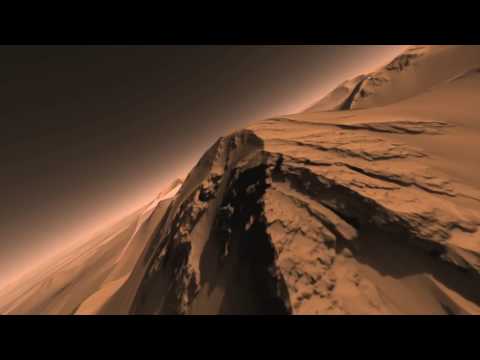
what you’re seeing here in this movie is
the results of our missions to Mars and
how we can assess that and we’re looking
at it robotically one of my students
that I oversee from a Swedish University
Lynch shipping University in Sweden I
loved his quote he says he loves Mars
because it’s the only planet that we
know of completely inhabited by robots
and those robot Syria are ups there are
things and no one’s gone there yet but
they’ve forgotten these tremendous
images the image you see in the movie is
a reconstruction in a way it’s a we’re
taking the mapping it’s an incredible
mosaicing mapping and that’s put
together in multiple colors to get the
color and then we put that together in
computer graphics we have the atmosphere
or doing this all guided by the science
but still that little kid that was
building up the clay dinosaurs myself
it’s my desire and will to sort of be
there and see it here we get even closer
we’re looking at mapping of Mars that
goes down to six meter resolution that’s
a like to say it’s bigger than a car and
smaller in a house about this every
pixel in this map it’s about five
terabytes for what we have just the
image we put that drape that over
terrain that was gender
apart from the laser altimeter but all
that information one pixel is about the
size of a two-car garage so if there are
any two-car garages on mars and seen
them by now but in any event what you do
see is the landscape at Sand Dunes this
is recorded flying over Mars in the
Hayden Planetarium and then after that
took the flight path and set it to
render you can also see things like
seems mosaics we have somewhat of an
incomplete pictures we build this up
over time different things are brought
in and but allows us through this
ability to take again the data and all
the science and the engineering but to
construct it have a sense of place what
Mars actually really looks like and
we’re getting closer and closer and
doing this so that from this data we
have even higher resolution data and but
this this sense of being able to fly
over it is really we’re looking at
landscape and as artists across the ages
of painted landscapes as some meditation
on a place you look and you
aesthetically choose you know your
composition of what is pleasing you know
artist is seated looking this way
perhaps not that way or that way not
this way and so in this way the data
becomes as template by which in the form
of what Natural History Museum’s have
done throughout time is show the context
of say specimens in their location and
really concentrate on place so Mars is a
subject involves a lot of the science a
lot of this engineering a lot of this
planning a lot of these dreams of
humanity and to see it ever closer is
really something that I don’t think will
ever really the answer until we’ve set
foot on Mars perhaps but in that what we
can do is take these things and put them
together and leave one other videos
coming up in a second that brings us
down what we were looking at there was
six meter resolution this is 25
resolution was a quarter meter this
imagery while not as widespread across
the surface our areas look at first for
landing site verification of nice smooth
areas this is not smooth little Hills
that you see here each are about a
football field wide maybe about a couple
hundred feet tall and what we’re seeing
this terrain looks sort of almost like a
road it would and we’re seeing basically
a fine layers terrain that have been
built up and then subsequently eroded by
the lands on Mars over billions of years
and in this particular case and what
we’re just looking at here is that we’re
looking at an area that has been
basically built up in the center of one
of the canyons on Mars Kandor casma and
what we do to construct this image is
that we contextualise it by surrounding
it with what you just saw and putting
that together these terrains are created
through elaborate process of using
stereo imagery and from the stereo
imagery that can be analyzed to give us
the height information and our US
Geological Survey in Flagstaff Arizona
actually create these terrain models but
what surrounds it we take the raw
materials put that together in my high
school students from Bergen County
academies I’ve been working with the
plat pass ten years have taken that and
have aided doing the surrounding terrain
for us in this case we don’t know the
atmosphere
what you’re seeing is sort of a work
product and development but in this
ability is we’re getting down closer and
closer to where we can actually come
down right to the Rovers themselves and
so this ability to see what’s close up
and I can tell you the scale and tell
you that these hills are about a
football field wide but it makes you
appreciate that the mountains in the
back are about as tall as the Rocky
Mountains straight up and sea level you
go see the Rocky Mountains in Colorado
you’re starting off from a plane that’s
already 5,000 feet high one mile mile
high city Denver
and then you see these mountains that
climb up another 10,000 feet in this
case you’re seeing about 1520 thousand
feet straight out from the base of this
valley Mars is known for having us this
tremendous landscape on a body in a
world it’s only half the size of Earth
it holds an atmosphere is a thin
atmosphere and really on the surface of
Mars about seven millibars Landers and
the rover’s and that’s equivalent to
about where our atmosphere we see almost
going black above our planet and that’s
really where the atmosphere starts so
you need a spacesuit on Mars so in this
reconstruction our latest work has to do
we are NASA funded on buses and open
space and open source so that everyone
can share in this we want to share this
with classrooms all around the world
that’s come down closer and this is just
filled yesterday for correspondents with
a team at NASA is doing a similar thing
as we’re coming down to the landscape
surrounding the rover we see this sort
of stretch views looking out the
landscape we come right down to where
the rover is and so we’re seeing the
rocks around the road there’s a little
white line shows the history path of the
rover and this sort of thing but it’s
actually allowing us now to come down
and view this you’re seeing this on a
single screen but this will be projected
on the planetarium what the planetarium
does is if you imagine this view you
stretch your arms out is that like you
know my arms go into peripheral vision I
can’t see but in here I have this
hemisphere of you and so the planetarium
becomes sort of a surrogate of York of
your view space and so the ability to
take us in information to many different
realms that we can measure by Sciences
with the planetarium offers in this case
take us to Mars and we see the terrain
one thing that is crucial here is that
we’re really seeing what it looks like
and when we show this to people there’s
been the reaction that I’ve been having
more and more so I
like to perhaps call this talk with
confessions of a margin but it’s a
reaction that I see it when we share
this with the hole in the dome
especially sort of on evenings or I grab
people come in we’re unbounded by time
we can float over Mars for hours literal
sometimes we play music or have
musicians come play but people say there
are no trees there’s no water it’s
frozen it’s very thin atmosphere this is
the most earth-like place in the solar
system and we consider perhaps you know
this is our goal with something I
thought about my whole life this is my
student Michael Paul strums together
with Karl instead are working on this
but we’re also in this new software
doing something else we’re looking here
at the earth with this is from a
Japanese satellite the Himawari weather
satellite and that we’re looking every
10 minutes in color which is somewhat
unprecedented this started about two
years ago it’s now joined by the goes 16
satellite similar going to Mars really
in my mind I feel that I’ve done this
and so here’s the close-up we see dual
storms off the coast of Southeast Asia
we can see the outline here of the
shorelines but the thing is about Mars
is it really makes you appreciate this
biosphere that’s here if we go to Mars I
have no question that one day people
will we are forever from this planet
this is the planet that we can live and
breathe I feel that my interest in Mars
is really to be able to see it ever
better and better
which were committed to doing at the
Museum for myself has really made me
fall in love with this planet that
perhaps I was so eager to abandon to go
to another and I do think in the future
those who will spend amounts of time off
this planet will really appreciate the
beauty of where they’re coming from
and so if anything all the colors
palette the artist palette all of that
that goes into what we think of is
beauty is something that is here on
earth and we see it just inverted when
we step away from it and look back at it
it’s a paradise really in space we may
find other planets that have life out
there but we will forever be from this
place in this place is a jewel in the
universe a place that we must appreciate and must take care of thank