
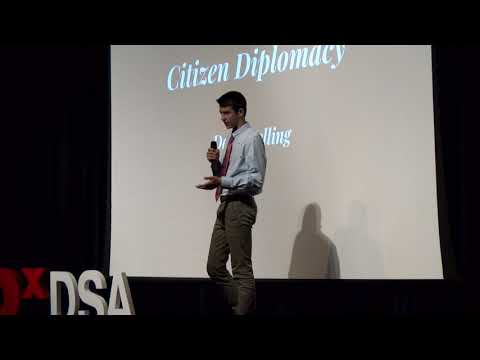
my name is Dean Galen and today I’d like
to talk to you about a issue that I find
equally applicable to anyone in this
auditorium and that concept is citizen
diplomacy and so how many people in this
room have traveled internationally in
the past year
so a reasonable man there’s a common
misconception among the American people
that our foreign policy and our
international relations are only handled
by those on Capitol Hill and by those in
the White House and this simply just
isn’t true and today I’ll be explaining
to you why citizen diplomacy is the idea
the concept that each and every one of
us has the responsibility to promote a
good outlook on the American people
abroad and this can be done in many
different ways through
because we have 67 million Americans
travel abroad every year 67 million
people make contact with foreign with
foreign peoples with foreign countries
and FARC with foreign cultures and if we
engage in proper conduct with those
people in those cultures we could
promote a better image of ourselves a
Berliner not only that but the US
Department of State brings millions of
people to the US through different
programs and through other other efforts
with diplomacy to help promote otherwise
otherwise engage them with American
culture and by engaging with those
people they would be able to go back to
their own countries with a different
outlook of how Americans interact
this past summer I was offered an
amazing opportunity from the United
States Department of State to go abroad
to South Korea while I was in South
Korea I was engaged with the locals I
engaged with their culture and I engaged
with their country in general and I
learned a great amount about the country
and about its people and so if each of
those 67 million Americans could travel
abroad and learn a thing or two about
the people and their culture
the idea of citizen diplomacy is that
that would trickle down into our foreign
policy and into our foreign relations
and as a democratic system formed the
way that we interact with other nations
in general
while I was in Korea there was this
amazing opportunity to live with a host
family I went to school every day and I
made a lot of great friends and through
interacting with them their outlook on
how Americans interact and my outlook on
how great under the direct was greatly
changed and so
if we were if each and every one of us
was able to go abroad as everyone who in
this room who raised their hand if we
were all able to go abroad and live like
this
it would create this huge effect this
huge ripple effect and that’s the idea
of this it’s changed on a small scale
that trickles down into our entire fall
or foreign-policy system as a whole so
while I was in Korea I was there for
seven weeks so I had lots of different
interactions that might fall into under
this umbrella topic of citizen diplomacy
but there was one in particular that was
really profound for me and that was one
night where I was just I was taking the
bus home from a dinner out with my
friends and the bus was packed people
were coming home from work we were
coming home from other different things
and so it was really packed I was
sitting on one of the last seats in the
bus when an older woman walked onto the
bus the first thing to do under proper
Korean etiquette would be to offer your
seat up to this woman so that’s exactly
what I did I stood up and before I could
get a word in in Korea and she started
stumbling over herself in English trying
to tell me that she didn’t need the seat
because she was getting off at the next
stop and so it took us about a minute
and a half to reach you know this mutual
understanding of what was going on but
at that point I figured it was there was
no point in sitting back down and I
stood there with this woman and we had
this great exchange in Korean about what
I was doing there and how I was learning
the language and two minutes later that
woman walked girl from the bus and I
never saw her again
but I think I was able to have a
profound effect on the way that she
thought
it’s not uncommon with in Korean society
for older people for the elderly to hold
misconceptions and hold stereotypes and
creat preconceptions about the American
people do two atrocities that were
committed during the Korean War and so I
hoped that by interacting with his woman
by showing her that I have respect for
her culture that I was able to change
the way that she thought about people
about Americans and about our country as
a whole and so we have all of these
Americans going abroad every year and
the problem with it is that we don’t
engage with the with the with the people
in general we don’t make these
person-to-person connections that
connect our nation’s globally and so if
we can make ties between people we can
make ties between nations and that’s the
goal
you don’t have to travel abroad to get
involved with citizen diplomacy it’s a
cause that starts on the smallest of
scales
and so by interacting with people who
come here by interacting with people
from abroad by reading up and being
informed about the world around us we
can increase our retention of global in
global education we can increase our
respect for different cultures and we
can maybe better understand how the
world works and how our Foreign
Relations and foreign policy work
the aim of this talk is to not to
of this talk is to help start a
grassroots movement the aim of this talk
is to spread this message because a lot
of people haven’t heard of this
initiative and so my hope is that
everyone in this room can walk out with
a different understanding of this
concept one where we see international
walls less as international borders less
as walls and more as bridges one where
we understand the power that each and
every one of us holds and one where we
go out into our communities and change
things for the better thank you
[Applause]
Please follow and like us: