
curious about my family’s ancestry the
natural world was always created a sense
of all to me the sunsets the trees
nature in general always kind of seemed
to be a very grounding piece of my soul
and as I talked with my parents more I
realized that we had some Native
American ancestry and once I learned
this it made me want to research that
side of my heritage a little bit more so
I’m a drummer in a composer and while I
was a student at VCU in the Jazz Studies
program some of my teachers encouraged
me to explore this side of my ancestry
to see how it might inform not just my
plane but also my approach to music so
as I started reading some books and
listening to native american music and
attending pow wows I started to see how
I might be able to use this knowledge to
inform my own plane in my own art and as
I was reading the book bury my heart at
wounded knee by Dee Brown I found myself
finishing a chapter and then I would go
and sit at the piano and just kind of
play a little bit to make sense of what
I just read and try to process it a
little bit and with no real intention
you know I would write down a melody
that might come and just kind of let it
be and then the next day would be the
same I’d read some I’d write some I’d
read someone to write some and what
started to happen is that this piece of
music started to unfold and I found
myself really kind of overwhelmed by the
material that i was reading i was
writing painting composing improvising
on the drums and talking to anybody that
would listen to me about what it was i
was studying and one thing I started to
realize is that as you study history
it’s not just a series of events and
dates on a timeline there’s a linear
quality to the history that we study so
for example events such as the Sand
Creek Massacre our wounded knee are the
Battle Little Bighorn even though they
had taken place in the 1800s we’re still
being felt today by many people for
example the sand creek massacre that I
just
mentioned just had one hundred and
fiftieth anniversary on November 29th of
2014 and this event happened when around
700 us volunteer soldiers attacked a
peaceful village of Cheyenne and Arapaho
Indians killing and mutilating the
bodies of nearly 200 villagers
two-thirds of whom were women and
children and I was falling along with
the protest as this event started this
anniversary was coming and there was a
lot of anger inside of the Native
community about how this was being
depicted by the Colorado history museum
which is where the state that this
massacre had taken place and also there
was a petition to have the town of
Chivington Colorado renamed because it
was named after the the colonel who led
the massacre on these villagers and so
these were and are very real events and
parts of people’s lives that sadly not a
lot of us are aware of so it was then
that I started to see a purpose for this
music that I was writing is to try to do
my part to shine a light not just on the
history but also on the reality that
these events have had on people’s lives
today and to try to do that with music
so as I would be thinking about an event
such as the Sand Creek Massacre I would
sit and try to write a piece of music
that could convey the image or the story
inside of someone’s mind even though
they might not know the actual back
story of what happened and as I would
write these pieces I wanted to call them
by the names of the events that inspired
them so that is my hope that a listener
would hear a song and then look to see
what it was called and take a few
minutes to do a little bit of research
on their own to find out some more
information so for example if you look
up Wounded Knee let’s say and you read a
little bit about it you can follow a
direct path that leads you to the
current protest at the Standing Rock
reservation that’s happening today in
North Dakota ultimately there was six
songs that ended up being part of this
suite that became known as bury my heart
they’re broken treaties Wounded Knee
little crows war Big Horn sancreek and
remembrance
and as we were playing some of this
music with my band one of the guys in
the band suggested that I might write
something that was not so dark he said
the music was a little too intense and
that everything is not that bad and I
have to admit it was a little bit hard
at first because most of the stuff i was
reading didn’t make me feel very happy
so but I continued to read more and i
would go to powwows and i would hear the
drums and I would see little kids
dressed in traditional clothing and it
made me want to write the last tune of
the suite which is called remembrance
and at first it might seem like a song
that’s about remembering all the bad
that happened and all the history which
it kind of is but truthfully and more
importantly it’s also about remembering
the beauty that exists today with mid
the native culture and the resurgence of
tribal identity throughout the country
and also to remember those things such
as the Sun set the stars the trees water
and everything that makes us part of
this natural world so I thought that it
would be fitting today to close this
talk with a performance of that song
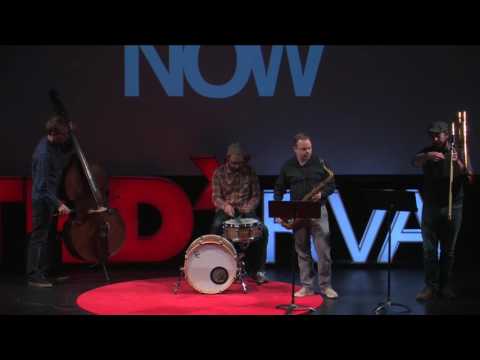
remembrance and I’d like to invite some
of my bandmates out on stage to join me
to play this song Jason Scott on
saxophone Tom Shay on bass and Toby
Whitaker on trombone and this is
Oh
[Music] Oh
Be First to Comment