
[Music]
so from the bowels of Bengal to the
Wragge in the Gurdwara from the Potter
in Kumar Thole to the weavers in Banaras
and the bead waker bead workers in
gujarat to the Langa’s and the manganese
here in rajasthan all of these people
make up the cultural industry here in
India and that industry is going to be
the next sunshine industry of the
country most governments have no idea
about the wealth and the contribution of
the arts to society our estimation is
that over 400 million people in some way
benefit from the arts in mostly agrarian
economies be it in Rajasthan or Madhya
Pradesh Gujarat or ERISA or Bengal
you’ll see between harvests a lot of the
folks do something that’s artistic they
will weave they’ll create stuff they
will paint a part they will be involved
in some kind of artistic contribution
and during famines and floods they leave
their states and go out to another state
to be able to earn a secondary income to
contribute to their family the world
over the creative industries contributes
largely to local GDPs if you look at
London’s West End or New York’s Broadway
London’s Western contributes about 9
billion pounds of additional income into
London’s economy and New York’s Broadway
contributes about 13 billion dollars
into New York’s economy at the Edinburgh
Festival which is one of the world’s
largest festivals which spreads over
five weeks this year I’m in 2017 275
million pounds of
additional spend was contributed to
edinburgh s– economy in Jaipur itself
in January a few days away from here
at our annual zjp literature festival
some years ago when we did a survey we
realized that the contribution to jaipur
local economy over five days was about
forty to fifty crores just in that
period because you have such a large
number of people who fly into the city
and everybody from the rickshaw driver
to the duty maker the hotels and
restaurants and the cars of the tourist
people everybody earns from a festival
and yet government’s continue to look at
the creative arts sector as a handout as
a Dean they don’t look at it as a
contribution why not
India today has 1.3 billion people we
have creative energy in our DNA from the
cradle to the grave we have some form of
art and entertainment we sing and dance
our way through life on every occasion
across religious divides across caste
and economic divides we know that we
celebrate the Arts the larger festivals
the Durga Puja has the Nevarez
the ganesh puja as the holies all of
these contribute in some way to not just
our creative insight but to local
economies and yet in these 70 years
since India’s independence no government
has thought it fit to do any kind of
enumeration of the contribution of this
industry to India’s GDP if you look
around us today
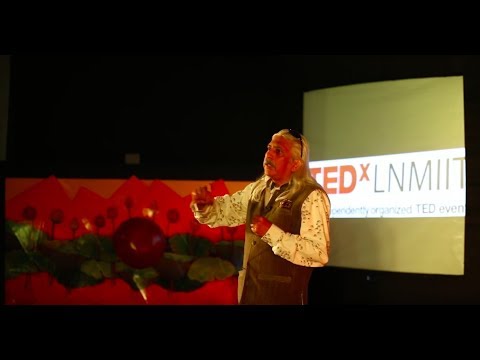
Nathan’s piece of art the TEDx logo your
chairs that you’re sitting on the head
wear that you’re wearing the red t-shirt
that you’re wearing all of this is
design and also forms part of the
creative industry sector all around us
in India we are steeped in design you
will hear some of our speakers
immediately after me looking at the
incredible wealth of traditional art
that we have that is so amazing because
it represents a tradition of form a
culture and it tells you a story
some years ago I remember in Dante vada
we’d set up something called the kahani
festival and much of what we do when we
do our festivals across the world is
that we look at places in conflict so
Egypt South Africa Israel
Dante vara and the reason we looked at
Dante bar as we realized that this was
in the midst of the Maoist belt as you
all know in a place that very little
gets to in a place where young people
are growing up
without any access to either their own
traditional art and craft and certainly
nothing that comes in mainstream we
brokered a deal between the government
and the Naxalites saying that on that
weekend that we were doing the tejani
festival that they would be a piece and
nobody would have any encounters nobody
be shooting each other and we busting
kids from a hundred kilometer radius so
about 7,000 kids came in each day over
these over the Friday Saturday Sunday
these were kids who had never ever seen
a teacher in their school they used to
go to their school to have a midday meal
but they didn’t have a teacher because
teachers were too frightened of going
out to teach there and they came into a
place and of course in our ignorance we
sort of said you know what do we take
there let’s take them stories of the
Ramayana and the Mahabharata and you
know blah blah blah not realizing that
when the storyteller started telling
them the stories of the Ramayana and
Mahabharata which we are so familiar
with they had no idea but what they did
know was their own stories the stories
of their trees of their forests of their
rivers of their stones of their gods of
their customs and of their traditions
and the wealth of India lies in these
stories in our diversity each of you
sitting in this room comes from a
completely different part of the world
because every hundred kilometers in
India everything changes the way we
speak the way we dress what we eat the
way we eat it the way we wake up the way
we sleep everything changes because we
have such an incredibly diverse country
and yet at one level and the onslaught
of Bollywood perhaps we are all becoming
you know in in one grain in one shade
and that perhaps is a big challenge into
the future where do ideas come from
ideas don’t necessarily only come from a
book that you’re reading or a textbook
or a lecture I
years come from people each of you each
of the 1.3 billion people from India
have an idea and why what’s unique about
it because unlike in the West where
there are very safe societies you know
this thing of nuts has nuts in it this
bottle of milk has milk in it so beware
because of the allergies etc a mind the
gap between the train and the platform
in India every second we’re having to
work to survive Dugard
the big economic concept that we have as
we all know you know what does yogurt do
you gotta make sure that when a
spaceship doesn’t go up you’ll have
somebody run across open the door why
something up and the spaceship will go
up if it was anywhere else you’d have a
committee formed that inspect that have
a report they’ll have a second report
bla bla bla but you got not in its
short-term reference but in its long
term has a lot to offer because we as
Indians are able to think outside of the
box because just to get your gas
cylinder or to get your Aadhaar card or
not to get your other card depending on
which side of the divide you’re sitting
today each of these things require us to
work around the system and the minute
you start working around the system
you’re going to be inventive so you send
somebody from bihar who we all think is
you know bihar oh my god they don’t know
anything you send them to NASA in
America and they will be able to
single-handedly send that’s that shuttle
out into space because they have that
ability to be able to think outside of
the box so what does culture do for us
culture creates that platform it gives
us an identity it routes us today when
you look at I’m sure all of you have
some NRI family friend when they come
back somewhat confused about whether
they’re American or British or Caribbean
or New Zealand or Australian and they
come back here and they just love being
amongst their cousins being fed being
shown the great palaces and forts of
of this beautiful city they are confused
because their roots are somewhat in two
places their parents keep telling them
that no you’re Indian and you must speak
this language and eat that you know
don’t go out with that boy or don’t go
out with that girl
because that’s terrible that’s not part
of your culture and yet when they come
back here they have a completely
different experience we as people in
India tend to adapt we adapt very
quickly we are able to think ahead we
are able to think fast the arts industry
as it continues to grow and we’ve been
seeing that you know even if you look at
the city of Jaipur ten years ago if we
had done a dipstick survey or should we
set up a Literature Festival in Jaipur
we would have been laughed out of hearth
and home because everybody had said
Jaipur no way nobody’ll read a book and
I remember standing at Dickey Palace in
the Durbar Hall at nine o’clock in the
morning on a cold winter day at the
first Jay politician festival wondering
lo Ganga and if they come will they be
enough to fill the Durbar Hall which was
two hundred forty chairs at that point
of time ten years down the line four
hundred fifty thousand people line up at
7:30 in the morning and they come true
what are we building we’re building a
brand but we’re building a brand which
is based on culture we’re building a
brand of ideas we’re building a brand of
knowledge and excitement you can sit and
the lawns of diggy palace in a chair and
you can travel the world everywhere
between Wellington and Vancouver and not
move an inch you can learn about
different people’s histories and
philosophies their their sociology the
way of life what they wear what they
think everything that gives you a window
into another culture
India 70 years ago when we were divided
every country or every civilized country
at that point of time including America
and Britain said they will not survive
because they are so diverse and they are
so divided and they bet on Pakistan
which had a very focused religious
direction and they said that will bind
them together 70 years later we have
survived in spite of all of this why
because we understand diversity or we
used to understand diversity all the way
from the Northeast to the south from the
east to the west we have an incredible
array of amazing built heritage
intangible heritage and tangible
heritage our built heritage is one of
the reasons why this festival had come
to Jaipur to begin with because at that
point of time when John and Fitz Singh
had come out to Edinburgh in 2001 to see
what we were doing there there which was
basically working with the with the
crafts and the arts and looking at a way
to be able to create a value in built
heritage they said they wanted to do
that here because of many of the old
Bailey’s were being toned down to be or
be converted into you know other species
south africa in 2000 and whatever year
sorry 1990s whatever year we started
working there what had happened was that
in the central business district of new
town in how Tang in Johannesburg all the
wealth and value had moved out of the
city because there was only crime during
the transition period and the city had
only two big banks Standard Bank and
First National Bank which was still in
the old part of the city and everything
else had moved out and they were very
keen for us to repeat what we had done
some years ago in New York and one of
the things we went and said to the then
government we said okay why don’t you
mark out an arts precent in in the
central business district and I said in
three years time if you provide me good
policing and great lighting on the
street I promise you in three years time
I will walk across Mary Fitzgerald’s
square which was one of the most crime
infested areas with my laptop expel
exposed at night and I won’t be mugged
that’s exactly what came to pass
restaurants moved in galleries came in
museums came in they’ve converted the
old rundown powerhouse into a conference
center of people came in it became
buzzing festivals started happening
there and today it’s one of the most
dynamic places attracting both funding
residential development commercial
development and everything else why
because they realized that you can use
the Arts to be able to create this kind
of wealth and value in Egypt when we
started during the Arab Spring
revolution we were invited to set up a
festival in in Egypt and everybody here
said to me are you
I mean you are mad we know that but I
used that man to go there at this point
of time and you know I’d never been to
Egypt so I was like I’m going to Egypt
to see what it’s like so we when they
set up the festival and what did it do
it created a sense of resurgence for the
people there today it’s one of the
largest festivals in that country it
brings in tourist traffic but most
importantly it
gives people that kind of belief in
themselves that they can continue to
address their needs their beliefs
through the arts when you look at any
kind of art form design or literature or
theatre or dance or music anything one
of the most important things in that is
to see where is the route to any of this
and the route always is goes back to the
soil of where it is emerged from today
Indian language writing is amongst the
richest writings that we have yes
there’s a lot of attention given to
writers in English from India but the
true wealth lies in language writing why
because they understand the nuance they
understand the language they understand
what makes you and me tick they
understand how to address and to refer
to people and all of this together
provides a basic fabric that weaves
different ideas and different people
together into one so it’s irrelevant
whether what religion we are or what
caste we are or which part of the
country we come from we all understand
that language and literature and theatre
and puppetry in’ and the visual arts and
everything more none of this needs in a
sense any language it crosses the cross
all divided today if you listen to
indian ocean or if you listen to
parikrama or you’ve listened to rigor
you listen to Surat ma or you listen to
raghu dixit it doesn’t matter whether
you understand the word at all you go
with what you feel is addressing you in
your heart and your soul as I said 1.3
billion of us and incredible energy 1.3
billion ideas waiting to erupt outside
of this classroom when you leave
each of you is like that Firefly when
lit on a dark night without a moon rises
up into the sky and has the capacity to
illuminate us all with knowledge with
the wealth and the depth of inspiration
and ideas so I hope each of you dream
your dream and you live your passion
that’s the most important thing not what
your parents have told you but really
your passion let that be your driver
always remember to be rooted always
remember to be appreciative of even the
worst kind of art because when somebody
starts doing something they do it
because they believe they have they have
a violation to do it writers right not
necessarily to entertain writers right
because they have a voyage into right
they have a day right because they are
able to fathom to tomorrow that we are
not able to fathom people are able to
create these incredible visions because
that’s what they do they help us to be
able to address the inner eye so best
wishes go out and do your thing and
thank you so much
[Applause]
Please follow and like us: