
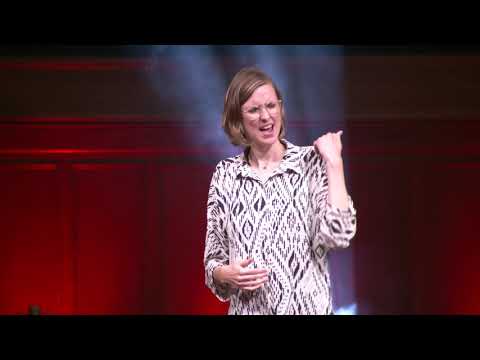
I was born deaf as well as my older
sister and when we were little we made a
drawing together of two worlds the Deaf
world and the hearing world and in
between those words was a bridge and
this was our ideal world because this
was a bridge that people could use to
experience to exchange experiences and
communicate without limitations I grew
up in both the Deaf and the healing
hearing world and I noticed that there
is a gap between the two when I was 10
years old I was at the platform waiting
for a train with my dad and I played
with his train ticket and he said this
and it said this was an assistance card
for a person with a handicap and I said
dad you bought the wrong ticket and he
said no this is how society views you
you are a person with a handicap that
made me laugh and it’s like I have a
handicap I can walk I’m not missing an
arm how am i a person with a handicap
only later I realized that that is what
society views me like because of my
deafness eventually I got older I didn’t
feel handicapped because when we are
among other deaf people communication is
easy there are no boundaries we are very
proud of our native language to Dutch
sign language we’re proud of our culture
and we can sign and communicate without
barriers I’ve lost my thread here so
we’re very proud of our culture our sign
language and we also have a shared
history just for your information that
in europe and other places in the world
from 1880 until 1980 a period of about
100 years sign languages have been
forbidden in education if a pupil were
to sign they would get punished we don’t
feel like people with a disability but
society poses boundaries for us because
it’s very hard to communicate with
hearing people who don’t know our
language it’s hard to communicate with
hearing people that view us from a
perspective that our ears are defining
us the things that we cannot do because
of our deafness and that is the medical
view in 2012 I started working at
Greenpeace and that was my dream job I
was really happy to be offered this job
because it gave me an opportunity and I
felt like I could be on equal footing
with others but I need it for 30% of my
working time to make use of the services
of interpreters to communicate with my
colleagues but unfortunately in the
Netherlands the law says that you only
have a right to 15% of your working time
so that was a boundaries boundary I went
to court try to fight the government but
lost the case that was a really big
setback and I wanted to appeal the case
but unfortunately laws regulations don’t
allow for that in the Netherlands so
that was hard that the government tells
me I cannot work at Greenpeace because
this is not a suitable job for me you
can only communicate with your
colleagues for 15 percent of your time
so that made me wonder am I the person
with a disability or does the society
give me this the society give me this
disability so my contract at Greenpeace
wasn’t renewed I had to leave and I
accepted that and I made a career switch
and I started my own company hotels with
my sister and we wanted to make our
dream come true we wanted to connect the
deaf in the hearing world and we became
consultants for accessibility in the
cold in the culture in arts fields and
we started in that field because we as
deaf persons are very proud of our
culture and we wanted to focus on a
cultural perspective so that is why we
started in that domain that was the best
place to start so we started working and
every once in a while a museum would ask
us why we thought that they were not
accessible because you know deaf people
can use their eyes they can see the
paintings and the objects and that is a
very good question but it’s also a very
good illustration of how difficult it is
to put yourself in a deaf person’s shoes
because yes we can see things obviously
but it’s still very complicated there is
a lack of information because society is
very sound based all information is
based on spoken language and that’s what
we miss and also just for your
information more than 95 percent of deaf
children are born with hearing in
hearing families and their parents then
need to learn how to sign so that
already causes a delay in their language
development and that is why the Deaf
education focuses on language learning
rather than culture so reading writing
but there’s less attention to culture
and arts as a deaf person when you grow
up and you go into a museum the first
hurdle you get to is the desk where you
buy your ticket because people tend to
panic slightly when they meet a deaf
person because they don’t know how to
communicate with them and the only thing
you want to do is buy a ticket and
that’s already a very difficult
situation which doesn’t make you feel
welcome and when you then get into the
museum there’s many people walking
around with headsets and in groups and
that makes you feel isolated as well and
then in the rooms
obviously there’s text on the wall maybe
in Dutch maybe in English and that’s
very hard to read because for many deaf
people Dutch is their second language
the native language is their sign
language this means that they don’t feel
at home in a museum it’s really for them
place for hearing people so in 2015
bottled and foam the Photography Museum
in Amsterdam we set up this project
museums in sign language and we’ve been
going on for three years now and we have
a network of 16 associated museums right
now and they have tour guides or tours
in sign language and we trained these
guides to do the tours and sometimes
people ask me how many people are there
in the Netherlands well there is a large
group of about a million and a half
people with some degree of hearing loss
it’s a relatively big group but there’s
many different forms there’s people who
become deaf of noises or old age a small
part of that group is 70,000 beep 17,000
people that uses sign language and that
might be a very small group yes but each
target audience has an added value and
the same goes for deaf people if you
target this audience you beat you forced
to think about how to make your
communication accessible is your
information spoken is it visual enough
how can you make it accessible in
language for this target group and every
target group small or large
can have an influence on the overall
quality of your accessibility and that’s
what everybody benefits from what’s
important is that you work together with
your target group with deaf people in
this case because then you can work on
an equal basis and inclusively towards
accessibility and our museum guides we
have decided to use museum guides deaf
people themselves so not hearing guides
with an interpreter but we want to deaf
people to do the tour’s themselves
because they are native signers they are
representatives of the deaf culture and
they have
an identification with their visitors
and we’re very visual sign languages are
3d languages and what they do when they
come into the museum is they make 2d
flat art come to life in a 3d language
it’s very visual and it’s very beautiful
to see also for hearing people it
intrigues them they notice it and that
is a way to make deaf people more
visible in society so that is a positive
thing for deaf people to be recognized
also when you go into a museum there’s
different exhibits different themes that
you can learn from that means that the
information the lack of information that
they if they have can be remedied by
that and this empowers them I do believe
that museums are an intersection for
different perspectives different
cultures and experiences and they are a
source for new ideas and inspiration and
I think that is the point of museums
that is they should be inspiring and I
think that museums when they become more
inclusive and accessible they can be
role models for other organizations as
well in their quest to an inclusive
society in the future I would like to
urge you to abandon your medical view to
look at deaf people from a cultural view
because it’s a very rich and beautiful
culture and they have a beautiful and we
have a beautiful language so talk to us
work with us on an equal basis
inclusively and maybe in that way the
bridge between the hearing world and the
deaf world can really become a reality
thank you [Applause]
Please follow and like us: