
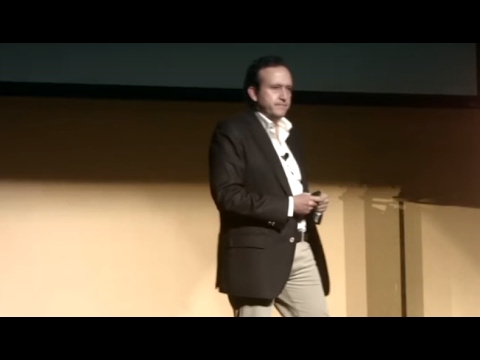
I want to start by making a
relationship
I ‘m not a banker, I’m a bank
I’m a banking officer and
experience as a bank
it has allowed me to be in operations
extraordinary grandiose for their
amounts for what they have meant by
the objectives that have been achieved but
since a few years ago I had a
obsession for a segment that I
I call the one of the protagonists of the
progress in banking we are very
used to segment customers
we call companies to the big
corporations
a segment we call SMEs to
microenterprises and people in
another segment and I do not like myself
I want to talk to you today about the metastasis
who is doing traditional banking
to attend to the protagonists of the
progress
who are the protagonists of the
progress of banking companies
big the big corporations
we could say that they are fine
attended by the bank but the
protagonists of progress the
enterprising housewives the
dreamers those who have the illusion of
progress the illusion of converting or
transform reality and make it possible
the dream are not being well
served by traditional banking and it is
a revelation that I make with all the
effects that it has for someone that the
low official
remember I ‘m not a banker I ‘m a banker
but it is something that is important that
let’s keep in mind because we are
all of us here are those who
We are going to experience some changes and
very favorable transformations for
those protagonists of progress
and that’s what I want to talk about today in this
presentation that with much affection I have
wanted to bring you in this my first you
what is happening because we are
saying that he is making a
metastasis the traditional banking for
meet those progresses to their
protagonists of progress that is
happening in the world there are several factors
to specifically consider three
great factors and in this vision of the
earth puts me in a situation
paradoxical and that situation very
probably lived millions of years ago
years when a meteor fell
remember that when the meteor fell
what ended up happening was that some
species disappeared not by big or
by small or by b speed or by
slow they disappeared because they were not
able to adapt and that’s what
is happening a bit with banking and
need to adapt to a new
what are these or those
levers of the change that is generating
a change so that we start talking about
a new way of doing banking
the first a crisis of confidence a
crisis of confidence that came to its
maximum expression in the year 2008 with
a financial crisis where the great
middle class in the united states said
motorcycle as well
Now it turns out that you end up taking me to
such high indebtedness states
to be able to package it into a few bonuses and
sell it around the world and it turns out that
also as a banker you take a
award in millionaire bonds
I do not believe you a banker, not a bank
It’s me
banker I do not believe you have destroyed my
trust
I do not trust you there’s something weird about those
complex operations that you do not
I’m so convinced of how you’re doing
talking as he is saying things
is man
important factor in front of the new
consumer that crisis of confidence
second the irruption of technology
a speed that we are not
accustomed to living in the last 15
years the technology has advanced from a
dramatic way and especially of a
very efficient way
before there were many barriers to entry
there are many problems to access the
technology today not today and that’s what
we see reflected
additionally in what we call the
massive adoption of technology
you know how many years it took the
humanity in accept as a solution
innovative to electricity
46 years 35 years to the telephone 31 years
the radio 26 years the television does not go
at the end the iPhone 2.5 years networks
social like facebook three years that
speed with which the
new technologies is very relevant
to understand all the changes that
affect the way they are
providing banking services for
the protagonists of progress third
great change and it has to do with the
consumer behavior
we started living and sharing with a
better informed consumer with better
decision capacity with probability
make decisions and make mistakes assuming
the risks
a different consumer a consumer that
is no longer in the role of being
offer a service to see if he
adapt service not a consumer that
is asking to be known so that
services
the products adapt to it is already
economically explained in the 20th century
beginning of the 21st century
We have lived three economics classes
a first economy that was the
production economy in the 20s
its maximum referent was the production
of the famous model t of fort where
everything consisted of producing your
highest peak was when the Americans
they managed to manufacture 25 aircraft carriers
alves economy production
later and in the postwar period
we entered an economy that was a
consumer economy
who were the great
protagonists of that economy of
consumer advertising and system
financial system that allowed leveraging
constantly getting the
objectives
that consumer economy ends with the
2008 financial crisis
why because that moment where we
We realize that everything can not reach
the levels of leverage to which
it came and that puts us in a new
consumer and a new economy that is
what are we experiencing the economy of
creation
now the protagonist is each of
you and your ability to create and there
many very practical examples
then then have a program starting
from which you can register and
design your own ego
that is happening creation economy
and that puts us with a consumer
different with one more consumer
informed by that begins to be
relevant all the topics associated with
predict and analyze data
a concept that he should wander through
there that you should not hear the big
dates the importance of predicting and
analyze to get ahead of the
consumer behavior
that is the great third change
those three things the crisis of confidence
the irruption of technology and the
way it was assumed and
adopting at a higher speed and a
new consumer class
this puts traditional banking in a
very complicated situation because
necessarily leads her to consider
how to deal with those changes
serve a consumer that is different
and makes consumer that is different for
that we understand as the behavior and
technology and the crisis of confidence
they become a powerful catalyst
of the reality of the financial client
we can see it in these four phases of
disruptive behavior of a client
of banking
here is present since the future a
first phase that produced the internet and
the social networks in all of us the
possibility to control and select
that’s called power and that’s an element
very important to be able to control
second phase technology appear the
applications and the screens the screens
the tows that allows me to do
any transaction at any time
and in any place
I have control I can do
transactions at any time and in
any place
that’s not science fiction
that we live today and phase 3 and
phase 4 which are the following phases
they take us to mobile wallets in
where the cash and the cards go to
disappear practically our
transactional system
is going to be a smartphone I have the
control
I have the possibility to do it in
any time at any time and in
anywhere and additionally with the
sure that I’m making a
correct and effective transaction and if
let’s get to a phase 4 that this is the
fear that I have as a bank does not like
banker and is that any of you
be a bank so that the banks
so yes I could finish doing
what a bank does and those are the
great challenges that we face
those that we still believe can be done
many things to generate a change
positive in the way of accessing
financial services with better
experience
this is the banker today that there
vanity ego sufficiency see me
I have the products
you need me I have the pasta
I know how this works
I am on the throne we are talking
of the banker who serves the
protagonists of progress and I talk to him
to that banker I can talk to you
because as I am a bank, we are not in
equality of conditions and I tell you to
that those vanities and the service of
banking in the last is so simple
let’s go back to simplicity those
protagonists of progress so that
they use a bank
we usually relate that banker
come conceited with very operations
complex
here there can be complexities this
it is part of everyday life
this is part of day to day and
he used the bank to do things
what I do on a day to day basis to be able to
fulfill my dream as the protagonist of
progress appears simplicity with a
clear message and iván hero care
you’re forgetting one thing I already I have
the power
I have the ability to choose and I do not
I have to submit to your conditions and
I can choose and when I choose
gave up something like that banker
be careful because I have the power
then to this type of clients who
they are offering them things and it appears
here a very interesting competition
between traditional banking and new ones
disruptive players that have appeared
to shake a little the atmosphere
known as fintech text end are
companies companies dedicated to lending
financial services but with a base
technological very important but also
with a new banker model a
jeans banker a bike banker a
banker without vanity is a banker who
wants to transform reality and you
puts the bank aside and says yes
we have problems with regulation and
we have problems with legislation and
we can confront each other and you can
find a lot of literature if they are going to
end up disappearing the banks were going
to flourish the filt the banks are not going to
disappear the banks are going to change in
benefit of all of us but it is
good that these elements appear
disruptive to make us think which
it’s the best way to get closer
humanely to offer services
banking and I’m a bank
I would not like this to happen but we
we are facing this reality
who are those protagonists of the
progress of its protagonists of
progress are the great middle class that
is emerging in colombia that this is
the bit of cardinal for any
banker because it ‘s a middle class that
consume
it’s a middle class that requires
financial services and products and
they are also protagonists of progress
in colombia the entrepreneurs the
dreamers who decides to ride a
clothing workshop and want to access
to credit and want to access products
and services that allow you to comply with
their dreams
those are the protagonists of the
progress where the bank has to
drastically change your thinking model
in a smarter debt in terms
different in different guarantees
this is where innovation comes
this is where the real
important initiatives and there are data that
it’s worth taking into account 6.5
millions of families are part of today
the Colombian middle class
we have gone from being that pyramid to doing
a hexagon with a few opportunities
interesting for the power of decision
they have and they are wrong
attended from the point of view
financial and banking
I do not like to talk about microentrepreneurs
the protagonists of progress
55 percent agree that
access to a financial institution will
has served to progress in your business
but 56 percent do not go to
credit and they know what is the worst
70% exclude me, they’re not going to
lend
I want to finish this talk today
making them a final revelation
I told them banking but they know that I
I dare to tell you I want to be a banker
but I want to be a banker to attend to
a type of client like the one
here sitting on the throne to put me at
service of those who really see
in the humanization of banking a
fair way and access goods and
services and be able to progress
Thank you
[Music]
[Applause]
[Music]
Please follow and like us: