
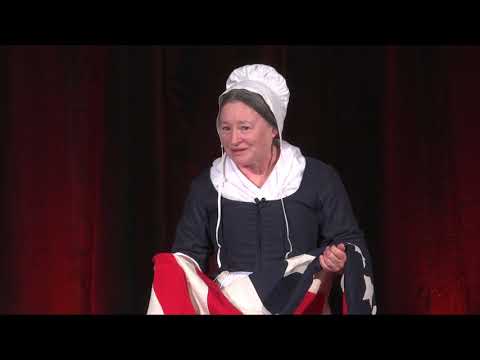
my dear good friends I am more than
pleased that I’m able to visit with thee
but it appears I must begin with in
apology as I look about the room Here I
am finding myself in the wrong century
my apologies but perhaps I shall begin
for a moment at least owe thee a little
bit about Who I am now most friends they
shall remember me by the name Betsy Ross
and they know me for making the flag of
the United States of America wasn’t the
first flag of our new nation I know not
if that is true but I do know it was not
the first time I had sown for Washington
oh no I had already made bed hangings
and bids for Washington all the goods of
my trade as an upholsterer Washington
knew my skill with my needle he trusted
me to make a flag against England I was
24 years old at the time I am ever so
much more than 24 now I am no longer
called by the name Betsy Ross I am known
as Betsy Claypool it is my third
husband’s name but if I were to cross
the centuries
I am also known by another name and that
name well that names perils faked
I am a first-person interpreter I am a
storyteller who makes history come alive
by being Betsy now let me explain every
year almost two hundred thousand people
from across the world are going to visit
the Betsy Ross house in Philadelphia
they all want to learn about the flag of
the United States of America and they
all want to meet let’s say why where
does the appeal of meeting a person from
the past come from I mean do we blame it
on the musical Hamilton please I hope
not no the reality is that many many
people are fascinated by the past they
want to know about the good old days
which really weren’t so good I mean do
you like nice clean clothes well then
try bleaching them with your end well
preferably your own are you feeling
under the weather today maybe the doctor
will bleed you with leeches it’s
surprising anyone survived the good old
days but the past the past intrigues us
so what does it mean to be a person from
the past sometimes it’s easier to
explain what a first-person interpreter
is by explaining what a first-person
interpreter is not or at least what we
don’t want people to think we are
first-person interpreter historic
interpreter character interpreter all
these names are pretty much
interchangeable but please don’t call us
impersonators leave that for Elvis well
an impersonator is going to be an
entertainer an interpreter is going to
be an educator not that an interpreter
should be a boring presentation no no
but we don’t want to be considered as
merely look-alikes who are nothing more
than window dressing although
if a first-person interpreter does look
like the person they’re portraying
that’s a bonus and i know three benjamin
franklin’s who look like his portrait on
the hundred dollar bill but no
documented portrait of Betsy Ross exists
we don’t know what she looked like
family tradition says her eyes were blue
and she was nicknamed the little rebel
my eyes are blue and you don’t get much
smaller than I am but there are also
some people who seem to think that Betsy
Ross isn’t a real person they think she
didn’t exist and really she’s only a
myth that is not true Betsy was born in
1752 she made bed curtains for George
Washington in 1774 and musket cartridges
for those guns of the Continental Army
in 1777 Betsy was a real woman so a
historic interpreter is going to
research a real person from the past and
they’re going to share the perspective
of that person to educate the public yes
we want to dress like the person we want
to speak like the person we want to
behave the mannerisms of that person if
they’re known but if they’re not known
we’re going to fill in the gaps with
what is historically known about people
from that time plausible possibilities
but a first-person interpreter can never
be another person nobody can ever be
another person thankfully we’re going to
be interpreting a person from the past
to give an experience of living history
it’s an experience of what if
what if you had a chance to talk to
George Washington to Benjamin Franklin
to Betsy Ross what would you ask them
people ask me lots of questions when I’m
portraying Betsy I’ve helped to identify
the most frequently asked questions
there are more than 75 questions that’s
because people are curious about the
past I’d mind you I’m not afraid to
answer their questions even personal
questions as Betsy wasn’t it against
your Quaker faith to make a flag yes but
was also treason against England how did
your husband die which which has been
how could a woman own her own shop I was
a widow and therefore all choices were
legally my own when we imaginatively
encounter a person from the past
we often consciously or subconsciously
compare ourselves to the attributes and
the accomplishments of that person would
I be as brave would bite I be as
courageous when I make the same choices
could I make better choices by the end
of her life Betsy was blind not NIF
truth she had made hundreds of flags
truth not myth
it’s always very special to me when
people with visual impairments will
visit Betsy’s upholstery shop I
encourage them to touch the cloth that’s
going to be sewn into a flag or bed
hangings and to feel the fibers from
which that cloth is made a tangible
experience of history that transcends
the boundaries of time and place
now many families with children are
going to visit Betsy and the children
are very often studying about Betsy
Russell school they’re writing reports
they’re even portraying Betsy and
biographical wax museums I remember one
particular mother who came to visit with
her two young daughters so eight years
old
ten years old and at this age the
children are in awe of meeting somebody
that they are learning about in school
and these young girls were no different
Betsy began to tell her story about
making a flag a family story an oral
tradition that has been passed down
through generations that’s he asked a
simple question does the knew the name
of the man who wanted me to make a flag
now the girls hesitated it was quite
obvious from their expressions if they
were entirely involved but they were not
so sure what to think about this small
woman dressed in unusual clothing and
speaking with those unfamiliar words the
vowels I instead of you and you’re the
mother where she looked at her daughters
and she realized that they were
awestruck but with some encouragement
they remembered the name who the man who
would later be our first President of
the United States why this Trez indeed
George Washington who would it me to
bake a flag yeah and then Betsy unfurled
the flag giving each girl a corner to
hold does they know the number
of stripes upon the flag a small voice
answered 12 the mother groaned she was a
little bit embarrassed well perhaps it
should be best if we count the stripes
together and Counting with Betsy the
proper number of stripes were soon
determined yes there are 13 stripes one
for each of the 13 colonies and then
very soon those girls became eager
participants in Betsy’s story as she
began to tell them about the stars of
the flag I shall lay no claim to having
designed the flag of the United States I
did not choose the 13 stars or the 13
stripes Washington brought it rolling
but I did indeed change the Stars
Washington had wondered six pointed
stars upon the flag yet I told him a
five-pointed star would be better and
then showed him that I would be able to
make a five pointed star so simply so
easily with only several folds to my
cloth as I’ve just done with his bit of
paper and when all is completed I shall
snip that cloth but once and a star
shall surely be created children which
is my contribution woman’s contribution
to the flag take it home and let
everyone know – as Betsy who gave it to
them
now you have to understand as an
interpreter I am really going to know
what happens after people encounter
Betsy in her shop I always hope that I
have opened the door to the past in
people’s minds and that they’re going to
think a little bit differently about
what it would have been like to live in
another time and when it comes to
children who are experiencing living
history I hope that parents and teachers
are going to use that open door as a
springboard to further discussion
discussion about important issues how
hard it is to stand up and make choices
that you believe in how difficult it was
and can be for women to live and work
independently what the flag symbolizes
to the citizens of a free country
important discussions now for those two
young girls in my story the ones who
said that there were 12 stripes on the
flag I’m fairly sure those discussions
occurred afterwards because you might
recognize the name of their mother
Michelle Obama
but truthfully it wasn’t her role at
that time as the First Lady of the
United States that’s important to the
story what is important that our mother
and her daughter’s like thousands of
other people who experience living
history had a personal encounter with
the past and for one small moment of
time the past became real by meeting
that same our perspectives change when
we experience the stories of the past we
begin to own our history how does the
past relate to me my responsibility as a
first person interpreter is to spark the
fire hoping others will fan the flame so
the warmth of that fire will spread
through the mists of time sometimes as I
shall be in my shop suing I cannot help
but to dream about what our nation shall
be like in the future I do hope all
those friends will always respect the
flag for it is indeed a symbol of
freedom sown with sacrifice I have told
my story to my children I now tell my
story to my grandchildren who shall my
grandchildren – I do not know
but I do know that when the stories of
the past and the people of the past
become personal to us then they become
real to us and relevant to our lives
it’s only when we understand the past
that the past will begin to enlighten
our future and I shall indeed be the
peace good friends
[Applause]
you
Please follow and like us: