
[Applause]
so I come from a long line of DaVinci’s
you may know our most famous cousin
Leonardo inventor engineer anatomist an
artist now I’m not really a da Vinci nor
my folks but we do follow in his very
brilliant shoes both of my parents were
classical musicians with day jobs in
medicine and in computers and my
siblings are a photographer printer
biologist and a carpenter thespian
respectively so when I showed an
interest know an obsession with drawing
and painting when I was a kid I knew
it’s what I wanted to do for the rest of
my life now my parents were reasonable
parents and they really wanted me to
concentrate on studying of course but
all I really wanted to do was draw cats
horses and most especially the beautiful
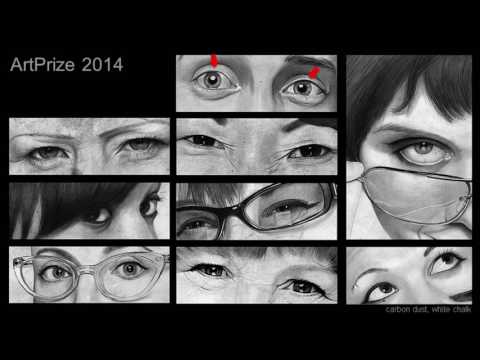
people and their dreamy eyes in the team
beat magazines right so why did I want
to do this why would why was the eye so
important to me even as a kid well I was
a really awkward kid I was bullied a lot
and I had a really hard time connecting
with my peers you know even as teenage
humans I think we have a desire to be
understood and to connect with other
people so when I came out as an artistic
person I thought I found my language you
know I had my anchor even if my social
problem was persisted you know the old
adage that window the eyes are the
window to the soul while I thought that
maybe if I drew them I might understand
my peers more what I realized is that
not only this extended far beyond the
eye if I wanted to understand anything
the best thing for me to do is to draw
it so much like Maximilian
sixteen now we just met when I was 16 I
found myself in my first anatomy class I
was detecting sharks and mud puppies and
turtles and creating a lot of lab
reports and what I realized is that I
could use my love for drawing to
understand what I was learning so I
became it began illustrating my lab
reports actually found this it was
amazing
1991 and my teacher noticed much like
maximillian’s teacher and she said you
know what you know all those drawings
and images in your textbooks people do
that for a job that’s a job and I
thought what the job that like real
people do you know they take they take
their artistic skill and their love for
the natural environment and they combine
them it’s just like me and my love for
the eye so that was it and I set my
sights on a career illustrating science
and in ten years I did it and made my
way through art and graduate school and
became a bona fide illustrator of
science so now when I draw the eye not
only do I appreciate it artistically but
also from a scientific perspective and
what could be more perfect for than
something like that for me well a PhD of
course so in 2012 I successfully
defended my dissertation at Wayne State
in the eye and I actualize the words of
my anatomy teacher from high school
these are just three of the textbooks
that contain my drawings it’s my real
job so I’m taking all of this
understanding of anatomy and science and
I’m now applying it to my fine art where
I’m still drawing the eye but now you
know I know what just beyond your
vantage point makes the eyelids look the
way they do what how the eyelashes grow
and you know contribute to the immune
system how the tears are made and how I
might paint that to make the eye look
really wet and reflective it’s all form
follows function right it is but there’s
a paradox there and the
paradox is this I’m constantly balancing
between what I know scientifically and
what I’m seeing with my artist’s brain
so I’m taught as an artist to trust what
I see so if I want to draw something
like this which I did two days ago I
need to start here now as an anatomist
this is a really weird use of color on
right and the detail is super loose so
you know at this stage of a drawing I’m
constantly fighting myself with myself
am I really my need for detail gets
really twitchy but I have to have faith
that’ll work out in the end the other
thing I have to keep in mind is that I
can’t take my very very familiar subject
for granted you know my scientist self
will pop in and say you know in when you
go through embryology even the tiniest
changes can create a gigantic
differences in the adult and we see a
tremendous diversity in the eye even in
the eyes of the same individual so
people will often people always often
think that art and science are very
different and I’m here to say that
they’re actually pretty some really
similar in my mind so they both require
a lot of expertise and precision and
even creativity and a lot of trial and
error so as a scientist I might do an
experiment and the results might be not
what I expect it might be really
challenging and as an artist I can be
faced with similar challenges so this
piece is four by eight feet everything
I’d done up to this point could pretty
much fit in my pocket so how would I
even begin to draw this right that’s
challenge number one challenge number
two is how do i buy a frame for this I
can’t go to Michael’s and buy a frame so
all of the stuff that you see there in
the framing of this piece was from lowes
so challenges and solutions creativity I
forgot that part that’s my hand and the
so another the most important thing to
me that blends aren’t that aren’t makes
art and science similar is that they
both can elicit a tremendous sense of
awe and wonder in the viewer sure it’s
because of the great diversity and
beauty we see in front of us but also
it’s because we know that we have so
much left to learn you know when we look
at this we know that science and art are
constantly changing and as it changes
the way we draw the eye will also
involve much as when I was a kid my
total goal in drawing was just to make
the drawings look like the person that I
was drawing to today we’re sure I’m in
you know looking like someone is very
important the dry the drawing in the
upper left is my husband for example but
I’m also trying to convey a sense of
emotion and I’m really trying to connect
with my viewer and in order to do this I
have to put a lot of trust in you and
have a lot of faith so that might mean
that I don’t draw every single hair
that’s coming out of the skin or every
single pore or every single wrinkle you
know I should leave things out because I
know you as the viewer or smart you know
what the eye looks like so when I leave
out you can fill in and I know as a
scientist that your brain actually wants
to do that work so when we establish
this trust it creates a connection
between me myself and you the ultimate
goal with all of my work whether it’s my
illustration work or my fine art is to
create this connection in the connection
built on trust is the strongest one what
I believe is that once we establish this
connection we can look around ourselves
and see the greater diversity that’s
amongst us it may make us
Gate our surroundings even more and
recognize the humanity in each other
because when we recognize that humanity
that we can grant people personhood and
dignity and that is something that my
awkward teenage self will continue to fight for thank you