
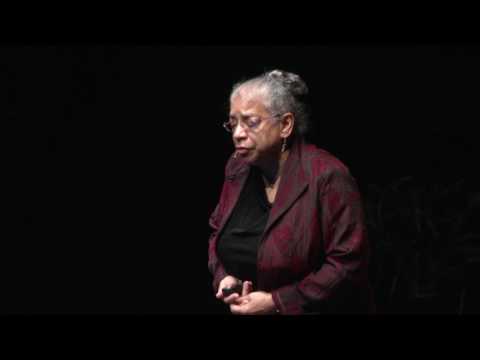
classicist in this nutshell that means i
love studying the languages and
histories of the ancient cultures of
Egypt Greece and Rome but before I get
into the hows and whys of who I am and
what I study I’d like to deconstruct for
you against the grain the theme of the
shears Hamilton tedxtalks and I do it
because that’s what I do the phrase
actually comes from carpentry it refers
to the fact that if someone rubs her
hand against the grain of a piece of
lumber she will get splinters it now
come into court arklow creole language
as an idiom referring to eccentric or
unusual behavior or acting out or
rebelling and suffering negative
consequences so if I were to start
covering a cons track against the grain
from his 2008 album freedom you would
probably think that this grandmotherly
professor of classics in Africana
Studies is going against the grain
herself heck even knowing who Akon is is
going against the grain this example is
fairly harmless most applications of the
phrase are negative and indeed a cons is
highly negative and problematic from a
black feminist and point a persona
in the song is going against the grain
because as he says he sell in love and
the refrain is I was wrong for falling
in love with female voices singing
gender slur they always say don’t love a
hole but does going against the grain
have to be negative or painful what is
going with the grain is what causes
splinters
what if doing was it is expected
reinforces and endorses stereotypes
racism sexism and other systems of
oppression I hope my story shows that
going against the grain can be a joyous
exhilarating and liberating form of
resistance it hasn’t always been
splinter free but I can say I stayed
true to me I just realized that rhymes
in my reflections on my location as a
black feminist who loves teaching Latin
and Greek I owe much to audre Lorde
patricia williams and to the personal
narratives of Fanny Jackson coppin and
Anna Julia Cooper who were among the
first to combine a classical education
with black feminism back in the 19th
century I began my love affair with the
Latin language when I was 14 and
attending high school in a small town on
the southern tier of New York it had
been originally suggested that I be
placed in the non regions that is non
college prep vocational track with an
emphasis on home economics now this was
going with the grain since I was a girl
of African descent and my grandmother
was a cook a highly regarded cook but a
domestic service nonetheless but the
problem was I was a hailing and the
haleys had lived in bath New York since
the early 1800s and although colored all
of us girls and boys alike were smart I
had always done well in school and
received good grades by 14 I already had
geometry and algebra at my previous
school on the campus of Hampton
Institute the site of the education of
many of the women who are the focus of
hidden figures I was very depressed to
learn that if play
just in this home at track I could not
take foreign language my father
persuaded none too gently the guidance
department of the injustice of this plan
and so begrudgingly I was placed in the
region’s track for a probationary period
to see if I could handle it now I say to
the thrilling but still ominous task of
choosing a language the options were
French latin and spanish i quickly
eliminated spanish and french because
they were conversational languages and i
had just recovered from a childhood
stammered and stuttered i took four
years of latin and itself I took the
Latin achievement exam and I won prizes
at the state and national conventions of
the junior classical league I continue
to take Latin at Syracuse University and
I started Greek never intending to major
in it I wanted to be an elementary
school teacher but always feeling the
wonder of those languages spoken so long
ago after two weeks in the school of
education at Syracuse I came back to
Latin and I did in fact declare it my
major but at Syracuse I began to wonder
if I were the only african-american
person ever to study these languages
there were no other students of color in
my classes there in fact my peers of
color derided my eventual decision to
major in Latin what good are you going
to accomplish for black people studying
the languages of dead white men what
indeed so by going against the grain in
this way I was deemed a race traitor but
I was born under the sign of aries and
so I persisted I went to the University
of Michigan for graduate work and their
encountered the ice
elation and racism which results when
there is not a critical mass of people
like oneself in the field however I
persevered I received my PhD in classics
the first and only african-american
woman to do so at the University of
Michigan and I thank you and I went off
to teach I am often asked why I run into
classics and more importantly why I stay
all I can say is somehow mystically I
suppose I connected with Latin perhaps
it was the kindness of my high school
Latin teacher she and I are still
Facebook friends perhaps it was the
orderliness of Latin all those neat
paradigms of declensions and
conjugations in a chaotic time in my
life my mother had died when I was 13
puberty it set in we had moved Ana in
any case I continued to teach classics
an elementary Latin remains my number
one favorite course to teach and for all
you hamilton college students i’m
teaching it in the fall a little plug
what i want to emphasize by giving this
personal history is that my training as
a classicist has been as traditional and
as mainstream as it comes it really does
go with the grain I can analyze a speech
of Cicero or explain the complexities of
the Roman family and legal structure or
give you a point-by-point analysis of
Herodotus is ethnography but I have the
added consciousness of an African
American woman no matter how much I
immerse myself in the ancient societies
of Greece and Rome I can never escape
what it means to be a black cisgendered
women in the united states that
consciousness combined with an
ever-evolving critical
feminist consciousness has made me
uneasy with some things I was taught or
rather with things I was not thought I
used to get great delight out of
people’s reactions to my field of
specialization until I analyzed the
intellectual presuppositions behind them
that realization came when i was
attending the annual meeting of the
American soul illogical Association now
renamed the Society for classical
studies I was talking to an official
from the National Endowment for the
Humanities he asked me what I did this
is a conference of classes all right he
asked me what i did i told him i teach
classics at howard university his reply
it must be grim teaching classics to
black people it was the only time i have
come up with that snappy reply you know
the one you think of hours later I said
not as a Grimm is sitting here talking
to you the assumption of course is that
folks of African descent are incapable
of intellectual pursuits and classics
represents the epitome of pure
intellectual endeavor in united states
history this assumption forthrightly
stated by pro-slavery advocates formed
the thesis of arguments against
educating africans in the united states
jhansi calhoun a senator from South
Carolina and vice president our seventh
vice president serving under john quincy
adams and andrew jackson was alleged to
have said and I quote if there can be
found a Negro who could conjugate a
greek verb I would give up my notions of
quote the same assumption and this very
statement were the goads that drove
black women especially to succeed in the
white Academy fan Lee Jackson coppin and
Anna Julia Cooper both site Calhoun
statement as the impetus to excel at the
gentleman’s course as classics was known
at Oberlin College the only institution
of higher education open to both men and
women of all races at that time but that
was then and this is now scores of
african-american women and men have
disproved Calhoun stereotype and moved
on to expand the parameters and
definition of knowledge they have gone
against the grain to empower us all yet
i persist in classics why really there’s
something wrong with me but I do it
because I am a literal radical I firmly
believe that to deconstruct the
hierarchy of knowledge you have to be
radical that is you have to get to the
roots of that hierarchy of knowledge
nevertheless there are times that I feel
like an intellectual schizophrenic to
resolve the resulting tension between
who I am african-american woman what I
believe black critical race feminist
theory and thought and what I love Latin
and Greek I turn to black feminist
seekers like patricia williams author of
the alchemy of race and rights early in
her introduction she writes and I quote
I am a commercial lawyer as well as a
teacher of contract and property law I
am also black and female a status that
one of my former employees described as
being quote at oxymoronic
odds with that of a commercial lawyer
while I certainly took issue with that
particular characterization it is true
that my attempts to write in my own
voice have placed me in a snarl of
social tensions and crossed boundaries
and quote talked about going against the
grain many of my crossed boundaries are
limits imposed by stereotypes held by my
audience to European Americans as a
black feminist at academic I must be in
Africana Studies or women’s studies if
not I must be in sociology or education
I must be a catch a cannon basher and
view education as an affirmation of my
culture and my culture does not include
eurocentric academic disciplines along
the same lines as a classicist I must be
conservative Eurocentric and male
centered my classroom must be able and
unconcerned with issues of race and
gender many of my fellow African
Americans view me as an odd fish as well
I must be one of those folks who prefer
croissants to cornbread one who reads
Tomasulo in stealth instead of bell
hooks surely I am a politically and
intellectually uncritical
assimilationist running through these
assumptions is the premise that you are
what you teach and you must teach what
you are there can be no crossover no
cross boundaries crossovers whether in
academic disciplines or popular music or
racial categories or sexuality and
gender expression are viewed with
suspicion and misunderstanding black
intellectuals have it seems always been
judged as crossovers but distrust and
suspicion of the community towards black
intellectuals is not a new
phenomenon here are the lyrics to a
popular song from the early years of the
niggas getting more like white folks
more like white folks every day niggers
learning Greek and Latin niggers wearing
silk and satin niggas getting more like
white folks every day august wilson
opposed to prize-winning playwright and
author of fences now a film starring
Denzel Washington and Viola Davis stated
and I quote the cultural background of
my life is black and that’s what I deal
with I’m not grounded in the history of
Western civilization I know the names
like grip ADIZ and Aristophanes but I
haven’t read all that stuff and what if
you are grounded in Western civilization
does that make me less black less woman
my location is a black woman and the
traditional humanities discipline the
marginalized of the marginalized has led
me to research how my foremothers
handled the oxymoronic odds cited by
Williams many of the women I have
studied from the 19th century were de
facto classically educated they seemed
to have reconciled any conflicts they
felt by using their classical education
as a fulcrum for social change
throughout their lives they continued to
go against the grain to improve the
lives of others I have come to realize
that I like other black women go against
the grain simply because I exist and
survive and in the words of audre Lorde
we were never meant to survive i also
have come to realize that i like other
black women speak in tongues to borrow
may wendelin Henderson’s words so yes as
a black feminist classicists I go
against the grain proudly and encourage
all of you to do the same no matter what
your individual tensions and pressures
are aim for borrowing once again from
Hendrix
quote a unity of understanding within
the dialects of your identity thank you [Applause]