
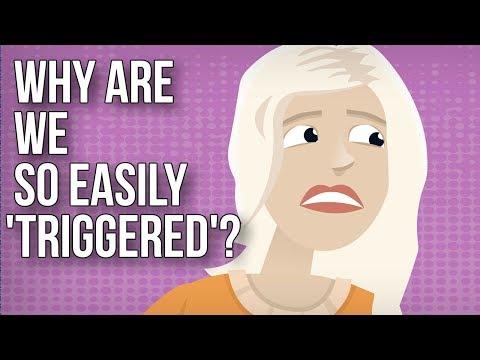
if we were totally sane we would respond
to the present only on its own terms we
would worry or be angered or give way to
anxiety only as much as the
circumstances actually before us
dictated but we are not of course most
of us quite sane as evidenced by the way
that we constantly respond with
disproportion to certain events in the
here and now we have tendencies to get
wildly more worried angry and anxious
than we really should if we were simply
following the facts in front of us what
causes us difficulty is that we are
wired to feel and respond according to
precedent rather than on the basis of a
dispassionate evaluation of the present
and in particular we follow emotional
tracks laid down in the distant past
when many of us were victims of deeply
unrepresentative and unusually painful
experiences from which we continue to
make panicky gloomy and unhelpful
extrapolations in other words we are to
use the inelegant but useful
contemporary term easily far too easily
triggered that is situations in the
present and licit from us with undue
haste responses formed by and frankly
better suited to a past whose details we
have forgotten and whose distinctiveness
we cannot now perceive a tricky but not
objectively existentially troubling
email will hence convinced us at once
that this is the end an item in the news
will plunge us immediately into
devastating guilt or boundless fury the
prospect of a party we have to go to or
a speech we need to give brings on
untouchable monumental terror the
triggering happens so fast there is no
chance to observe the process and see
the way in which we see our powers of
evaluation from present to past our
minds are simply flooded with panic we
lose our bearings the rational faculties
shut down and we are lost
perhaps for days in the caverns of our
minds
we get triggered because we don’t have a
direct link with objective reality each
of us approaches the outer world through
the prism of an inner world with a more
or less tenuous connection to it in this
inner world of ours lies a repository of
expectations formed through our unique
histories our internal working models
our best guesses of what the outer world
will be like how others will respond to
us what they will say if we complain and
how things might turn out if there were
to be a challenge crucially and this is
what we of course miss when we’ve been
triggered the inner world is not the
outer world
it contains generalizations and
extrapolations from a past that may be
far harder stranger and more dangerous
than the present psychologists have a
handy rule of thumb to alert us to the
disproportionate side of our responses
if we experience anxiety or anger above
a 5 out of 10 they tell us our response
is likely to be fueled not by the issue
before us but by a past that we’re
overlooking in other words we have to
believe contrary to our triggered
feelings that the issue won’t be what it
seems to be about the best way to free
ourselves from being so eagerly
triggered is to refuse to believe in
what most overwhelmingly and rapidly
frightens or angers us we must learn to
adopt a robust suspicion of our first
impulses it isn’t that there is nothing
scary or worrying in the outer world
whatsoever simply that our initial
responses are liable to be without
proportion or without calculation of
adults strength resilience
resourcefulness and options another way
to approach our panic and anxiety is to
remember that despite appearances we are
not a single person or unified AI we are
made up of an assemblage or a blend of
parts dating right back to our earliest
days in a way we can’t easily track
different events will engage with
different parts of us some of our most
troubled moments are when a difficulty
in the present isn’t handled by an adult
part
but by a part formed when we were say
six months or three years old we end up
so scared because the challenge of
public speaking or of a seduction or a
worry at work has unbeknownst to the
adult part of us been left in the hands
that are very scared toddler in the
circumstances it can help to ask
ourselves at points not what we are
afraid of but what a part of us is
worried about and to learn more
carefully to differentiate the parts in
question what might we tell a part of us
in order for it not to be so scared it
is a milestone of maturity when we start
to understand what triggers us and why
and take steps to mitigate the most self
harming of our responses whatever our
past seems to tell us perhaps there
won’t be a catastrophe perhaps we’re not
about to be killed or humiliated
unbearably perhaps we have adult
capacities for survival too much of our
past is inside us in a way we don’t
recognize or learn to make allowances
for we should dare to approach many of
our triggers like a starting pistol or a
fire alarm that we will from now on for
well-grounded reasons simply refuse to
listen to
our resilience cards are designed to
help us become tougher in the face of
adversity to learn more follow the link on screen now
Please follow and like us: