
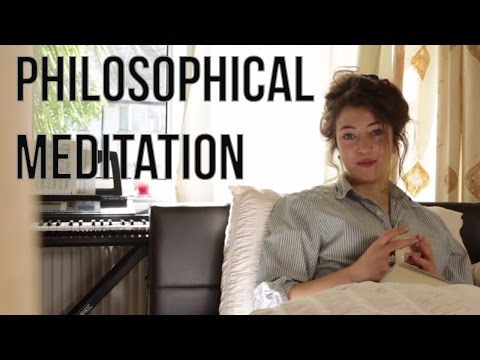
our minds give us trouble and one of the
leading ways that people deal with them
nowadays is through mindfulness or
meditation processes whereby we quieten
our thoughts empty our minds and focus
on just a few things at a time like the
rustle of leaves or the flow of water at
the school of life we want to put
forward an alternative or rather a
complementary idea we’ve devised
technique based not on Eastern thought
but on ideas that come down to us
through the Western philosophical
tradition and we’ve called it
philosophical meditation the basic idea
behind philosophical meditation comes
from the idea that a lot of the trouble
in our mind comes from thoughts that
haven’t been properly cleaned up or
ordered muddled or unfocused thoughts
are constantly swirling around our minds
worrying us on Julie because we don’t
understand their true nature and we
can’t grasp them properly sometimes we
feel the need to sort of head set or gas
on top of things but it’s not quite
clear how we might do this or it’s not
very much discussed this is what
philosophical meditation is designed for
it’s a tool and an occasion for clearing
up our minds the first priority is to
set aside a bit of time ideally about 20
minutes every couple of days you should
sit probably in bed either
early in the morning or late at night
with a pad of paper and you’re going to
ask yourself a set some very simple
questions firstly what am I currently
anxious about secondly who am I upset
with and why and thirdly
what am I currently excited or ambitious
about at first when asked to respond to
these rather large questions the mind
tends to be really inarticulate and a
bit scared generally something comes to
mind but you can’t quite tell what it is
it might be a word a mental image or a
place that doesn’t matter write it down
anyway and don’t worry too much about
its ultimate sense
relax entirely and don’t censor anything
so under what am i anxious about I’m
going to write down a few things and it
will probably be nonsense to anybody
else but that doesn’t matter I don’t
really understand what it means either
but the point is to get the inner censor
out of the way and just get something
down keep scouring the mind for stray
wisps of anxious thoughts wait quietly
and catch them like butterflies in a net
when you’ve got them all in begin the
second phase which is analysis you see
anxiety is a signal but a garbled and
unclear signal about what one part of
the brain perceives off as danger so
that’s why you need to take time to
interpret these anxious signals and to
do this you can ask yourself a series of
six simple questions to every one of
these anxious thoughts tell the story of
the coming anxious period in great
detail and say exactly what you imagine
might go wrong what would happen to you
if it did all go wrong reflect on this
how might you still be okay even if the
worst happened how would the person
you’d like to be ideally deal with this
situation what previous situations does
this remind you of what helped in the
past now time to move on to the second
part of the philosophical meditation the
bit where you ask Who am I upset with
and why the theory here is that we don’t
often allow ourselves to analyze the
hurts that we receive from other people
and this happens everyday from a
misplaced sense of stoicism and bravery
we pay for this dearly for undigested
hurts generate bitterness confusion and
misdirected aggression so take what
you’ve written and ask yourself the six
following questions retell yourself the
upsetting incident in great detail as if
you are retelling it to a very kind and
patient friend
what good part of yourself feels in
danger how might a nice person have
ended up doing this thing if they won’t
actively mean is there another
explanation for the hurt they’ve caused
you
what are you afraid might happen if this
were to continue and if you had to pin
down an incident in the past that this
somehow reminds you of what was that and
can you see a pattern if this had
happened to a friend how might you now
advise them
next comes ambition and excitement and
by this we mean a range of positive
emotions tremors of interest tentative
enthusiasms delights and so on all these
things that are just hovering on the
edge of consciousness and are extremely
calming to bring into focus there are
six questions here to describe your
excitement as if to a sympathetic
interested friend you need to change
your life in certain ways so what would
it be like to change your life in light
of this this excitement holds a clue to
what’s missing in your life what might
be missing if this thing could talk what
might it tell you if this thing could
try to change your life what changes
might it advise and if other parts of
your life were like this what might they
be like answering these questions starts
the vital work of decoding the jumbled
mess that’s usually clogging up our
minds and the longer we’ve gone without
doing one of these mental audits the
more there will be to go through
philosophical meditation doesn’t
magically solve our problems but it
hugely helps us by creating an occasion
where we can identify our thoughts and
put them into some kind of order fears
resentments and hopes become easier to
name we’re less scared of the contents
of our own minds and hence were easier
to live with and around if you want to
practice philosophical meditation more
frequently we’ve prepared a little guide to help you the link is below the screen
Please follow and like us: