
Morna Kea Hawaii in 1988 professor David
Jewett of the University of Hawaii’s
Institute for astronomy begins a
dedicated hunt for another object beyond
Neptune
despite harnessing the latest digital
technology the task of looking for a
tiny asteroid sized object at the far
reaches of the solar system is a
daunting one
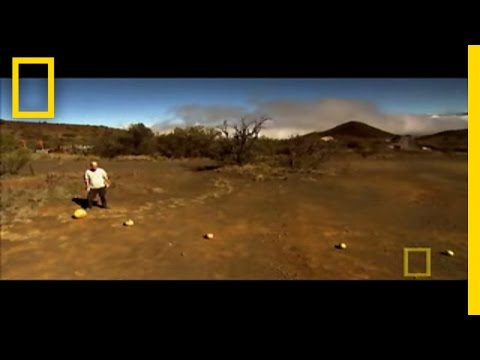
a bit like finding a grain of rice on a
mountainside as Jewett demonstrates to
give you an idea for the scale of the
Kuiper belt relative to the orbits of
the planets I’ve laid out the solar
system using various kinds of fruit and
vegetables so we have a ball to
represent the Sun next to the Sun which
is the center of the solar system we
have the rocky planets so we have to go
out to five astronomical units five a
use to find Jupiter the biggest thing in
the solar system except for the Sun then
we go out from Jupiter Saturn located at
NAU out from Saturn is Uranus at 20 au
Uranus is the first of the ice giant
planets and Uranus has a near twin it’s
called Neptune Neptune is over here at
38 you and then just beyond Neptune
comes the famous Pluto represented here
by a tasty macadamia nut and Pluto moves
in and out from the Sun but it’s roughly
located at 39 a you so we’ll put that
back where we find it copperbelt starts
roughly at the orbit of Neptune and goes
out to larger distances so we can
represent that by grains of rice from
this bag which I’ll drop on the ground
these are cotton belt objects falling in
space and here they go but in fact they
go very far out they go out in this
direction and in fact it goes out so far
that I can’t throw it far enough it goes
out to the hill in the distance far
beyond me but in 1988 all this is
speculation it’s just a theory there’s
no hard evidence of other objects in the
Kuiper belt Dave Jewett continues
believing there have to be more Kuiper
belt objects out there somewhere
for four years he toils in the thin air
of Morna Kia’s high altitude
observatories he has no idea how big or
bright any of the objects might be then
in late November 1992 he and his
colleague Jane loose bought a faint
moving dot in the sky it was a very very
definite object far above the noise far
above the threshold of uncertainty we’re
completely sure that we found the first
really slow moving thing in the solar
system since Pluto and its small just
140 miles across its diameter is just a
tenth of Pluto’s if we were able to find
one body in a tenth of a percent of the
sky which was the case then we knew
there must be something like a thousand
times more objects than we’d found
Jewett’s discovery has astounding
implications
now astronomers know there are
potentially thousands of icy bodies
escapees from early planetary formation
orbiting out beyond Neptune
and Pluto is just one of many perhaps
Pluto is not a planet after all
you
Jewett of the University of Hawaii’s
Institute for astronomy begins a
dedicated hunt for another object beyond
Neptune
despite harnessing the latest digital
technology the task of looking for a
tiny asteroid sized object at the far
reaches of the solar system is a
daunting one
a bit like finding a grain of rice on a
mountainside as Jewett demonstrates to
give you an idea for the scale of the
Kuiper belt relative to the orbits of
the planets I’ve laid out the solar
system using various kinds of fruit and
vegetables so we have a ball to
represent the Sun next to the Sun which
is the center of the solar system we
have the rocky planets so we have to go
out to five astronomical units five a
use to find Jupiter the biggest thing in
the solar system except for the Sun then
we go out from Jupiter Saturn located at
NAU out from Saturn is Uranus at 20 au
Uranus is the first of the ice giant
planets and Uranus has a near twin it’s
called Neptune Neptune is over here at
38 you and then just beyond Neptune
comes the famous Pluto represented here
by a tasty macadamia nut and Pluto moves
in and out from the Sun but it’s roughly
located at 39 a you so we’ll put that
back where we find it copperbelt starts
roughly at the orbit of Neptune and goes
out to larger distances so we can
represent that by grains of rice from
this bag which I’ll drop on the ground
these are cotton belt objects falling in
space and here they go but in fact they
go very far out they go out in this
direction and in fact it goes out so far
that I can’t throw it far enough it goes
out to the hill in the distance far
beyond me but in 1988 all this is
speculation it’s just a theory there’s
no hard evidence of other objects in the
Kuiper belt Dave Jewett continues
believing there have to be more Kuiper
belt objects out there somewhere
for four years he toils in the thin air
of Morna Kia’s high altitude
observatories he has no idea how big or
bright any of the objects might be then
in late November 1992 he and his
colleague Jane loose bought a faint
moving dot in the sky it was a very very
definite object far above the noise far
above the threshold of uncertainty we’re
completely sure that we found the first
really slow moving thing in the solar
system since Pluto and its small just
140 miles across its diameter is just a
tenth of Pluto’s if we were able to find
one body in a tenth of a percent of the
sky which was the case then we knew
there must be something like a thousand
times more objects than we’d found
Jewett’s discovery has astounding
implications
now astronomers know there are
potentially thousands of icy bodies
escapees from early planetary formation
orbiting out beyond Neptune
and Pluto is just one of many perhaps
Pluto is not a planet after all
you
Please follow and like us: