
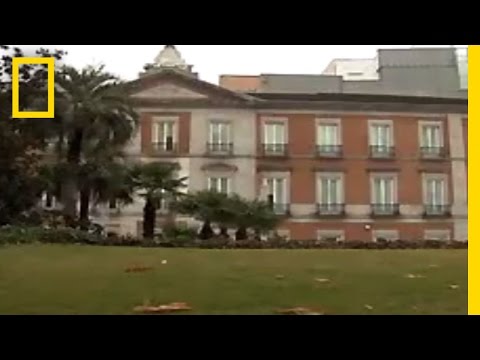
in a museum filled with treasures a
masterpiece stands out a prized work by
the French impressionist Camille
Pissarro a rainy afternoon in Paris
years ago it hung in a family living
room until the Nazis sent an envoy and
removed it it’s my painting there’s no
question about it
Claude kassir was born in 1921 into a
prominent Jewish family in Germany the
painting once belonged to his
grandmother my mother had died and my
grandmother was like a substitute mother
for me and she lived in an apartment on
the corner from where we were living him
in above the couch was this painting
this Pissarro painting and that is part
of my life that’s how I was brought up
the cáceres lived a life of privilege
until the Nazis came to power and
persecution of Jews in Germany
intensified fearing for their safety
Claude’s grandmother and her husband
Otto noid Bauer petitioned the German
government for an exit visa in response
the Nazis sent an appraiser to evaluate
their property he came to my
grandmother’s apartment in Munich and he
said my grandparents could leave Germany
but they would not allow to take the
Pissarro painting with him they made it
very very clear you mean this was a lot
not a matter of choice that if my
grandparents wouldn’t agree to this
transaction he would end up in daha one
of the worst concentration camps near
Munich when World War two ended the
grotesque realities of Nazi war crimes
were exposed
and proof of systematic plunder and
cultural artifacts was revealed hundreds
of thousands of paintings sculptures and
jewels had been taken from churches
museums and private homes across the
continent
Claude kassir and his grandmother both
escaped but their family heirloom remain
missing until more than 60 years later
Claude saw a photo of the painting
hanging in a museum in Spain I could
hardly believe it I could hardly believe
it there was such a coincidence in such
America the painting had changed hands
at least five times in three countries
over a 50-year period before it was
purchased by one of the world’s
wealthiest art collectors Baron Heinrich
von thyssen-bornemisza in 1993 the Baron
sold his collection in a joint
arrangement with the kingdom of Spain
and a foundation museum that now bears
his name for Claude Kassir
seeing the painting that day was a
glimpse into a boyhood long past where
the painting was my grandmother’s love
how she sported me how she fed me how
she went on excursions with me how she
helped educate me all these interrelated
kassir petitioned the museum to return
the painting and when that didn’t work
he decided to sue the museum and its
host country the kingdom of Spain for
the return of what he believes is stolen
property representatives of the Spanish
government and officials at the
thyssen-bornemisza museum declined
interview requests for this story in a
written statement the museum asserts
that it’s the legitimate owner of the
work and that
mr. casseras request has no legal
foundation under Spanish law further the
museum contends that the casera family
was duly compensated for their loss by
the German government in 1958 Claude
accepts that his family received $13,000
but even that he had to split with
another claimant for some crazy reason
which I never understood we had to give
part of the money to the guy who stole
the painting why I don’t understand it
today the paintings value is estimated
at 20 million dollars but Claude insists
there’s much more to this case than
money I would be a fool to say that
money is of no concern but why should
they have something this for a 5 or 10
or 15 20 40 50 or 60 million when it
doesn’t belong to them and it’s a simple
event any legal experts expect kassir
will face considerable challenges in
court generally the more an object
changes hands the more difficult the
case would be you can keep stolen goods
the defendant museum puts the plaintiffs
or the prove prove to me that you own
the object proved to me that of the
stolen case has been tied up on
jurisdictional issues that means prove
that you have the right to call me from
Spain into court in the United States
that that’s just and fair and equitable
you know what I would say to them if
there’s any question of in there minding
illegally there should be no question in
their mind morally the point at which
law ends and morality begins is often
very hard to find the museum has to make
a legal moral and ethical judgment about
what it should do I never give up and we
never gonna give up above the pizarra
cases like the ownership of this
impressionist masterpiece of forcing the
legal community to reevaluate the
intersection of property law and
morality a single artwork has traveled
through the years from a living room in
Nazi Germany over oceans and back it’s a
journey that represents both the best
and worst of our humanity as society
wrestles with the aftermath of war
you
masterpiece stands out a prized work by
the French impressionist Camille
Pissarro a rainy afternoon in Paris
years ago it hung in a family living
room until the Nazis sent an envoy and
removed it it’s my painting there’s no
question about it
Claude kassir was born in 1921 into a
prominent Jewish family in Germany the
painting once belonged to his
grandmother my mother had died and my
grandmother was like a substitute mother
for me and she lived in an apartment on
the corner from where we were living him
in above the couch was this painting
this Pissarro painting and that is part
of my life that’s how I was brought up
the cáceres lived a life of privilege
until the Nazis came to power and
persecution of Jews in Germany
intensified fearing for their safety
Claude’s grandmother and her husband
Otto noid Bauer petitioned the German
government for an exit visa in response
the Nazis sent an appraiser to evaluate
their property he came to my
grandmother’s apartment in Munich and he
said my grandparents could leave Germany
but they would not allow to take the
Pissarro painting with him they made it
very very clear you mean this was a lot
not a matter of choice that if my
grandparents wouldn’t agree to this
transaction he would end up in daha one
of the worst concentration camps near
Munich when World War two ended the
grotesque realities of Nazi war crimes
were exposed
and proof of systematic plunder and
cultural artifacts was revealed hundreds
of thousands of paintings sculptures and
jewels had been taken from churches
museums and private homes across the
continent
Claude kassir and his grandmother both
escaped but their family heirloom remain
missing until more than 60 years later
Claude saw a photo of the painting
hanging in a museum in Spain I could
hardly believe it I could hardly believe
it there was such a coincidence in such
America the painting had changed hands
at least five times in three countries
over a 50-year period before it was
purchased by one of the world’s
wealthiest art collectors Baron Heinrich
von thyssen-bornemisza in 1993 the Baron
sold his collection in a joint
arrangement with the kingdom of Spain
and a foundation museum that now bears
his name for Claude Kassir
seeing the painting that day was a
glimpse into a boyhood long past where
the painting was my grandmother’s love
how she sported me how she fed me how
she went on excursions with me how she
helped educate me all these interrelated
kassir petitioned the museum to return
the painting and when that didn’t work
he decided to sue the museum and its
host country the kingdom of Spain for
the return of what he believes is stolen
property representatives of the Spanish
government and officials at the
thyssen-bornemisza museum declined
interview requests for this story in a
written statement the museum asserts
that it’s the legitimate owner of the
work and that
mr. casseras request has no legal
foundation under Spanish law further the
museum contends that the casera family
was duly compensated for their loss by
the German government in 1958 Claude
accepts that his family received $13,000
but even that he had to split with
another claimant for some crazy reason
which I never understood we had to give
part of the money to the guy who stole
the painting why I don’t understand it
today the paintings value is estimated
at 20 million dollars but Claude insists
there’s much more to this case than
money I would be a fool to say that
money is of no concern but why should
they have something this for a 5 or 10
or 15 20 40 50 or 60 million when it
doesn’t belong to them and it’s a simple
event any legal experts expect kassir
will face considerable challenges in
court generally the more an object
changes hands the more difficult the
case would be you can keep stolen goods
the defendant museum puts the plaintiffs
or the prove prove to me that you own
the object proved to me that of the
stolen case has been tied up on
jurisdictional issues that means prove
that you have the right to call me from
Spain into court in the United States
that that’s just and fair and equitable
you know what I would say to them if
there’s any question of in there minding
illegally there should be no question in
their mind morally the point at which
law ends and morality begins is often
very hard to find the museum has to make
a legal moral and ethical judgment about
what it should do I never give up and we
never gonna give up above the pizarra
cases like the ownership of this
impressionist masterpiece of forcing the
legal community to reevaluate the
intersection of property law and
morality a single artwork has traveled
through the years from a living room in
Nazi Germany over oceans and back it’s a
journey that represents both the best
and worst of our humanity as society
wrestles with the aftermath of war
you
Please follow and like us: