
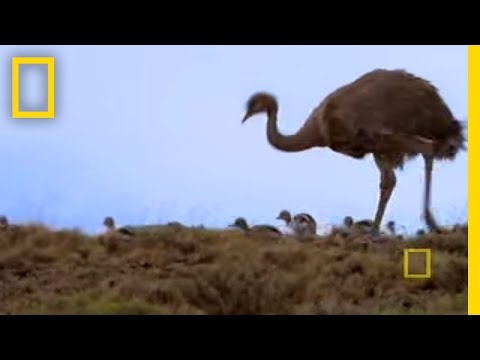
at first glance it appears a mother
ostrich is watching over her chicks in
the savannahs of Africa but the location
is actually the scrublands of the Andes
Mountains at the southern tip of South
America the birds are the ostriches
distant cousins called Ria’s and the
parent is not a diligent mother but a
doting father
the Ria’s breeding cycle varies greatly
from most other birds it’s the male’s
that stake out their territories and
scratch out a nest
then they encourage the females to lay
their eggs near the nest they’ve made
from that point on child-raising is the
domain of the expectant father who
initially incubates the eggs then keeps
a watchful eye on the chicks for about
six months until they are old enough to
forage on their own
so protective is the father that if one
of the chicks mothers were to approach
too closely he will drive her away from
her own child but once the chicks are
mature his protective instincts fade and
they will join with other flocks these
lesser Ria’s spend most of their day
foraging looking for grasses seeds
insects and even small rodents and
reptiles for protection they often
congregate with other herd animals like
these guanaco just as their African
cousins are sometimes found with
antelope and zebras the principle is the
same
the more eyes ears and noses there are
the easier it is to sense a predator and
the Ria’s keen eyesight complements the
one acos excellent sense of smell
when predators approach lesser Ria’s are
capable of quick bursts of speed and can
run almost 40 miles an hour but adults
are too large for most predators on
average standing three feet tall and
weighing 40 pounds it is the chicks who
are most vulnerable they are at risk
from small predators like foxes and
Raptors all the more reason for this
father to be so overprotective of is
young
ostrich is watching over her chicks in
the savannahs of Africa but the location
is actually the scrublands of the Andes
Mountains at the southern tip of South
America the birds are the ostriches
distant cousins called Ria’s and the
parent is not a diligent mother but a
doting father
the Ria’s breeding cycle varies greatly
from most other birds it’s the male’s
that stake out their territories and
scratch out a nest
then they encourage the females to lay
their eggs near the nest they’ve made
from that point on child-raising is the
domain of the expectant father who
initially incubates the eggs then keeps
a watchful eye on the chicks for about
six months until they are old enough to
forage on their own
so protective is the father that if one
of the chicks mothers were to approach
too closely he will drive her away from
her own child but once the chicks are
mature his protective instincts fade and
they will join with other flocks these
lesser Ria’s spend most of their day
foraging looking for grasses seeds
insects and even small rodents and
reptiles for protection they often
congregate with other herd animals like
these guanaco just as their African
cousins are sometimes found with
antelope and zebras the principle is the
same
the more eyes ears and noses there are
the easier it is to sense a predator and
the Ria’s keen eyesight complements the
one acos excellent sense of smell
when predators approach lesser Ria’s are
capable of quick bursts of speed and can
run almost 40 miles an hour but adults
are too large for most predators on
average standing three feet tall and
weighing 40 pounds it is the chicks who
are most vulnerable they are at risk
from small predators like foxes and
Raptors all the more reason for this
father to be so overprotective of is
young
Please follow and like us: