
Leonardo is really a bundle of
contradictions
he was an illegitimate child born in
1452 although we know him for being so
prolific producing so much
he thought that he produced so little
that in his deathbed he turned to an
assistant and he asked did anything get
done
he was good in virtually everything he
took up and he’s known as a universal
genius I started learning about Leonardo
when I was in high school school called
st. Andrews in Middletown Delaware well
when I was in the fifth former 11th
grade the father of a student an
engineer gave a talk about the divine
proportion and the golden ratio and for
the first time I saw how mathematics in
art could in fact be cobbled together I
had always had a passion for mathematics
and I did art in my youth when my father
was assigned as a military attache to
London from Turkey
I remember we lived in the house of Lord
Curzon and I went around beautifying
these paintings I remember that the one
thing that Leonardo used to say was that
the eyes were this the windows to the
soul
these paintings had no soul they were
produced in the 18th and 19th centuries
but the pupils were all closed I went
around opening the pupils with a cork
opener and no one really noticed my
improvement until a few months later
when the devil came to visit my father
dressed as a diplomat he put out his
hand and without stopping he raised his
hand and he said there are holes in
those eyes do you have a son
so he had gotten to the culprit right
from the beginning anyway over the years
I did produce art and I gave lectures on
cruises frequently and in the late 80s a
passenger on the silver seas started
applying steady but gentle pressure to
publish how we in order to this art how
mathematics and science came in handy
I can speak about 1% of Leonardo and it
will be interesting and it could be any
1% if Keith wants Lee my co-author
speaks fast Leonardo I’m sure it’d be
another 1% so this is 1% from the point
of view of the scientists rather than in
the artist now let me tell you about the
other Leonardo the other Leonardo lived
300 years before Leonardo da Vinci his
name was Leonardo Fibonacci de Pisa
Nardo Fibonacci de Pisa he was probably
born around 1162 1170 at the same time
as in Pisa when the Leaning Tower was
first being erected
well let’s Leonardo Fibonacci de Pisa in
1202 came back to us to a city of Pisa
and wrote a book called the liberal a
bocce the book of the abacus the year
was 1202 it sounds very much like the
name of a late pianist libera bocce
in the book he starts out by proposing a
couple of numbers
he says read this number and then anyone
read that number
IDH how about this number will suffer
also 98 L is 50 so 10 less than the next
50 and you can write the same number in
different ways 1999 you can write 4 or 5
different ways he proposed using the
Arabic system making 98 with two symbols
and he introduced in his book in the
first chapter the symbols some borrowed
from the Arabs and some that he made up
one to two horizontal lines I sort of
lightly connected three horizontal lines
slightly connected one two three four
one two three four five one two three
four five six number of straight lines
reveal the value of the symbol seven
takes some imagination but seven in
medieval Europe when he wrote his book
was like this one two three four five
six seven and of course Europeans still
across there seven eight one two three
four five six seven eight nine she
borrowed from the Arabs and the zero
which he bought from the Hindus it was
the Hindus who had originally come up
with a decimal system and then the zero
invented by the Hindus by a
mathematician named Arya pata around 500
BC it turns out to be an all important
component for modern mathematics you
couldn’t we couldn’t have done calculus
Newton could not have invented calculus
without the zero you wouldn’t have had
limits
then he does in the book of 13 chapters
algebra problems and finally in the last
chapter he proposes a problem of rabbits
rabbits left in an enclosure a room like
this where they’re left to multiply
except there are some definite rules for
example they must one pair of rabbits
start the entire cycle then the rabbits
have to mature for two months before
they can give rise to new rabbits and
the new rabbits have to mature for two
months before they can give rise new
curette to new rabbits so now we start
out the cycle in January with one pair
of rabbits in the second month February
will give them an ear which means there
are one month mature now but they can’t
have offspring yet by March they have a
second ear and they reproduce by April
the fourth month here’s the original
pair one new pair this para gains an ear
in May here’s the original pair one new
pair this pair gains an ear this pair
gains a second ear and reproduce this
see how it works it’s all in the ears in
June there’s the original pair one new
pair this pair of gains an ear this para
gains a second ear and immediately
reproduces this pair is already mature
they reproduce this pair gains an ear
now as he looked at this cycle and these
numbers he wondered whether there was a
general way to ascertain how many
rabbits there would be at the end of the
year without drawing all these ears and
he noticed squiggly that the first month
was one the second month was one next
month it was two next month it was three
then five and then a
anyone want to guess the next one
thirteen next one twenty-one next
thirty-four next fifty five I told you
this was the smartest room in the entire
city five then eighty nine then 144 233
377 what’s the algorithm how am I doing
this
add the last two terms to get the next
six ten nine eighty seven three fifteen
ninety seven and so forth I’ll do one
more 2584 so first months January
February March April May June July
August September October November
December 144 pairs by the end of the
year January February March April May
June 18 months into the cycle there
should be twenty-five hundred and eighty
four pairs of rabbits this is called the
Fibonacci series as you add these
numbers it’s an infinite sequence goes
on like this what he didn’t realize it
was discovered only the 19th century was
that these are nature’s numbers if you
look at at a flower if you look at let
me look at a pinecone first here’s a
pine cone pine cone has helical a
pattern of scales that go up this way
then there’ll be a pattern that goes
this way you look at the bottom and the
scales will radiate clockwise like this
but then as you look at the sunflower
the pine cone you’ll find that there are
spirals in the other direction and in
all pine cones
it’ll be 13 in one direction 8 in the
other it can’t be anything else this is
the Filat axis of the pine cone if it
were a daisy it would be 21 and 30 also
true for the chrysanthemum in the case
of the sunflower sunflower looks like
this
there are radial patterns that go this
way and radial patterns that go in the
other direction this way you count them
and there they have to be 89 in one
direction 55 in the other in some some
some some flowers to actually find 144
and 89 in every instance is a pair a
sequential pair of Fibonacci’s numbers
leonardo knew this Leonardo knew about
the spiral he used it in drawing embryo
he used it in drawing hurricanes and and
locks of the hair he always made this is
signature Leonardo if you see
logarithmic spirals and the curls it’s
Leonardo okay I’ll go to my slides now
this is Java nachi we have no idea what
he really looked like but this was
carved in 1978 it’s a statue on the
banks of the Arno and Pisa there you can
see the spirals in the Daisy and in the
pine cone if I draw or paint a tree I
start from the bottom at one point I
divided up into two large branches after
a while one of these divides up again
but the other doesn’t but then after a
while this divides up and one of these
two branch but this one does not after a
while this will branch this will not
this will branch and one of these two
will branch if the light is falling from
this side as a right-hander I would
shade this way if I were left-handed
like Leonardo I would shade this way if
the light is coming from this side then
obviously it will be darker on the left
side you can make the bark darker like
this but what does this have to do with
to Bonacci or do you see at any given
height 1 2 3 1 2 3 4 5 1 2 3 4 5 6 7 8
if your Leonardo you do that if your any
other artist you don’t count if a tree
looks right it’s right it’s fine okay
I’ll go ahead and turn this off
there’s the cork tree this was the first
x-ray picture taken by Wilhelm Rankin
who invented of course the x-ray machine
he discovered x-rays and in this case
it’s a hapless hunter who’s been wounded
by birdshot in this case the
significance is if you measure the
various joints this length divided by
this length is 1.618
this length divided by this is one point
six point eight this divided by this is
one point six one eight nature knows how
to divide how cells replicate and in the
19th century Gustav Fechner cut
rectangles in different proportions and
handed them out to people to select
their favorites this would be a square
this would be a rectangle 20 percent
longer than it is wide the one that one
with 35% is one point six two and here’s
the histogram representing that
so it’s clear that we do have this
propensity for this ratio a three by
five card looks better than a three by
four for example here’s the Parthenon
this is how the distortion would have
looked it would it look like it’s
sagging so they built it with a convex
curvature like this I took this picture
very long time ago
there used to be a Dean my friend Roy
Weinstock would know this thing but he
was there with two other colleagues and
he wanted to pick up a piece of the
Parthenon he bent over to tie his
shoelaces and when he stood up he was
ashen white as friends asked him what
was wrong was he sick and he said no I
stole a piece of the Parthenon I could
wind up in prison just as that they were
leaving the Acropolis they saw a truck
appear and to dump tons of stones for
the next day now this is a sketch that I
did at the National Cathedral and I used
the inverse of that that golden
rectangle with a hot spot the golden
spot is right right down there with my
Macintosh I was able to draw these
polyhedra it’s called graph theory where
you do this you write equations for
different polyhedra and there are
exactly these five regular polyhedra in
this case these are irregular polyhedra
the truncated icosahedron is here the
truncated dodecahedron the stellated
icosahedron right there is is the
dodecahedron so you probably recognize
this painting from the National Gallery
it’s Salvador Dali’s Last Supper to the
ancient Greeks
this fifth polyhedron this one was the
shape of the universe the dodecahedron
the other four with
shapes of atoms they believe there were
four atoms earth fire water and air so
this is all done with a Macintosh
this is Leonardo without a Macintosh he
Illustrated a book the Divina purports
he owned it with for his good friend
Luca Pacioli in the years that he lived
in Milan
there is Leonardo in a self-portrait but
we’re not exactly certain we know it’s
by Leonardo’s hand but we’re not certain
it’s him
most Leonardo’s scholars agree that it
is him but David Allen Brown at the
National Gallery who’s a renaissance
scholar I thinks it’s from the wrong
period Leonardo in his deathbed in
Amboise France in the Loire Valley
attended to by Francis the first his
royal patron of the last three years he
lived in France the last three years of
his life as one reason the French the
Louvre owns more than half Leonardo’s
output this is Amboise the Chateau dump
was there’s a church in the back where
he’s buried is thought this is the
church st. soother and his beloved Arno
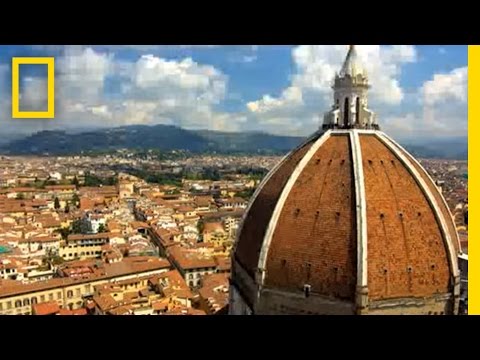
Valley and of course Florence where he
lived from the time he was about 15 to
the time he was close to 30 about 27
when Leonardo was 19
working for Andrea del Verrocchio he
helped put this 8-foot copper sphere on
top using the same voice that
Brunelleschi had used the generation
earlier this is the drawing the cartoon
for school of athens this great painting
by Raphael Raphael’s masterpiece since
in the Vatican in the foreground is
Michelangelo sitting in for Heraclitus a
very difficult philosopher from the
ancient days
it was a good choice in this case
because Michelangelo was a very
difficult man
but Michelangelo had seen the painting
and he wasn’t in it and when he admired
it so much
Raphael decided to put him in there you
see in the earlier cartoon he’s not
there others in the painting this is
Pythagoras over here is Euclid although
it could be Archimedes Leonardo as Plato
and this is Aristotle we don’t know who
the model is the model for this is
Bramante and Raphael himself is standing
right there is sort of a Alfred
Hitchcock moment this statue visited
Washington I guess about four years ago
anyone see it
yes it’s under it
rocio’s depiction of David just thought
that the model for this is Leonardo
himself as a teenager Verrocchio’s
painting the baptism of Christ in which
he asked his assistants to paint the
angels Botticelli or de kratie painted
this angel and Leonardo painted this
angel if you go to the aficio from the
Botticelli room to the Leonardo room and
this is the painting facing you
well when baroque you saw the angel he
gave up the brush for good and didn’t do
any more painting after that but it’s a
genius meeting a trend a transformative
genius happened when Isaac Newton I came
back from 16 months in his village with
a list of his mental inventions his
theories and his professor Isaac Barrow
immediately he had discovered calculus
formulated calculus he had discovered
the three laws of motion the universal
law of gravitation is endless yet
explained how a telescope works his
professor Isaac Barrow also retired
immediately and became a vicar a priest
and Newton became the location professor
Leonardo had a penchant for as I
mentioned for the grotesques along with
the sublimely beautiful in this case is
called a man being teased by gypsies and
the facial features with the golden
rectangle for 17 years or so he was in
the in the higher of the sports that
Duke Sforza in Milan it was one of his
most productive periods that’s what he
was doing engineering military
engineering and producing a few pieces
of art including the Last Supper which
was finished in 1498 now in here you can
see his drawings at the top for the side
wheeler and I bought a couple of ties
along I don’t know if you can make these
out but one has a positive slope the
other has a negative slope this one has
the positive slope that’s the way a
right-hander would sketch would shade
this is the way the left-hander was
would sketch all English and European
ties have positive slope
all-american striped eyes have negative
slope I don’t know where the convention
comes from but it’s there’s never a
violation of this rule but the negative
slope the American tie this is the way
the left-hander Leonardo would have
shaded so that proves he really was
American after all
to me his drawings his mechanical
drawings uh this particular exploded
gear diagram is incredible it’s three or
four hundred years before anyone else
came up with exploded views of machine
parts heat transmission this turns out
to be it was always called Leonardo’s
cart the powered cart but it turns out
to be robotics he had invented he had
started the field of robotics
that’s an odometer this is a robotic
Knight this is a mercedes-benz
3000 dollar bike these are Leonardo’s
drawings left-handed shading for chain
and sprockets and is designed for a
bicycle and there is a model a replica
of the bicycle more than anything else
he wanted to master flight he wanted
humans to achieve flight he said
whatever the birds can do man should
also be able to do so he designed
various ornithopters these flapping wing
devices you can imagine his assistants
coming to work and being told they were
going to test fly then he decided maybe
a helicopter would work better and
Sikorsky early in the 20th century
invented the helicopter inspired he said
by having seen Leonardo’s drawing of the
aerial screw in case something there was
a mishap he invented the parachute
there’s the drawing and the specs were
given below all through the 20th century
that people have seen this drawing they
would say it’s amazing
such prescience except they said it
probably would not work in that design
in 2000 here’s someone in South Africa
coming down with whee
whose parachute it works his great
patron Lorenzo the Magnificent and his
brother Giuliano de Medici Giuliano was
assassinated in the cathedral and
Lorenzo barely escaped but within a few
weeks all the assassins were rounded up
the ringleader of the assassins had fled
all the way to to Constantinople
actually it was already Istanbul by then
this was 1478 Leonardo would have been
26 he saw the man hanging and
immediately did the sketch and even like
a photojournalist explain what the man
was wearing he said he’s wearing Turkish
clothes by 1498 when he was in Milan the
notorious southerner Ola of course had
upended the Medici in Florence Leonardo
was living in Milan after two or three
years of truly a cool rule the Pope
realized it wasn’t that there was he’s
seen as an early Protestant revolution
and he was denounced by the Pope he was
burned at the stake and in Ferrara where
he was born there’s a statue of him now
and certainly if Leonardo had been
influenced then he would have sketched
this a student of mine sent this to me
once it says I saved some money on the
footings but don’t worry no one will
ever notice well two people who noticed
were Leonardo and gal Leo Leonardo did
some experiments dropping objects from
the side and there’s no evidence that he
did this experiment in Pisa I’m not sure
you ever went to Pisa but this is a good
model to to explain the phenomena he
found that an equal second periods of
time second units that an object would
descend one
two three four five units of distance
sequential seconds
Galileo 110 years later found the
distances to be one three five seven
these are both arithmetic series when
you add these arithmetic series the sum
is a quadratic what this means is the
acceleration is constant and that’s what
Galileo is giving credit for having
discovered the law of freefall that
objects fall with constant acceleration
independent of their weights Leonardo
had discovered that but he hadn’t
written it here is Galileo also
Aristotelian physics physics being
taught all through the 17th century had
the trajectory of projectiles to be like
this
Galileo discovered in 1609 with his
experiments that there were parts of
parabolas that the trajectories were
parabolic Leonardo 120 years earlier had
already drawn this picture of parabolic
trajectories the trouble with Leonardo
is he didn’t publish then in the hands
of Isaac Newton another 160 years later
the parabolic trajectories became
elliptical trajectories this is the
frontispiece of Isaac Newton’s great
book the most important book in the
sciences here is Galileo’s telescope
1609 here is Isaac Newton’s reflector
1668
here is the hubble reflector 1986 and
here is Leonardo’s reflector 1500 this
is the level of anatomical drawings that
existed in Leonardo’s day Bernardo did
his own anatomical drawings and in this
case his writing was always from right
to left he always wrote backwards it was
more practical he was left-handed and if
he wrote to the right the the quill
would get stuck in the
/ so he wrote a mirror script and you
need to put a mirror right next to it to
make out the text but these the detail
of these vital organs in the human here
is the heart and lungs
the cardiovascular system as detailed
drawing notes all written beautifully
from right to left his master Verrocchio
had told the pupils his apprentices to
learn the body from the inside out he
would have had no idea to what level
Leonardo would go to learn the body from
the inside out in this case the old man
here is thought to be one fellow he met
when he visited a hospital in in
Florence man was very old and Leonardo
asked him he sat with him and held his
hand and asked how old he was and the
man said I don’t know but I’m very old
Leonardo said what is very old and he
said I don’t know what my grandson is 58
in order estimated man must been over a
hundred and with a smile on his face man
passed away leonardo wrote I quickly did
a anatomy of him well he wanted to find
out how anyone could die such a happy
death then a few weeks later he did an
Anatomy or post-mortem on a child and he
wrote the difference he said in the case
of the child the blood vessels leading
to the heart were supple and clear in
the case of the old man they were
occluded or clogged and brittle he’s
describing atherosclerosis 500 years ago
was first identified in modern times by
at the university of vienna around the
1890s and the person who revolutionized
medicine Berzelius of course in 1543 24
years after Leonardo’s passing hired a
Flemish artist to draw a human body
during dissections
this is Vesalius at 29
that’s when the scientific revolution
starts with Copernicus’s book in 1543
and with Vesalius his book Leonardo’s
drawings of the heart the human heart
recently it was it came to the news a
couple of years ago that a well-known
surgeon cardiac surgeon in Cambridge at
Cambridge University was doing mitral
valve repairs looking at Leonardo’s
drawings and his descriptions and this
turns out to be revolutionary medicine
mitral valve repair using these five
hundred year old descriptions that
Leonardo gave or maybe the modus
operandi that he taught us my son who’s
a Cardiacs
radiologists gave me that drawing I
could rotate the heart and get just the
right angle as a counterpoint to
Leonardo’s drawings of the human heart
this is the way you would have seen his
handwriting pretty hard to read this is
called the da vinci font you can flip it
back and forth like this fact in the new
book Leonardo’s universe all the
quotations are with Leonardo’s font he’s
talking about evolution
this is 350 years before Darwin there is
a legend that around 1480 the the
conqueror of constantinople mammoths ii
invited Leonardo to Turkey to
Constantinople Leonardo had just taken a
job in Milan and he was very happy with
the job in Milan he didn’t go but
there’s no real proof of this 20 years
later
Leonardo was out of a job this forces
were ran out run out by a French
and Leonardo applied to the Sultan of
Turkey
this letter ironic it’s written from
right to left
in the way that old Turkish used to be
written but following Convention
correctly he talks about building a
bridge over the Golden Horn Golden Horn
is an Istanbul it said unless about 7
miles or 10 kilometers long from the
Bosphorus and he says I understand
you’re looking for an architect or
engineer to build this bridge and I
happen to be the architect who can do
this unhappily the Sultan the son of the
conqueror was not a visionary and he
didn’t hire Leonardo a couple of hundred
years later a bridge was built it
probably survived for ten or fifteen
years here’s the bridge over the Golden
Horn
there is a fire tower in the back and
this is the famous mosque the selamanya
but this is the Golden Horn it’s about
two hundred forty meters or seven
hundred and ninety feet across I sat at
the top of the tower and looking at this
mosque I sketched it here is two point
perspective Leonardo had invented two
point perspective one point perspective
was known by Brunelleschi but this is
two point perspective where these
parallel lines converge at two vanishing
points and in this sketch the Golden
Horn or hullick would be right here for
500 years
Leonardo’s plans lay they were wasted
these are Leonardo’s designs for the
bridge and finally in Norway just
outside Oslo the bridge was built this
is Leonardo’s design and the Norwegian
artist who spearheaded this project
Beveren son would like to do it
in Istanbul me this is in the Golden
Horn and this is what the bridge would
look like now I should have shown you I
should have talked about this when I was
first sketching but in 1998 Christopher
Tyler an Englishman a psychologist
living in San Francisco discovered the
centerline principle in all great
portraits a line that divides the
painting into a vertical line passes
through an eye here is of course Mona
Lisa here’s a Rembrandt self-portrait
it’s in the National Gallery and here’s
the Picasso the portrait of Dora Maar if
Picasso had known this principle he
would have put the eye somewhere around
here this is in in Leningrad at Saint
Patsy Armitage there is a the portrait
of the old rabbi by Rembrandt who seems
to have more life than four haggard
tourists in the front right through the
eye right through the eye as my son
right through the eye go home and look
at your pictures photographs that you’ve
taken and see if you haven’t focused
that way in this picture in this
painting by
a Jamie Wyeth line doesn’t go through
the center of the portrait central would
be somewhere around here but it turns
out this is one part two 0.618 the
golden ratio
Jamie Wyeth wrote a little blurb for the
back of math and the Mona Lisa
it was fascinated he said by chapter 8
where I talked about this principle now
one other principle it turns out we have
a propensity for left cheeks over right
cheeks when we pose for portraits there
are more left cheeks than right cheeks a
young Australian psychologist decided to
put this to the test to find out whether
it was the subject deciding or whether
it was the artists eye
which way to have the subject turn so he
said he took a group of 400 which would
be just about the size of this audience
and he he said we’re going to do a
portrait of you with a camera
photographic portrait then he escorted
how to half of them out of the room and
he told the half that remained that the
portrait was going to hang in the house
of their mothers their boyfriends their
girlfriends but a loved one and
immediately it would be the left cheek
that became prominent the person would
face this way then the second group was
brought into the room and the first
group left they were told that the
painting was going to hang next to
Albert Einstein a certified genius
immediately was the right cheek in
something like 78 percent of the time
and the question is why do we behave
like this and it was exactly the same
number for men and women and the
psychologists had a very interesting
interpretation we we do art we are
emotional we emote on the right bright
on the right brain which controls the
left cheek we do mathematics right here
above the left ear and that of course
controls the right cheek so if we want
to hang next to Albert Einstein we start
putting out our intelligent cheek
controlled by the left left brain in
this case though these are all
Rembrandt’s now Leonardo painted all of
a dozen paintings
Rembrandt painted himself ninety seven
times this is a sampling of of six
paintings and they’re all six to one
here is five to one but six to one with
right cheeks why does he want to be
intelligent looking rather than
emotional or cute looking endearing
looking any ideas any portrait artists
here we’re looking at a mirror it’s
reversed
this is his endearing sight these were
all not his right cheek but his left
cheek in the portraits
okay Leonardo’s virgin of the rocks– he
painted two of these is his partners the
pretty brothers helped him and probably
painted most of the second version the
one in England but this one is in the
Louvre it’s one of the most beautiful
paintings in the world certainly they
are organized by the pyramid
Leonardo invented this pyramid form for
for organizing his quartet and then it
was a plot this is the English version
of the virgin of the rocks– it’s
slightly different but just a couple of
years ago I think it was in 2006 that an
infrared refract ography revealed that
Leonardo had another design in mind I
presumably his patrons you can see the
red here it’s been reproduced over here
he had an entirely different design of
mine rather than using the same form
that he had used for virgin of the
rocks– in the Louvre version there are
the golden rectangles organizing each of
the three women that he painted 15 years
apart this is the one in Washington now
in the one in Washington this part of
the painting is missing David Allen
Brown the curator of Renaissance art I
melded brought together the hands that
Leonardo had drawn there in Windsor
Castle and with computers they married
together the hands and the rest of the
painting in each case the central line
goes through one eye the Mona Lisa is
organized further in the Golden Triangle
and right there is Leonardo’s
fingerprints he was touching the
painting and fixing it with his fingers
called the process called Villa Tora
where the paint is not mixed on the
palate but applied directly onto the
board rarely a canvas they used wooden
boards then
and then he would use his fingers he was
finger-painting there is the Mona Lisa
and the next time you see a portrait of
the Mona Lisa close-up look at the mouth
look away can’t come back go back and
forth and see if that phenomena doesn’t
occur to you the smile disappears when
you look right at the mouth now in this
painting these are the rocks they were
always thought to be a figment of the
inaros imagination is very rich
imagination has experienced seeing
nature and right there is a bridge with
seven arches there are the rocks there
are the valdarno
there in the county of Valdano they’re
called the balsa rocks and this is the
bridge the Ponte Ponte Briana very close
to arezzo not far from Florence finally
The Last Supper
how many of you believe this is Mary
Magdalene oh he did make st. John rather
a feminine feminist he had he was like a
Hollywood casting director
he knew the faces he wanted for his
painting he had a fairly easy time
finding various apostles or disciples
here this is Bartholomew this is Andrew
this is a Vettius this is doubting
Thomas as Saint Peter right there Saint
John and Matthew well he had a very hard
time finding his model for Christ and
his model for Judas Iscariot
he painted Christ in sort of a nebulous
way it’s never quite clear but in the
case of Judas a friend came to him and
told him of having seen a perfect Judas
for him he was in a prison in order went
to the prison in Milan and found the man
and agreed that this would indeed be a
perfect model for his Judas
is the man in all earlier paintings of
the Last Supper
you see Judas from the back but Leonardo
use the more Democratic lineup all
looking this direction except Judas’s
faces in the shadow
he’s spilled the cellar of salt he has
in front of them and he’s holding a
small purse in his hand anyway when he
started painting Judas the man agreed
and he started drawing and painting him
man said you don’t recognize me do and
Nardo suddenly started trembling you
realized this was as Jesus three years
earlier this was a picture I saw coming
out of Johns Hopkins once the iconic
figure these are various languages that
not the Mona Lisa’s appeared in and here
is the new book anyway thank you very
much
you
contradictions
he was an illegitimate child born in
1452 although we know him for being so
prolific producing so much
he thought that he produced so little
that in his deathbed he turned to an
assistant and he asked did anything get
done
he was good in virtually everything he
took up and he’s known as a universal
genius I started learning about Leonardo
when I was in high school school called
st. Andrews in Middletown Delaware well
when I was in the fifth former 11th
grade the father of a student an
engineer gave a talk about the divine
proportion and the golden ratio and for
the first time I saw how mathematics in
art could in fact be cobbled together I
had always had a passion for mathematics
and I did art in my youth when my father
was assigned as a military attache to
London from Turkey
I remember we lived in the house of Lord
Curzon and I went around beautifying
these paintings I remember that the one
thing that Leonardo used to say was that
the eyes were this the windows to the
soul
these paintings had no soul they were
produced in the 18th and 19th centuries
but the pupils were all closed I went
around opening the pupils with a cork
opener and no one really noticed my
improvement until a few months later
when the devil came to visit my father
dressed as a diplomat he put out his
hand and without stopping he raised his
hand and he said there are holes in
those eyes do you have a son
so he had gotten to the culprit right
from the beginning anyway over the years
I did produce art and I gave lectures on
cruises frequently and in the late 80s a
passenger on the silver seas started
applying steady but gentle pressure to
publish how we in order to this art how
mathematics and science came in handy
I can speak about 1% of Leonardo and it
will be interesting and it could be any
1% if Keith wants Lee my co-author
speaks fast Leonardo I’m sure it’d be
another 1% so this is 1% from the point
of view of the scientists rather than in
the artist now let me tell you about the
other Leonardo the other Leonardo lived
300 years before Leonardo da Vinci his
name was Leonardo Fibonacci de Pisa
Nardo Fibonacci de Pisa he was probably
born around 1162 1170 at the same time
as in Pisa when the Leaning Tower was
first being erected
well let’s Leonardo Fibonacci de Pisa in
1202 came back to us to a city of Pisa
and wrote a book called the liberal a
bocce the book of the abacus the year
was 1202 it sounds very much like the
name of a late pianist libera bocce
in the book he starts out by proposing a
couple of numbers
he says read this number and then anyone
read that number
IDH how about this number will suffer
also 98 L is 50 so 10 less than the next
50 and you can write the same number in
different ways 1999 you can write 4 or 5
different ways he proposed using the
Arabic system making 98 with two symbols
and he introduced in his book in the
first chapter the symbols some borrowed
from the Arabs and some that he made up
one to two horizontal lines I sort of
lightly connected three horizontal lines
slightly connected one two three four
one two three four five one two three
four five six number of straight lines
reveal the value of the symbol seven
takes some imagination but seven in
medieval Europe when he wrote his book
was like this one two three four five
six seven and of course Europeans still
across there seven eight one two three
four five six seven eight nine she
borrowed from the Arabs and the zero
which he bought from the Hindus it was
the Hindus who had originally come up
with a decimal system and then the zero
invented by the Hindus by a
mathematician named Arya pata around 500
BC it turns out to be an all important
component for modern mathematics you
couldn’t we couldn’t have done calculus
Newton could not have invented calculus
without the zero you wouldn’t have had
limits
then he does in the book of 13 chapters
algebra problems and finally in the last
chapter he proposes a problem of rabbits
rabbits left in an enclosure a room like
this where they’re left to multiply
except there are some definite rules for
example they must one pair of rabbits
start the entire cycle then the rabbits
have to mature for two months before
they can give rise to new rabbits and
the new rabbits have to mature for two
months before they can give rise new
curette to new rabbits so now we start
out the cycle in January with one pair
of rabbits in the second month February
will give them an ear which means there
are one month mature now but they can’t
have offspring yet by March they have a
second ear and they reproduce by April
the fourth month here’s the original
pair one new pair this para gains an ear
in May here’s the original pair one new
pair this pair gains an ear this pair
gains a second ear and reproduce this
see how it works it’s all in the ears in
June there’s the original pair one new
pair this pair of gains an ear this para
gains a second ear and immediately
reproduces this pair is already mature
they reproduce this pair gains an ear
now as he looked at this cycle and these
numbers he wondered whether there was a
general way to ascertain how many
rabbits there would be at the end of the
year without drawing all these ears and
he noticed squiggly that the first month
was one the second month was one next
month it was two next month it was three
then five and then a
anyone want to guess the next one
thirteen next one twenty-one next
thirty-four next fifty five I told you
this was the smartest room in the entire
city five then eighty nine then 144 233
377 what’s the algorithm how am I doing
this
add the last two terms to get the next
six ten nine eighty seven three fifteen
ninety seven and so forth I’ll do one
more 2584 so first months January
February March April May June July
August September October November
December 144 pairs by the end of the
year January February March April May
June 18 months into the cycle there
should be twenty-five hundred and eighty
four pairs of rabbits this is called the
Fibonacci series as you add these
numbers it’s an infinite sequence goes
on like this what he didn’t realize it
was discovered only the 19th century was
that these are nature’s numbers if you
look at at a flower if you look at let
me look at a pinecone first here’s a
pine cone pine cone has helical a
pattern of scales that go up this way
then there’ll be a pattern that goes
this way you look at the bottom and the
scales will radiate clockwise like this
but then as you look at the sunflower
the pine cone you’ll find that there are
spirals in the other direction and in
all pine cones
it’ll be 13 in one direction 8 in the
other it can’t be anything else this is
the Filat axis of the pine cone if it
were a daisy it would be 21 and 30 also
true for the chrysanthemum in the case
of the sunflower sunflower looks like
this
there are radial patterns that go this
way and radial patterns that go in the
other direction this way you count them
and there they have to be 89 in one
direction 55 in the other in some some
some some flowers to actually find 144
and 89 in every instance is a pair a
sequential pair of Fibonacci’s numbers
leonardo knew this Leonardo knew about
the spiral he used it in drawing embryo
he used it in drawing hurricanes and and
locks of the hair he always made this is
signature Leonardo if you see
logarithmic spirals and the curls it’s
Leonardo okay I’ll go to my slides now
this is Java nachi we have no idea what
he really looked like but this was
carved in 1978 it’s a statue on the
banks of the Arno and Pisa there you can
see the spirals in the Daisy and in the
pine cone if I draw or paint a tree I
start from the bottom at one point I
divided up into two large branches after
a while one of these divides up again
but the other doesn’t but then after a
while this divides up and one of these
two branch but this one does not after a
while this will branch this will not
this will branch and one of these two
will branch if the light is falling from
this side as a right-hander I would
shade this way if I were left-handed
like Leonardo I would shade this way if
the light is coming from this side then
obviously it will be darker on the left
side you can make the bark darker like
this but what does this have to do with
to Bonacci or do you see at any given
height 1 2 3 1 2 3 4 5 1 2 3 4 5 6 7 8
if your Leonardo you do that if your any
other artist you don’t count if a tree
looks right it’s right it’s fine okay
I’ll go ahead and turn this off
there’s the cork tree this was the first
x-ray picture taken by Wilhelm Rankin
who invented of course the x-ray machine
he discovered x-rays and in this case
it’s a hapless hunter who’s been wounded
by birdshot in this case the
significance is if you measure the
various joints this length divided by
this length is 1.618
this length divided by this is one point
six point eight this divided by this is
one point six one eight nature knows how
to divide how cells replicate and in the
19th century Gustav Fechner cut
rectangles in different proportions and
handed them out to people to select
their favorites this would be a square
this would be a rectangle 20 percent
longer than it is wide the one that one
with 35% is one point six two and here’s
the histogram representing that
so it’s clear that we do have this
propensity for this ratio a three by
five card looks better than a three by
four for example here’s the Parthenon
this is how the distortion would have
looked it would it look like it’s
sagging so they built it with a convex
curvature like this I took this picture
very long time ago
there used to be a Dean my friend Roy
Weinstock would know this thing but he
was there with two other colleagues and
he wanted to pick up a piece of the
Parthenon he bent over to tie his
shoelaces and when he stood up he was
ashen white as friends asked him what
was wrong was he sick and he said no I
stole a piece of the Parthenon I could
wind up in prison just as that they were
leaving the Acropolis they saw a truck
appear and to dump tons of stones for
the next day now this is a sketch that I
did at the National Cathedral and I used
the inverse of that that golden
rectangle with a hot spot the golden
spot is right right down there with my
Macintosh I was able to draw these
polyhedra it’s called graph theory where
you do this you write equations for
different polyhedra and there are
exactly these five regular polyhedra in
this case these are irregular polyhedra
the truncated icosahedron is here the
truncated dodecahedron the stellated
icosahedron right there is is the
dodecahedron so you probably recognize
this painting from the National Gallery
it’s Salvador Dali’s Last Supper to the
ancient Greeks
this fifth polyhedron this one was the
shape of the universe the dodecahedron
the other four with
shapes of atoms they believe there were
four atoms earth fire water and air so
this is all done with a Macintosh
this is Leonardo without a Macintosh he
Illustrated a book the Divina purports
he owned it with for his good friend
Luca Pacioli in the years that he lived
in Milan
there is Leonardo in a self-portrait but
we’re not exactly certain we know it’s
by Leonardo’s hand but we’re not certain
it’s him
most Leonardo’s scholars agree that it
is him but David Allen Brown at the
National Gallery who’s a renaissance
scholar I thinks it’s from the wrong
period Leonardo in his deathbed in
Amboise France in the Loire Valley
attended to by Francis the first his
royal patron of the last three years he
lived in France the last three years of
his life as one reason the French the
Louvre owns more than half Leonardo’s
output this is Amboise the Chateau dump
was there’s a church in the back where
he’s buried is thought this is the
church st. soother and his beloved Arno
Valley and of course Florence where he
lived from the time he was about 15 to
the time he was close to 30 about 27
when Leonardo was 19
working for Andrea del Verrocchio he
helped put this 8-foot copper sphere on
top using the same voice that
Brunelleschi had used the generation
earlier this is the drawing the cartoon
for school of athens this great painting
by Raphael Raphael’s masterpiece since
in the Vatican in the foreground is
Michelangelo sitting in for Heraclitus a
very difficult philosopher from the
ancient days
it was a good choice in this case
because Michelangelo was a very
difficult man
but Michelangelo had seen the painting
and he wasn’t in it and when he admired
it so much
Raphael decided to put him in there you
see in the earlier cartoon he’s not
there others in the painting this is
Pythagoras over here is Euclid although
it could be Archimedes Leonardo as Plato
and this is Aristotle we don’t know who
the model is the model for this is
Bramante and Raphael himself is standing
right there is sort of a Alfred
Hitchcock moment this statue visited
Washington I guess about four years ago
anyone see it
yes it’s under it
rocio’s depiction of David just thought
that the model for this is Leonardo
himself as a teenager Verrocchio’s
painting the baptism of Christ in which
he asked his assistants to paint the
angels Botticelli or de kratie painted
this angel and Leonardo painted this
angel if you go to the aficio from the
Botticelli room to the Leonardo room and
this is the painting facing you
well when baroque you saw the angel he
gave up the brush for good and didn’t do
any more painting after that but it’s a
genius meeting a trend a transformative
genius happened when Isaac Newton I came
back from 16 months in his village with
a list of his mental inventions his
theories and his professor Isaac Barrow
immediately he had discovered calculus
formulated calculus he had discovered
the three laws of motion the universal
law of gravitation is endless yet
explained how a telescope works his
professor Isaac Barrow also retired
immediately and became a vicar a priest
and Newton became the location professor
Leonardo had a penchant for as I
mentioned for the grotesques along with
the sublimely beautiful in this case is
called a man being teased by gypsies and
the facial features with the golden
rectangle for 17 years or so he was in
the in the higher of the sports that
Duke Sforza in Milan it was one of his
most productive periods that’s what he
was doing engineering military
engineering and producing a few pieces
of art including the Last Supper which
was finished in 1498 now in here you can
see his drawings at the top for the side
wheeler and I bought a couple of ties
along I don’t know if you can make these
out but one has a positive slope the
other has a negative slope this one has
the positive slope that’s the way a
right-hander would sketch would shade
this is the way the left-hander was
would sketch all English and European
ties have positive slope
all-american striped eyes have negative
slope I don’t know where the convention
comes from but it’s there’s never a
violation of this rule but the negative
slope the American tie this is the way
the left-hander Leonardo would have
shaded so that proves he really was
American after all
to me his drawings his mechanical
drawings uh this particular exploded
gear diagram is incredible it’s three or
four hundred years before anyone else
came up with exploded views of machine
parts heat transmission this turns out
to be it was always called Leonardo’s
cart the powered cart but it turns out
to be robotics he had invented he had
started the field of robotics
that’s an odometer this is a robotic
Knight this is a mercedes-benz
3000 dollar bike these are Leonardo’s
drawings left-handed shading for chain
and sprockets and is designed for a
bicycle and there is a model a replica
of the bicycle more than anything else
he wanted to master flight he wanted
humans to achieve flight he said
whatever the birds can do man should
also be able to do so he designed
various ornithopters these flapping wing
devices you can imagine his assistants
coming to work and being told they were
going to test fly then he decided maybe
a helicopter would work better and
Sikorsky early in the 20th century
invented the helicopter inspired he said
by having seen Leonardo’s drawing of the
aerial screw in case something there was
a mishap he invented the parachute
there’s the drawing and the specs were
given below all through the 20th century
that people have seen this drawing they
would say it’s amazing
such prescience except they said it
probably would not work in that design
in 2000 here’s someone in South Africa
coming down with whee
whose parachute it works his great
patron Lorenzo the Magnificent and his
brother Giuliano de Medici Giuliano was
assassinated in the cathedral and
Lorenzo barely escaped but within a few
weeks all the assassins were rounded up
the ringleader of the assassins had fled
all the way to to Constantinople
actually it was already Istanbul by then
this was 1478 Leonardo would have been
26 he saw the man hanging and
immediately did the sketch and even like
a photojournalist explain what the man
was wearing he said he’s wearing Turkish
clothes by 1498 when he was in Milan the
notorious southerner Ola of course had
upended the Medici in Florence Leonardo
was living in Milan after two or three
years of truly a cool rule the Pope
realized it wasn’t that there was he’s
seen as an early Protestant revolution
and he was denounced by the Pope he was
burned at the stake and in Ferrara where
he was born there’s a statue of him now
and certainly if Leonardo had been
influenced then he would have sketched
this a student of mine sent this to me
once it says I saved some money on the
footings but don’t worry no one will
ever notice well two people who noticed
were Leonardo and gal Leo Leonardo did
some experiments dropping objects from
the side and there’s no evidence that he
did this experiment in Pisa I’m not sure
you ever went to Pisa but this is a good
model to to explain the phenomena he
found that an equal second periods of
time second units that an object would
descend one
two three four five units of distance
sequential seconds
Galileo 110 years later found the
distances to be one three five seven
these are both arithmetic series when
you add these arithmetic series the sum
is a quadratic what this means is the
acceleration is constant and that’s what
Galileo is giving credit for having
discovered the law of freefall that
objects fall with constant acceleration
independent of their weights Leonardo
had discovered that but he hadn’t
written it here is Galileo also
Aristotelian physics physics being
taught all through the 17th century had
the trajectory of projectiles to be like
this
Galileo discovered in 1609 with his
experiments that there were parts of
parabolas that the trajectories were
parabolic Leonardo 120 years earlier had
already drawn this picture of parabolic
trajectories the trouble with Leonardo
is he didn’t publish then in the hands
of Isaac Newton another 160 years later
the parabolic trajectories became
elliptical trajectories this is the
frontispiece of Isaac Newton’s great
book the most important book in the
sciences here is Galileo’s telescope
1609 here is Isaac Newton’s reflector
1668
here is the hubble reflector 1986 and
here is Leonardo’s reflector 1500 this
is the level of anatomical drawings that
existed in Leonardo’s day Bernardo did
his own anatomical drawings and in this
case his writing was always from right
to left he always wrote backwards it was
more practical he was left-handed and if
he wrote to the right the the quill
would get stuck in the
/ so he wrote a mirror script and you
need to put a mirror right next to it to
make out the text but these the detail
of these vital organs in the human here
is the heart and lungs
the cardiovascular system as detailed
drawing notes all written beautifully
from right to left his master Verrocchio
had told the pupils his apprentices to
learn the body from the inside out he
would have had no idea to what level
Leonardo would go to learn the body from
the inside out in this case the old man
here is thought to be one fellow he met
when he visited a hospital in in
Florence man was very old and Leonardo
asked him he sat with him and held his
hand and asked how old he was and the
man said I don’t know but I’m very old
Leonardo said what is very old and he
said I don’t know what my grandson is 58
in order estimated man must been over a
hundred and with a smile on his face man
passed away leonardo wrote I quickly did
a anatomy of him well he wanted to find
out how anyone could die such a happy
death then a few weeks later he did an
Anatomy or post-mortem on a child and he
wrote the difference he said in the case
of the child the blood vessels leading
to the heart were supple and clear in
the case of the old man they were
occluded or clogged and brittle he’s
describing atherosclerosis 500 years ago
was first identified in modern times by
at the university of vienna around the
1890s and the person who revolutionized
medicine Berzelius of course in 1543 24
years after Leonardo’s passing hired a
Flemish artist to draw a human body
during dissections
this is Vesalius at 29
that’s when the scientific revolution
starts with Copernicus’s book in 1543
and with Vesalius his book Leonardo’s
drawings of the heart the human heart
recently it was it came to the news a
couple of years ago that a well-known
surgeon cardiac surgeon in Cambridge at
Cambridge University was doing mitral
valve repairs looking at Leonardo’s
drawings and his descriptions and this
turns out to be revolutionary medicine
mitral valve repair using these five
hundred year old descriptions that
Leonardo gave or maybe the modus
operandi that he taught us my son who’s
a Cardiacs
radiologists gave me that drawing I
could rotate the heart and get just the
right angle as a counterpoint to
Leonardo’s drawings of the human heart
this is the way you would have seen his
handwriting pretty hard to read this is
called the da vinci font you can flip it
back and forth like this fact in the new
book Leonardo’s universe all the
quotations are with Leonardo’s font he’s
talking about evolution
this is 350 years before Darwin there is
a legend that around 1480 the the
conqueror of constantinople mammoths ii
invited Leonardo to Turkey to
Constantinople Leonardo had just taken a
job in Milan and he was very happy with
the job in Milan he didn’t go but
there’s no real proof of this 20 years
later
Leonardo was out of a job this forces
were ran out run out by a French
and Leonardo applied to the Sultan of
Turkey
this letter ironic it’s written from
right to left
in the way that old Turkish used to be
written but following Convention
correctly he talks about building a
bridge over the Golden Horn Golden Horn
is an Istanbul it said unless about 7
miles or 10 kilometers long from the
Bosphorus and he says I understand
you’re looking for an architect or
engineer to build this bridge and I
happen to be the architect who can do
this unhappily the Sultan the son of the
conqueror was not a visionary and he
didn’t hire Leonardo a couple of hundred
years later a bridge was built it
probably survived for ten or fifteen
years here’s the bridge over the Golden
Horn
there is a fire tower in the back and
this is the famous mosque the selamanya
but this is the Golden Horn it’s about
two hundred forty meters or seven
hundred and ninety feet across I sat at
the top of the tower and looking at this
mosque I sketched it here is two point
perspective Leonardo had invented two
point perspective one point perspective
was known by Brunelleschi but this is
two point perspective where these
parallel lines converge at two vanishing
points and in this sketch the Golden
Horn or hullick would be right here for
500 years
Leonardo’s plans lay they were wasted
these are Leonardo’s designs for the
bridge and finally in Norway just
outside Oslo the bridge was built this
is Leonardo’s design and the Norwegian
artist who spearheaded this project
Beveren son would like to do it
in Istanbul me this is in the Golden
Horn and this is what the bridge would
look like now I should have shown you I
should have talked about this when I was
first sketching but in 1998 Christopher
Tyler an Englishman a psychologist
living in San Francisco discovered the
centerline principle in all great
portraits a line that divides the
painting into a vertical line passes
through an eye here is of course Mona
Lisa here’s a Rembrandt self-portrait
it’s in the National Gallery and here’s
the Picasso the portrait of Dora Maar if
Picasso had known this principle he
would have put the eye somewhere around
here this is in in Leningrad at Saint
Patsy Armitage there is a the portrait
of the old rabbi by Rembrandt who seems
to have more life than four haggard
tourists in the front right through the
eye right through the eye as my son
right through the eye go home and look
at your pictures photographs that you’ve
taken and see if you haven’t focused
that way in this picture in this
painting by
a Jamie Wyeth line doesn’t go through
the center of the portrait central would
be somewhere around here but it turns
out this is one part two 0.618 the
golden ratio
Jamie Wyeth wrote a little blurb for the
back of math and the Mona Lisa
it was fascinated he said by chapter 8
where I talked about this principle now
one other principle it turns out we have
a propensity for left cheeks over right
cheeks when we pose for portraits there
are more left cheeks than right cheeks a
young Australian psychologist decided to
put this to the test to find out whether
it was the subject deciding or whether
it was the artists eye
which way to have the subject turn so he
said he took a group of 400 which would
be just about the size of this audience
and he he said we’re going to do a
portrait of you with a camera
photographic portrait then he escorted
how to half of them out of the room and
he told the half that remained that the
portrait was going to hang in the house
of their mothers their boyfriends their
girlfriends but a loved one and
immediately it would be the left cheek
that became prominent the person would
face this way then the second group was
brought into the room and the first
group left they were told that the
painting was going to hang next to
Albert Einstein a certified genius
immediately was the right cheek in
something like 78 percent of the time
and the question is why do we behave
like this and it was exactly the same
number for men and women and the
psychologists had a very interesting
interpretation we we do art we are
emotional we emote on the right bright
on the right brain which controls the
left cheek we do mathematics right here
above the left ear and that of course
controls the right cheek so if we want
to hang next to Albert Einstein we start
putting out our intelligent cheek
controlled by the left left brain in
this case though these are all
Rembrandt’s now Leonardo painted all of
a dozen paintings
Rembrandt painted himself ninety seven
times this is a sampling of of six
paintings and they’re all six to one
here is five to one but six to one with
right cheeks why does he want to be
intelligent looking rather than
emotional or cute looking endearing
looking any ideas any portrait artists
here we’re looking at a mirror it’s
reversed
this is his endearing sight these were
all not his right cheek but his left
cheek in the portraits
okay Leonardo’s virgin of the rocks– he
painted two of these is his partners the
pretty brothers helped him and probably
painted most of the second version the
one in England but this one is in the
Louvre it’s one of the most beautiful
paintings in the world certainly they
are organized by the pyramid
Leonardo invented this pyramid form for
for organizing his quartet and then it
was a plot this is the English version
of the virgin of the rocks– it’s
slightly different but just a couple of
years ago I think it was in 2006 that an
infrared refract ography revealed that
Leonardo had another design in mind I
presumably his patrons you can see the
red here it’s been reproduced over here
he had an entirely different design of
mine rather than using the same form
that he had used for virgin of the
rocks– in the Louvre version there are
the golden rectangles organizing each of
the three women that he painted 15 years
apart this is the one in Washington now
in the one in Washington this part of
the painting is missing David Allen
Brown the curator of Renaissance art I
melded brought together the hands that
Leonardo had drawn there in Windsor
Castle and with computers they married
together the hands and the rest of the
painting in each case the central line
goes through one eye the Mona Lisa is
organized further in the Golden Triangle
and right there is Leonardo’s
fingerprints he was touching the
painting and fixing it with his fingers
called the process called Villa Tora
where the paint is not mixed on the
palate but applied directly onto the
board rarely a canvas they used wooden
boards then
and then he would use his fingers he was
finger-painting there is the Mona Lisa
and the next time you see a portrait of
the Mona Lisa close-up look at the mouth
look away can’t come back go back and
forth and see if that phenomena doesn’t
occur to you the smile disappears when
you look right at the mouth now in this
painting these are the rocks they were
always thought to be a figment of the
inaros imagination is very rich
imagination has experienced seeing
nature and right there is a bridge with
seven arches there are the rocks there
are the valdarno
there in the county of Valdano they’re
called the balsa rocks and this is the
bridge the Ponte Ponte Briana very close
to arezzo not far from Florence finally
The Last Supper
how many of you believe this is Mary
Magdalene oh he did make st. John rather
a feminine feminist he had he was like a
Hollywood casting director
he knew the faces he wanted for his
painting he had a fairly easy time
finding various apostles or disciples
here this is Bartholomew this is Andrew
this is a Vettius this is doubting
Thomas as Saint Peter right there Saint
John and Matthew well he had a very hard
time finding his model for Christ and
his model for Judas Iscariot
he painted Christ in sort of a nebulous
way it’s never quite clear but in the
case of Judas a friend came to him and
told him of having seen a perfect Judas
for him he was in a prison in order went
to the prison in Milan and found the man
and agreed that this would indeed be a
perfect model for his Judas
is the man in all earlier paintings of
the Last Supper
you see Judas from the back but Leonardo
use the more Democratic lineup all
looking this direction except Judas’s
faces in the shadow
he’s spilled the cellar of salt he has
in front of them and he’s holding a
small purse in his hand anyway when he
started painting Judas the man agreed
and he started drawing and painting him
man said you don’t recognize me do and
Nardo suddenly started trembling you
realized this was as Jesus three years
earlier this was a picture I saw coming
out of Johns Hopkins once the iconic
figure these are various languages that
not the Mona Lisa’s appeared in and here
is the new book anyway thank you very
much
you
Please follow and like us: