
I probably am the envy of quite a few
fifth graders I’ve I’ve got a big
laboratory I work for the Smithsonian
Institution I get to play with lasers I
study volcanoes so that we can have a
better understanding of why eruptions
happen and then when an eruption does
happen why does it behave the way that
it does volcanologists describe volcanic
rocks as lavas which erupt and flow out
across the surface and then there’s
pyroclastic rocks a natural prior
plastic flow are ups from volcano as a
mixture of pumice and ash and gas that
explodes upward as a cloud and then
collapses to make a current in our case
we heat up talc powder we load them onto
a conveyor belt and then we slowly pour
them into the tank at a controlled rate
that powder that we introduce flows out
across the base of the current as a
cloud and that cloud is essentially the
pyroclastic flow that we’re simulating
so one of the challenges of
understanding what’s going on on a
pyroclastic flow is being able to see
the interior of that flow and in a
natural current you really only see the
the outer surface of the cloud in our
experiments we can see right through the
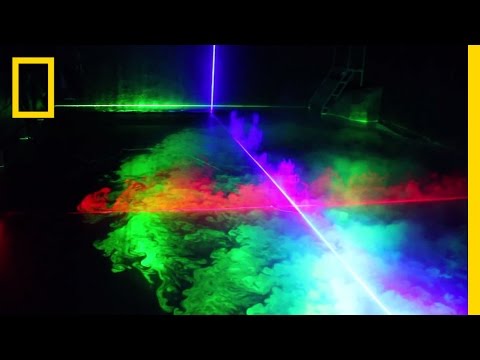
cloud and so what we use is some lasers
to illuminate essentially a single slice
through the current we can see the laser
sheets are going to be using to
illuminate the currents and we use here
we have three laser sheets we have a
green laser sheet this horizontal and is
about five centimeters above the floor
we have a blue laser sheet that runs the
length of the tank and is vertical then
we have a red laser sheet that runs
across the tank and is also vertical and
these three sheets between them give us
an idea of the 3d structure of these
pyroclastic flows one of the surprises
that we’ve had with these experiments is
that there are some enormous differences
in the behavior of cold currents versus
warm currents if we look at how a cold
current spreads out across the floor it
spreads out more or less radially
if instead we put a hot current into the
tank it initially starts out as a
somewhat radial but then very quickly
becomes a very long narrow current and
we think this is because as the current
lifts off that upward motion of the
plume basically prevents any further
spread of the current to the sides one
of the other surprises we’ve had is that
when currents encounter a barrier or a
topographic Ridge the currents if
they’re warm they hit that barrier and
they lift off to form a plume and they
really don’t keep going at all volcanoes
can inject ash up into the stratosphere
they can shutdown aviation over a large
fraction of the globe they can also
influence the climate so having a better
understanding of how volcanoes work can
hopefully help us mitigate some of those
volcanic hazards
Please follow and like us: