
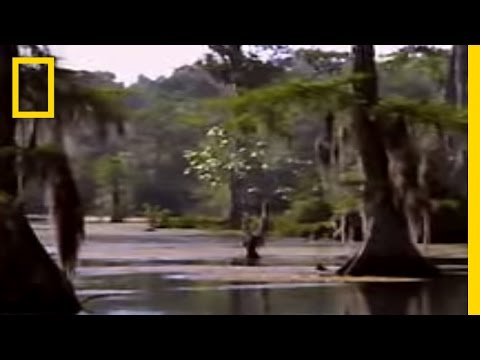
the cool waters of what kala Springs
makes it a popular place to beat
Florida’s heat tourists lounge on the
main beach while the locals prefer the
opposite bank despite the cold blooded
company people have visited these
historic Springs for years but for how
long is a mystery archaeologists hope to
solve National Geographic grantee Jim
Dunbar and his research team are
searching for signs of the first
Floridians ice age people who may have
come to a culluh for a Spring Break over
ten thousand years ago if you could
project yourself back into time you
would see a Florida that looked like the
Serengeti in terms of the animal
population it had and where would
animals go like that they would come
around maybe Oasis where there was
plentiful water resources and with say
large herbivores that come in what else
would come in the Predators it could it
be saber-tooth cat it could be something
like that or it could be people
the crew is hoping the hit paydirt
prehistoric tools left behind by an Ice
Age hunter in the search for Stone Age
tools diggings done the old-fashioned
way each bucket bull gets carefully
screened for the smallest clues and the
sand itself is helping geologists unlock
the age of their discoveries quartz
crystals in the sand
naturally emit a radioactive signal that
gets reset when exposed to life by
testing the signal geologists Jack rink
can tell how long ago this sand layer
was buried jack takes a core sample the
study in his lab and gets a reading on
radiation levels in a couple of months
we’ll know how long it’s been since this
Sands was last exposed to light and by
relating that information we can say
that the artifact was deposited at the
same time as when the sand was exposed
to light and that gives us a date on the
artifact itself partway through the digs
the archaeologists have found hundreds
of small artifacts mostly small flakes
from Stone hunting tools
a short distance away Clues begin to
surface as to what was on the
prehistoric dinner table dive team led
by underwater archaeologist Andi
Hemmings sets out to investigate
fossilized Mastodon bones at the bottom
of the screen it’s forensic science at
25 feet deep
while the team takes notes and he makes
a fascinating find deep grooves on a
mastodon fossil it could be the work of
an Ice Age hunter while the divers
explore underwater geologists on Scott
and Harley means are heading out on a
different expedition
this one’s underground with a help to
special ground-penetrating radar
they may look like ghostbusters but this
gear really works the radar reveals
denser objects such as fossils buried
below so I know conceivably we have to
ground truth this to see if this were a
boner or some archaeological material
any one of those little reflections down
in the settlement column there certainly
could be back at the dig site Jim’s team
strikes gold mark a well-preserved knife
Jim guesses that this point could be
14,000 years old more than 1,500 years
before people were thought to have
arrived in Florida it’ll take months for
test results to reveal whether the tools
belong to one of the first Floridians in
the meantime Jim and his team just have
to wait
fortunately for them we’ll call it
spring isn’t such a bad place to pass
the time
sponsored by National Geographic mission
programs taking science and exploration
into the new millennium
Please follow and like us: