
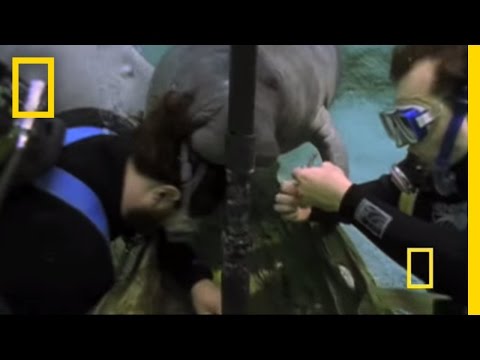
Florida loves its manatees here in
Crystal River it’s practically an
obsession nearly everywhere you look
there’s a manatee looking back at you on
shirts on buildings and even on license
plates but despite their popularity
times are tough for these lovable beasts
recent surveys show that Florida’s
manatee population is steadily declining
and today there may be less than 3,500
left in the wild of those that remain
four out of five bear the scars of
encounters with boat propellers but
what’s most puzzling is why manatees
don’t swim away from the noisy motors of
oncoming boats dr. Edmund Gerstein has
been puzzling over this question for
nearly three decades
Edie began to unravel the mystery with
the help of two captive-bred manatees
trained to perform simple tasks but we
ask the simple question is it possible
that manatees can’t hear the boats or if
they can hear them they can’t tell which
direction they’re coming from so my wife
and I actually set up a series of
experiments to test the manatees hearing
to see you exactly what they could hear
what the Gerstein is discovered was
astonishing the manatees seemed confused
by the low-frequency sounds made by
motor boats but when confronted with
certain high-pitched sounds they
responded almost instantly what we found
was that manatees have very good hearing
but their hearing is it at higher
frequencies than what anyone expected
actually the animals hear fairly poorly
at low frequencies and unfortunately for
them slow moving boats produce primarily
very low frequencies now after nearly 20
years of research Edna’s wife Laura have
an innovative idea could they develop an
alarm that exploits the manatees best
hearing abilities flashcards are in now
it’s time to put it to the test
we’re ones all set together
and his team has secured special permits
to conduct trials in the restricted
waterways near NASA’s Cape Canaveral the
team sets boys in the water
equipped with underwater microphones and
digital sound recorders being naturally
inquisitive manatees soon move in to
inspect the buoys and when they do ed
and his team approach them in boats the
drivers are trained to prevent
collisions but will they need to the
boats are equipped with new alarms they
are emitting a high-pitched sound that
Eddie believes the manatees will hear as
you can see one camera is capturing the
wide-angle view back in the lab ed and
has assisted Josiah review video of the
experiments normally manatees will not
move to avoid a boat until the very last
moment which is often too late but when
Ed’s vessel sounds the alarm the
manatees reaction is clear you can see
the animal coming to frame here yeah
look at that and he starts to orient at
about what would you say that is 75 feet
about 24 meters that’s great now he’s
taking off rather quickly yeah this is a
successful arm run yeah that’s really
good and definitely tell the animal
reacts again
and again and again we’ve got seventeen
alarm runs and for those alarms we’ve
got a hundred cent reaction we got
Animus reacting way before the boat gets
there and we’ve got over 65 silent runs
where nine B seven percent of time the
animals haven’t reacted off the alarm is
a success it hopes at Sunday all boats
and manatee filled waters will be
equipped with similar devices in a sense
if we were to put this device on the
boat which would be very inexpensive
only about a hundred and twenty-five
dollars it’s a user based tax that the
voters would gladly pay if they could
put this on their boat and maybe get to
an area a little bit quicker and more
importantly protect the animal as
they’re going sponsored by National
Geographic mission programs taking
science and exploration into the new
millennium
Crystal River it’s practically an
obsession nearly everywhere you look
there’s a manatee looking back at you on
shirts on buildings and even on license
plates but despite their popularity
times are tough for these lovable beasts
recent surveys show that Florida’s
manatee population is steadily declining
and today there may be less than 3,500
left in the wild of those that remain
four out of five bear the scars of
encounters with boat propellers but
what’s most puzzling is why manatees
don’t swim away from the noisy motors of
oncoming boats dr. Edmund Gerstein has
been puzzling over this question for
nearly three decades
Edie began to unravel the mystery with
the help of two captive-bred manatees
trained to perform simple tasks but we
ask the simple question is it possible
that manatees can’t hear the boats or if
they can hear them they can’t tell which
direction they’re coming from so my wife
and I actually set up a series of
experiments to test the manatees hearing
to see you exactly what they could hear
what the Gerstein is discovered was
astonishing the manatees seemed confused
by the low-frequency sounds made by
motor boats but when confronted with
certain high-pitched sounds they
responded almost instantly what we found
was that manatees have very good hearing
but their hearing is it at higher
frequencies than what anyone expected
actually the animals hear fairly poorly
at low frequencies and unfortunately for
them slow moving boats produce primarily
very low frequencies now after nearly 20
years of research Edna’s wife Laura have
an innovative idea could they develop an
alarm that exploits the manatees best
hearing abilities flashcards are in now
it’s time to put it to the test
we’re ones all set together
and his team has secured special permits
to conduct trials in the restricted
waterways near NASA’s Cape Canaveral the
team sets boys in the water
equipped with underwater microphones and
digital sound recorders being naturally
inquisitive manatees soon move in to
inspect the buoys and when they do ed
and his team approach them in boats the
drivers are trained to prevent
collisions but will they need to the
boats are equipped with new alarms they
are emitting a high-pitched sound that
Eddie believes the manatees will hear as
you can see one camera is capturing the
wide-angle view back in the lab ed and
has assisted Josiah review video of the
experiments normally manatees will not
move to avoid a boat until the very last
moment which is often too late but when
Ed’s vessel sounds the alarm the
manatees reaction is clear you can see
the animal coming to frame here yeah
look at that and he starts to orient at
about what would you say that is 75 feet
about 24 meters that’s great now he’s
taking off rather quickly yeah this is a
successful arm run yeah that’s really
good and definitely tell the animal
reacts again
and again and again we’ve got seventeen
alarm runs and for those alarms we’ve
got a hundred cent reaction we got
Animus reacting way before the boat gets
there and we’ve got over 65 silent runs
where nine B seven percent of time the
animals haven’t reacted off the alarm is
a success it hopes at Sunday all boats
and manatee filled waters will be
equipped with similar devices in a sense
if we were to put this device on the
boat which would be very inexpensive
only about a hundred and twenty-five
dollars it’s a user based tax that the
voters would gladly pay if they could
put this on their boat and maybe get to
an area a little bit quicker and more
importantly protect the animal as
they’re going sponsored by National
Geographic mission programs taking
science and exploration into the new
millennium
Please follow and like us: