
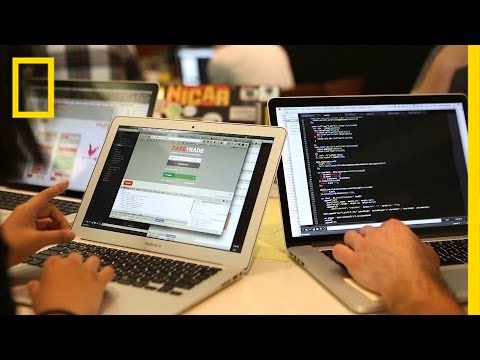
this is national Geographics first
hackathon we have people who are really
passionate about coding we have people
who are passionate about design and we
have people who are passionate about the
United Nations Food and Agricultural
organization has had this treasure trove
of data for a long time and in this
particular case we really want to match
the UN FAO s data set which is very deep
because I know everything there is to
know about food and agriculture with all
these people who are used to presenting
to the public we are already providing
free and open access to all our data but
one thing is date availability the other
is data use in order to make data
actually used you have to make stories
our out of your data you have to
transform information into knowledge
Tech has the power and potential to add
value to our lives disrupt markets and
food is something that needs the most
unbelievable like reinvention right now
our our food system is broken food is
important because there’s a lot of data
that exists around food it’s like for
example the United Nations data that
we’re working with today I haven’t seen
that really utilized in news
organizations it’s also something I
didn’t know existed before the tak of
convoy and does this kind of story angle
looking at this idea of impossible foods
of foods a hackathon is just a place
where you say in a fixed period of time
we are going to commit to make something
we want to be able to show an individual
person if you bought something today
let’s say a banana what is the average
probable amount of miles its travel to
get to you sometimes there’s a lot of
energy sometimes there’s a real lull
sometimes there’s a lot of thinking
sometimes there’s a lot of doing the
later it gets and the closer we get to
deadlines the more energy there will be
in the room
just a touch of panic we wanted to avoid
that we want to see what could we do
that could be helpful for NGOs if you
know you want to do something where is
the best place to do it say what if
Tanzania ate like a person in the United
States I’m it would require different
metrics and then basically have things
like land-use blows up like the Death
Star what is going to waste away in the
back of your refrigerator
it seems tempting to buy that bag of
lemons but you’re swimming upstream
against the stats because 91% of the
lemons are going to end up in the trash
so by one
Please follow and like us: