
Good morning Believe Nation, it’s Evan.
My one word is believe, and I believe in people
more than they believe in themselves.
And my sincere hope is that if you see in yourself
what I see in you, you’ll be able to change the planet.
So to help you on your journey,
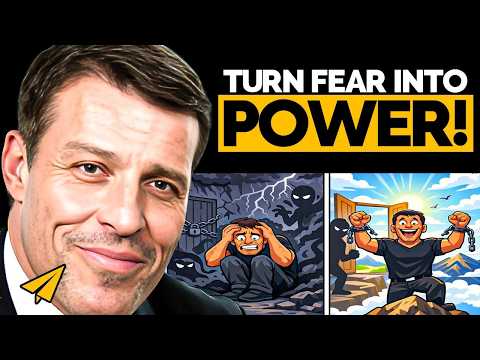
today’s message is “Use fear.”
Over to you, Tony Robbins.
(rooster crows)
(hip hop beat)
♫ I wake up every morning
♫ Espresso keep me going
♫ I wake up every morning
The only way to deal with fear
that I’ve found in my life, is a couple ways.
One of those ways is to turn it on itself,
and ask yourself, “What am I afraid of?
“I’m afraid of that?
“I got to be more afraid of what I’m going to miss out on.
“Missing out on my mission.
“Missing out on who I’m supposed to be.”
In other words, if you’re not going
to get rid of fear, then use fear.
Use fear, or it uses you.
It’s that simple.
So you got to say, “Okay, what’s the price
“if I just stay doing this?
“What’s the price, I need to really get scared
“If I learn all this and I don’t follow through.”
That’s something to be scared about.
And then that fear will get you over your fear.
It’ll push you through. Turn fear on itself.
Second way you can do it, is use what,
you’ve probably heard me say ’cause I’ve used it
since I was 17, is my little rocking chair test, right?
I’m going to sit myself in my rocking chair,
I’m 85 years old and looking back on my life,
and I say, “I didn’t do this, or I did.”
So I like to use fear in two different ways.
The first is the rocking chair test.
It’s, “Will I regret this when I’m on my deathbed,
“when I’m 80, 90, 100, 250 years old.”
However long we’re living at that point in the future.
“Will I regret this?”
And that was something that I learned
when I was 18, 19 years old,
and it’s been one of the most powerful lessons
that has had an impact on me,
that I had this moment in my life,
I’ve talked about Paris and the girl story
that I had before, and from there
I decided that I don’t want to live with regret.
Like, I can deal with short-term pain,
but I can’t deal with not knowing.
And that led me to join the start-up company,
and ever since, if I’ve come across a situation
and I’m going to, feel like I’m going to regret it,
like I want to say yes but I’m really afraid
because of whatever short-term impact there might be,
I just make the longer-term fear
bigger than the short-term fear.
So I’m more afraid to miss out on a lifetime of opportunity,
versus the short-term fear of it not working out.
And if you can catch yourself when you feel those moments
of, “I’m just finding practical reasons
“why I shouldn’t do this, but really it’s just fear.”
I find that that really helps me
thinking about the long-term,
and whenever I have a major decision
that I’m unsure about, I imagine my life
on my deathbed, rocking chair test,
looking back, “Am I going to regret this?”
And if it’s yes, if I’m going to regret
not taking action, then I know I have to take action
however scary that may be short-term.
The second thing that I use fear for
is building the muscle, is my muscle-building test.
And that’s where I want to get used to
being uncomfortable, I want to get used to
if I’m afraid of something,
not just always shrinking down.
And the hardest part, I think for most people
is to catch it, because again we come up with
these rational reasons why we shouldn’t do something,
where really it’s just that fear speaking out,
so understanding the “why” behind the “why,”
really really important.
And the more you say yes to those things,
the more you stretch your comfort zone,
just for the fact that you were afraid of doing it,
the more that muscle is going to build.
And I’ve shared a number of different examples
in different videos of me, you know,
dancing on the street, and being afraid
of what people would say about me,
or me trying to do snowboard jumps,
and being afraid of what people
would say or look at me, or even here,
walking, making a video, this is not a green screen.
Somebody commented before, “What green screen are you on?”
I’m not on a green screen.
This is the actual business that I own,
Toronto Dance Salsa, that’s an actual window.
There’s real people walking behind.
And at the start that can be intimidating, right?
That people are walking behind.
Sometimes people like, look in and see what’s happening.
And I have to worry, like, “Are they judging me?”
But the fact that I’m afraid of that
means that I have to go out and do it.
Just to see it, just to get rid of that fear.
And then what that does is it expands my comfort zone.
So that the next time I do it, it’s not as scary.
And the next time it’s not as scary,
and the next time you lose the fear.
So I’m not afraid to come here now,
and speak with people walking by.
But if you constantly allow fear to beat you
then even the smallest things,
you’re going to shrink down from.
And when you have opportunities that can serve
your higher purpose, that can make
a great life for yourself, you’re not going to do them
because you’re too afraid.
‘Cause you just live in this tiny, little bubble.
So if you can continue to expand,
like the great things happen at the edge
of your comfort zone.
So if you can continue to expand your comfort zone,
more and more and more great things
are going to happen to you.
And so just recognizing it, whenever
you can catch that fear, it can make a big difference.
If you decide to say yes, to step into the fear,
to lean in on it, and just do it even though you are afraid.
So those two tests, the rocking chair test,
look forward, if you’re going to regret it
for the rest of your life then you have to say yes,
you have to have the certainty,
you have to know, and deal with the short-term,
potential failure of it not working out,
versus the long-term, for the rest of your life
feeling like you’re living with regret.
And two, just building the muscle.
Recognizing that the great things happen
at the edge of your comfort zone,
and the more you practice stretching your comfort zone,
the more great things are going to happen to you.
So the question of the day today is,
I’m curious, how do you use fear?
How have you used fear to help you
in your business, in your life?
I’d love to hear an example if you want to share it.
Please put it down in the comments below.
And also if you’re responding with a comment
in the first couple of hours of this video going live,
you have a chance to win one of our two daily prizes.
I also want to give a quick shout-out to Serge Berberof,
Serge thank you so much for picking up
a copy of my book, Your One Word,
and taking that picture and posting to Twitter.
I really, really appreciate the support, man,
and I’m so glad you enjoyed the book.
Thank you guys again for watching,
I believe in you, I hope you continue to
believe in yourself and whatever your one word is.
Much love, and I’ll see you again tomorrow morning
for another shot of #Entspresso.
♫ I wake up every morning
♫ Espresso keep me going
– When you experience moments of self-doubt,
how do you approach getting out of the dark place?
– I grandiose my way out of fear.
(audience laughs)
– [Robert] If you can imagine that.
– [Woman] It’s a good way. It’s charming.
– You know, it’s like literally,
it’s like, “Okay, I’m going to do
“one of the greatest car chases of all time.
“And if I don’t, I’m not as talented
“as I thought I was.”
And I will realize there’s a ceiling to my talent,
right now I don’t think there is,
(audience laughs)
But if I don’t do, but if it’s not one
of the greatest car chases of all time,
then I’ve failed, and I, there is a ceiling to my talent,
I’m not as good as I thought I was.”
And I said that to everybody.
And was I scared?
Yeah.
I had trepidation going all the way,
because it’s mine to fail.
And it’s failing in front of the mirror, too.
Because I’ll know if I did it or not,
and I’ll be like, “Okay.”
“You are not as good as you thought you were.”
And that got me to Mt. Everest.
– It’s true, I remember at one point he goes,
“Robert, can you imagine you and me doing
“this car chase together, how great it’s going to be?”
And I’m like, “Hey man, you’re on your own brother.”
(audience laughs)
“I ain’t going out there, I got five kids.
“I’m not doing 100 mile an hour bull.
“You want to live the Vanishing Point dream buddy, live it.”
(Quentin and Robert laugh)
And he did it all by himself,
and I’m so proud of him.
– There’s a scene in there where you talked about
um, bullies, and running from danger
and things like that when you were trying to help this kid.
– Yeah, what happens is this boy is being harassed
by the neighborhood bully.
And his father is encouraging his son
to beat up this little boy.
And I wrote this scene.
I wrote this particular scene in the script.
And I was trying to think,
“What can I write to encourage this boy
“to handle the situation, you know,
“with this bully in the neighborhood.”
And I’m spending days trying to figure out,
“What can I say to a boy?”
And finally I came up with the answer,
and it was a situation that I, as a child,
had encountered about his age.
I went to a school in Arizona
that was mostly Indians from the reservation.
And there was this one Indian kid
who just didn’t like me, and every day
he would chase me home from school.
And uh, and I’d have to run by this gas station
and this mechanic would watch me being chased
by this Indian kid every day.
And finally he just couldn’t handle it anymore.
And he stopped me, and made me face this boy.
And I told him, I told him I was scared
and he said, well, and what he said to me
which is still true, which I remember,
is that he says, “You know, that running from your fear
“is more painful than facing it.”
And that’s something I’ve always remembered.
And this is what I relate to this boy,
and of course eventually he has to face
this fear in the film. (audience applauds)
– Be right back with more Chuck Norris.
– [Interviewer] I see you in your basement
like Batman with all machines and stuff.
It’s really precise I guess, and really what you put,
you know what you put and then you go live.
What’s the difference? The risk?
– The risk. You know, and the risk
and I have stage fright, you know,
and I never confronted the risk.
Or when I did confront, I mean
Belgium, 2000. The year 2000.
That was, you have no idea what it took them
to get me to do it.
– [Interviewer] And why did you say yes?
– No no no no, I had a thousand,
I had a thousand excuses why not to do it,
and finally I did it, and it was…
(sighs)
Exquisitely horrifying, that’s the only way I can put it.
– [Interviewer] Complex.
– Yes. It was very, very, very complex.
And what was really good
was right at the beginning, within like two seconds,
I played just the worst wrong note
and I could either stop and cry, or I could laugh, right?
And it didn’t kill me.
And nobody else out there, nobody was throwing anything.
You know? It was fine.
Thank you to the people of Ghent for not killing me.
And giving me the courage, you know, and the absurdity.
You know, you have to be able to laugh at yourself.
And you have to learn how to laugh at yourself.
Please follow and like us: