
– One day all of this will be yours.
The other people who are spending
their whole time on ego trips.
We’ve configured society in such a way
that so many things can be bought.
Well if you’re giving back
you took too much.
And human beings don’t do scary things on their own.
There’s nothing in nature that grows indefinitely
except cancer.
How many people do you know that in their deathbed
said, “Boy I wish I had spent more time at the office.”
They say this seems to be out of control,
pull the reins.
And letting it sit there and not doing it is
an important part.
What am I doing this for?
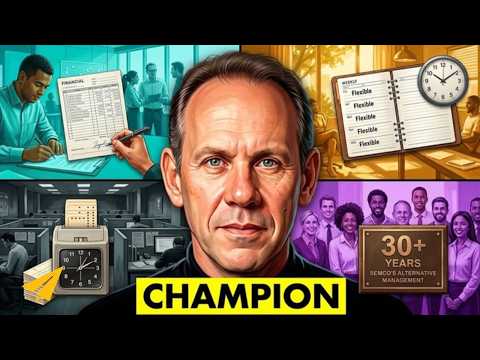
– He is the CEO and majority owner of Semco Partners.
Under his leadership the business grew from four million
dollars to 212 million dollars.
His innovative management policies have attracted
widespread interest from around the world.
He’s Ricardo Semler and here are his
top ten rules for success.
– I taught MBAs at MIT for a time
and I ended up one day at the Mount Auburn cemetery
it was beautiful cemetery in Cambridge.
And I was walking around, it was my birthday,
and I was thinking.
And the first time around I saw these tombstones
and these wonderful people who do done great things
and I thought, what do I want to be remembered for?
And I did another stroll around
and the second time another question came to me
which did did me better, which was,
why do I want to be remembered at all?
(laughing)
And that, I think, took me different places.
When I was 50, my wife and I had a nice (mumbling)
for a whole afternoon.
We had a big pit with fire
and I threw everything I had ever done into that fire .
This is a book in 38 languages,
hundreds and hundreds of articles and DVDs.
Everything there was.
And that did two things.
One, it freed our five kids from following
in the steps of shadow of,
they don’t know what I do.
(laughing) Which is good.
And I’m not going to take them someone say, “One day
“all of this will be yours.”
So the five kids know nothing which is good.
And the second thing is I freed myself
from this anchor of past achievement
or whatever it is and I’m free to start something new.
Every time and to decide things from scratch.
I think that a certain amount of ego
and vanity and self-esteem is absolutely necessary.
I don’t think it’s possible for you to
to keep a
a structured personality
with you giving up ego and vanity and everything.
It’s yourself, that is that small percentage
of religious people or people or Hermits,
or people who are able to go to that that extent.
As on the other hand, the other people
who are spending their whole time on ego trips
and making sure that they show up
and their photograph is in the paper.
And they go to be seen and be seen.
And I’m not in any of these in any of these situations.
So I’m constantly managing the issue of ego
and asking myself, why am I doing this?
Am I doing this, is it enough of a message?
Is it important?
Do I do a few very very select of these?
Or do I do it all the time just to make sure
that I’m I’m busy, I’m in the news or whatever.
I don’t do the second part
because the amount of things I refuse per day is enormous.
And so I am trying always to manage that issue.
But I think without this force of
of ego which is within myself.
So when I’m giving when I feel that
I’m giving something anonymously.
A school for example,
that they will never know that it was me who gave it.
It is feeding my ego
to feel good about having done that.
But it doesn’t have my name on it,
I don’t show up there so it doesn’t have that second part
of the ego which I don’t think I need.
And I needed more in the past and I started to
tame it as the years go by.
And so it’s a very delicate exercise
but I think the people without that first
need to express themselves or to have the ego issue
balanced end up doing very little as well.
– Mm-hmm. – For the very
little publicly, of course.
That’s what we’re talking about.
For me, the idea of success,
power, and money together has never been a motto.
It was just a realization
that this was so important to people in general.
But success, the idea that success is connected to money
to me is really a strange combination.
It’s
there’s a very small correlation
between success and money, in any case
there’s a strong correlation between money and power
because we’ve configured society in such a way
that so many things can be bought.
But success fits into another the other Trinity
of balance, of security certainly because
it was much more secure in our society
to have a bank account than to have none.
But it’s not by any means that
this will enable you in any of the other
in any of the other factors.
But I think the people that imagine that success,
money, power etcetera are
useful only believe in this for a while
it’s very difficult to imagine that somebody
believes in this over the long run
because there’s so many opportunities
and examples to see that there are so
many important things that you can’t buy with any of this.
I accumulated a lot of money when I think about it
you when you think and you say,
“Now is the time to give back.”
Well if you’re giving back, you took too much.
(laughing)
(applause)
I see, I keep thinking of Warren Buffett
waking up one day and finding out that
he has 30 billion dollars more than he thought he had.
And he looks and says. “what am I going to do with this?”
He said, “Let me give it to somebody who really needs this.
“I’ll give it to Bill Gates.”
(laughing)
And, my guy, who is my financial adviser in New York,
he says, “Look you’re not you’re a silly guy
“because you would have 4.1 times more money today
“if you had made money with money
“instead of sharing as you go.”
But I like sharing as you go better.
Our past is very determinant.
When you think about Europe or the Western hemisphere,
in general, we are stuck by issues of the past.
It is the past that holds back.
You know, and if you said that you were as
I’ve done in the past, you said let me burn everything,
let me get rid of everything in the past
you you’re free to start thinking about the future.
But if you’re still collecting the past
and looking to the past as a solution
having history is a very strong anchor,
you’re unable to move forward
because there are historical reasons why our tribe
of humanity is such a slow changer because
change is very very scary.
And human beings don’t do scary things on their own.
They take something much bigger to force them into change.
– [Man] What kind of big thing would that be?
– For every human being individual
it’s the heart attack, the car accident,
the something that happened which was much bigger than you.
Which suddenly you wake up and say, “Oh my God
“I’ve been spending all my life inside a box
“just working for someone else.
“Oh isn’t there a better way?”
For humanity, in general, it is this that
suddenly it stops raining, suddenly everything goes crazy
and you can’t control the climate.
So that’s big enough.
If the world were hit by a meteorite it would be enough.
It takes enormous things like that.
So we are a bit, didn’t dinosaurs in that sense
that we will roam around and do our thing
until we’re hit by something much bigger than us.
And that’s true even for the individual who
needs a heart attack to wake up to find
out that they’ve been working too much.
– In each block of time your company has grown,
your profits have grown,
your own personal wealth has grown.
A company that might have had a few hundred
now has 5,000.
What is it in all of that still motivates you?
Is it about the growth, is it about being bigger,
and feeling good about yourself because
you’ve run something like that?
– No, as a matter of fact, now we’ve had
a few opportunities to sell to partners.
Our part completely and I’m very happy to do that
in a thousand people, or 2,000 people will go at a stretch.
No, I think I’ve gotten over that.
There’s something in the beginning of a career where you
where you find that important.
But the you realize that there’s nothing in
nature that grows indefinitely except cancer.
You know, everything else and you have the tall
poppy syndrome rationale here in Australia.
The tree that grows most is the one that’s first
struck by lightning.
This is the idea that you grow more, you have more money
and you become better is very very silly idea.
And so, what takes me let’s say, from business to education
or to dealing with two-year-olds is that I’m
interested in human nature and why we do
some of the silly things we do is
there’s not a better way to do this.
I always come back to variations of the
the question that my my son asked me when he was three.
We’re sitting in a Jacuzzi and he said,
“Dad, why do we exist?”
There is no other question,
nobody has any other question.
You have variations of this one question from three onwards.
And so, when you spend time in a company,
in a bureaucracy, in an organization
and you’re you’re saying, boy, how many people
do you know that in their deathbed
said, “Boy I wish I had spent more time at the office.”
So there’s a whole thing of
having the courage now,
not in a week, not in two months.
No not when you find out you have something.
To say no, what am I doing this for?
Stop everything, let me do something else
and it’ll be okay.
It’ll be much better than what you’re doing
if you’re stuck in a process.
So when you think about the fact that we
allocate the same amount of hours,
what is it that that we need to do
or we can do?
It’s very easy today to set up organizations.
That’s the way we’re set up.
Where we don’t want to know how many people work.
We don’t want to know exactly how many hours
each person works.
We’re going to negotiate with the group
or with a person for a certain result.
If the person is able to do it in three hours
or four hours or seven hours
we don’t want to know.
We don’t want that control anymore.
We want to be able to say,
“Look, if you can distribute your life
“differently in terms of where you are
“or the amount of hours you work or between
“idleness and leisure and the rest of the
“things you want to do.”
The framework that’s available today already permits that.
It’s just companies that are not
letting go because they think they need control.
They want to know if the person showed up et cetera
because otherwise it’s unfair for the other one
who worked more hours.
And that’s an obsolete rationale
it’s an obsolete system.
And so, it’s perfectly possible and that’s
how we work is to say, “Give me this
“by such and such a date.”
And then if it’s more hours less hours
or where you do it is none of our concern.
And that solves the issue of
allocating too many hours
when today we don’t need that many in order to produce
the same thing.
In a time in which things seem to be lost
in terms of control and direction
the first reaction is the same one
is you have with a horse.
When you’re riding a horse and the horse
is going downhill and it starts speeding up
and losing control
you pull the reins which is the very
worst thing you could ever do.
Because then the horse has to pull up their head
and try to go down with you pulling the rein there
because you’re afraid.
This is the same thing that happens in these
organizations, it’s been happening in the companies.
They say this seems to be out of control,
pull the reins together
and let’s get control of this thing that we’re losing.
And the fact is the more you do that
the more you have an entity,
an organism, an organization that doesn’t know
what to do and is frightened.
And so this fear, this malice that’s there in society
today, needs a completely different organization
is a completely different architecture than this one
of more and more and more control and more slaves
building up something for you.
It needs something that says give up the reins
and realize that once the horse has control
and the head is free, that you’re able then to use
the best qualities of knowing where to step in the things
that came naturally and that came tribally already within
is, many of which are much wiser than the
smart decision of control.
– [Man] Control is smart
but it’s not wise?
– Yeah control always seems smart
it seems intelligent to say ah,
so you tell me where you were, you tell me this,
you tell me how much you spent, you come here.
You all come from everywhere around
from 50 kilometers away
and you take subways, and you take buses
and you spend three hours a day in traffic.
But once you come here
I can control you, I know whether you’re here,
I know whether you came on time.
I have a boarding-school mentality really
of control.
So if I send my kids over there and I know
that they’re going to wake up
and they’re going to go to mathematics and then biology
said they’re going to be great.
It seems smart, but it’s very unwise.
You have kids who then leave that
and who’s thought they’ve wasted half their life there.
And then they want to do away with all of this organization
that was in place before.
Well you know I had a I had this
unsuccessful career as a rock guitarist which was wonderful.
I mean, it was a wonderful period of my life.
But it was very interesting because
it showed where
where the limitations are
and why sometimes you want to do
something because you want to.
But the combination of talent and time is not right.
And letting it sit there and not doing it
is an important part.
We’ve all learned how to go on Sunday night
to go to the email and work from home.
But very few of us have learned how to go to the
movies on Monday afternoon.
And if we’re looking for wisdom we need to learn
to do that as well.
And so it’s basically
what we’ve done all of these years is very simple
is use the little tool which is
ask three whys in a row.
Because the first why you always have a good answer.
For the second why, it starts getting difficult.
By the third why you don’t really know
why you’re doing what you’re doing.
And so, what I want to leave you with is
the seed and the thought that maybe
if you do this you will come to the question,
what for?
What am I doing this for?
And hopefully, as a result of that,
and over time, I hope that with this
and that’s what I’m wishing you
you’ll have a much wiser future.
Thank you very much.
(applause)
– Thank you so much for watching.
I made this video because Marco Aurélio asked me to.
So if there’s a famous entrepreneur
that you want me to profile next
leave it in the comments below
and I’ll see what I can do.
I’d also love to know which of Ricardo Semler’s
top ten rules meant the most to you,
had the biggest impact.
Leave it in the comments and I’ll join in the discussion.
Thank you so much for watching,
continue to believe, and I’ll see you soon.
Please follow and like us: