
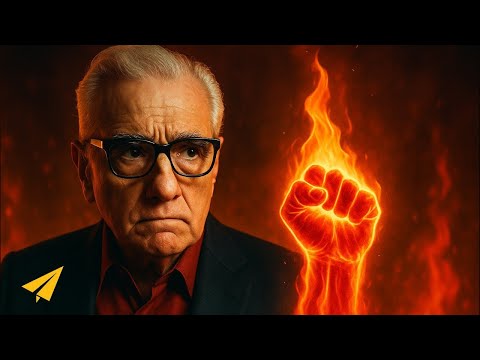
– I’m mad all the time.
Mike can tell you
Just angry, angry, angry, pain in the neck.
In the morning I would get up maybe 45 minutes earlier
to do meditation before I was able to face that set.
We create movies.
Don’t pay attention to industry, do your own thing.
Thinking in the morning, we’re going to do this
then about two hours in, say we’re doomed.
(laughter)
We’re never finishing this film!
We’re going to be in movie hell
for the rest of our lives.
– He’s an American director, producer,
screenwriter and actor whose career spans
more than 50 years.
Part of the new Hollywood wave of filmmaking,
he’s considered one of the most influential
and greatest filmmakers of all time.
With 8 Best Director nominations,
he’s the most nominated living director.
He’s Martin Scorsese and here is my take
on his top 10 rules for success.
Rule number 7 is my personal favorite and make sure
to stick around all the way through to the end
for some special bonus clips.
Also as you watch and listen to Martin in these clips,
if there’s something that he says
that really resonates with you,
add it to the comments below with quotation marks
so we can keep track.
(swoosh) (thunk)
– [Audience Member] I’m wondering when you’re trying
to make a film and you come up against obstacles
and barriers, what do you attribute your strong dedication
to getting that film made?
– Really, (laughs) hysteria, usually.
(laughter)
Hysteria and obsession and anger,
I think mainly anger.
(laughter)
I’m mad all the time.
Mike can tell you.
Just angry, angry, angry, pain in the neck.
That’s why I use humor a lot
because it deflates myself
I don’t want to take it seriously
because I really do.
I would have been gone much longer, 25 years ago.
I wouldn’t have survived.
But the anger is enormous.
About everything, about everything.
So that also fuels me to make a picture, I think.
But keeping a sense of humor is the key thing,
the irony, the irony.
When you get there in the morning
and you get a note that one actor’s had a nervous breakdown
and you an’t go on with the film.
(laughter)
(applause)
It happened, it happened.
– [Host] They don’t want to come out
of the trailer.
– Yeah, they don’t want to come out of the trailer.
– Right here, right here in the black sweater.
What’re you going to do?
You get a heart attack otherwise.
Or you kill someone.
It’s not good.
– [Interviewer] Without meaning to be presumptuous,
what sacrifices do you think you’ve made in order
to create the work, to make the films, make the career
that you’ve done?
What do you think in your life you’ve sacrificed?
– It think, as an old friend, an old priest told me,
said you pay a price.
You pay a price.
Just quite honestly, a personal life, really.
Relationships go by the board.
It’s as if the Frank Capra quote,
it’s like a drug or something that you have to continue.
Now, as I say, some people call that drive,
some call it obsession, some just call it being selfish
and being not a very nice person.
But the reality is that I just had
to continue that process.
Whatta you do when you change
how the world thinks of cinema?
What’s next?
Do you keep making the same kind of film?
Or if you’re a person like Rossolini,
if you are, you try something experimental.
You push further, and that’s just experimental
for experiment’s sake, but you push the boundaries further.
– Talk to me, talk to the group about
why the subjects and the difficulties in getting films made.
Why can’t you ever do anything that’s easy?
– I guess any film is not really easy.
I would think.
I think you’re driven by something
that’s like an obsession, I would think.
Before you realize it, you have your eye
through the eyepiece and you say we’re crazy.
How the hell do we think we’re ever going to do this?
This is madness, but you keep going.
And I never really thought otherwise.
I actually thought people wanted to see that kind of film.
The industry changed, I started making Mean Streets in ’73,
Taxi Driver and Raging Bull and New York, New York.
Particularly in Last Waltz, and Last Waltz was somewhat
of a different story, but I actually had no…
I really was surprised
that there would be resistance
to Taxi Driver, for example.
It was very difficult to get made.
And certainly, Last Temptation of Christ, I understood
there would have been some controversy
but usually from certain areas,
not necessarily what happened at the time.
So we just go ahead
and eventually there’s some studio people.
In the case of Taxi Driver, it was a combination
of De Niro and myself.
He’d just done Godfather II.
When I did Mean Streets, I brought the answer print up
to show Francis Coppola in San Francisco
and he hired De Niro for Godfather II based on that.
That led to Taxi Driver and then Raging Bull was a project
of De Niro’s, really.
I remember doing the film called Hugo,
which was a film we shot in three dimensions
and it would take about an hour to get there,
to the studio.
But in the morning I would get up maybe 45 minutes earlier
to do meditation before I was able to face that set.
(laughing)
With children actors that could only work for like a minute,
(laughs) a dog that wasn’t listening,
Sacha Baron Cohen, who was improvising everything
and everything in 3D!
And overscheduled and over budget!
God, there’s only one thing you can do is…
Calm it down.
And get into it and deal with the realities.
If there is something on my mind,
if there is something I’m really worried about
in terms of a character development
or particularly, a thematic issue
or just trying to get a shot done.
Literally, they’d say well, we can’t do that,
we don’t have the hallway,
there’s got to be a track down a hallway.
We have no hall.
Now what?
Well, what is it about?
It’s about his face.
All right.
And so you just forget it
and you go into meditation.
– That’s it, and you come up with an answer.
– And somehow something came out.
I said dammit, that’s (drowned out by laughter)
I did my first short film at the summer workshop in ’63,
that’s where I met Thelma Schoonmaker.
– Yeah.
– She was a history major at Columbia.
– Now, and Thelma Schoonmaker is Marty’s editor
and this is, without overstating it,
one of the truly great collaborations in motion pictures.
So for somebody who has a vision like Marty
to get other people, because you’ve got to get other people
to do it with you who are on the same frequency,
who understand what you’re looking for,
who share the vision and can make it happen,
that’s priceless.
– Yeah, it really is and that’s the struggle, too.
Cause it is collaborative.
If I could shoot it, and if I could edit it myself
and if I could write it, if I could act in it, fine.
But I can’t.
(laughing)
So you need people who are like-minded in a way
or exploring certain areas that you want to go
to possibly at this certain point in your life.
But with Thelma and myself, we edit films
just like I was saying, we’re getting
to be two old people in a cottage making a three-piece suit.
Sort of stitching it by hand.
They’re banging on the door of the studio,
they want the picture.
I’ll be right with you, just you got to put cuffs
on the pants!
That’s it!
But it’s that sort of thing, and there’s a lot
of care that goes into it, and a lot of time
that’s spent in the actual editing of the films.
– Make your own industry.
We create movies.
Don’t pay attention to industry, do your own thing.
Put it this way.
You want the work to be seen
but it doesn’t have to be at the Odeon.
No more, that’s all different, that’s another ancient world.
That type of film, or not even that type of film,
the communal experience is always important.
You can make a film on a camera the size
of that doorknob and still show it
to 1,600 people, an audience,
and it’s still a great communal experience.
It doesn’t necessarily mean it has to cost
over 100 million pounds.
– Have you ever done a movie where everything pretty much
fell into place and there were no monumental battles,
no anxiety, no angst, no near nervous breakdowns?
Which seems to be actually kind of what your life is about.
– Pretty much, yeah.
(laughing)
– Has there ever been a movie where you just started
and what do we have, 45 days shooting?
Did it like (snaps)?
– No, never, never.
(laughter)
I mean I’m shooting at two in the morning last night.
You find yourself on the edge of the seat, like this.
Frozen.
The actors are moving a certain way, what is it?
Maybe I think it should be more to the left.
Whatta you think, Michael Ballhaus?
Yeah, move him more to his–
I have a problem with left or right,
so whenever I say left, I go (slaps) left!
(laughter)
No, right, that’s it!
And the guys are lookin at me.
Marty?
Oh, no, no, it’s definitely to the left.
But it’s that kind of thing, you can’t–
Also as you get older, too
sometimes with the heat on the set,
and this week was very hard,
you do find time to get that energy midday.
You need like 15 minutes, close your eyes, just think.
But you have to keep, there’s no such thing…
People are “oh but you love shooting.”
For me shooting is an extraordinarily stressful situation.
Because there’s not one moment to relax
because you need to push, you need to, first of all
not only get something wonderful from the actors
and cinematographer and everybody but you have
to do it on a schedule.
And you have to prove that you’re responsible.
You have a certain responsibility.
$96 million dollars, $100 million dollars.
Yeah, you have a responsibility
to do what you can with that money.
You have to present a picture.
You have to make the day. – Make the day, means you get
to the end, you’ve done the set-ups and the pages,
that’s the way they judge these things.
– Yeah and then you usually feel sometimes
well, I’m not shooting this schedule
for God’s sakes, you’re making a film!
But then you realize well,
at a certain point sometimes you slip behind.
We were able to, for example, on Aviator, that picture
came in on schedule.
90 days, on schedule, all that stuff
with the airplanes and everything.
I don’t know how we did it,
but there wasn’t one day that we didn’t suffer
kind of the ups and downs of it.
Thinking in the morning, we’re going to do this,
then about two hours into it, say we’re doomed.
(laughter)
We’re never finishing this film!
We’re going to be in movie hell for the rest of our lives.
The planes, Howard Hughes, I don’t know what’s going on.
Where are we?
Then two hours later, hey!
By the end of the day, it was my God, we made it.
Or you slipped over to the next day
and cut down another scene
and somehow it all came together.
– Yeah.
– By the time the dust had settled, we looked around,
it was 90 days, we did it.
In Gangs, it was a different thing.
It was a much bigger effort,
you’re looking around like we never did,
we just never got there.
But that’s the last of that kind that can be done.
– [Audience Member] What’s the hallmark of a great script?
How do you know you want to choose that one
over thousands or hundreds of others that you look at?
What–
– Personally, usually I don’t read other people’s scripts.
I usually develop something or I have something in mind.
I work with a friend, usually,
in some cases Nick Pileggi, in some cases Jay Cocks
or hire Paul Schrader for Bringing Out The Dead.
But, for example, when Taxi Driver was given
to me to read by Brian De Palma,
I hadn’t done Mean Streets yet.
When he said “you’ll be great for this,”
I automatically, it had to be an emotional connection
to the material and to the characters.
The obsessiveness of Travis Bickle,
the sense of being the outsider
and not being the dispossessed.
We felt that way, myself and I could speak
for De Niro to a certain extent
because we didn’t articulate it that way,
I can’t really say oh, we’re outsiders.
We were tryin’ to get in!
(Martin drowns out audience member)
We’re tryin’ to stay in Hollywood and in the meantime,
this thing is–
– [Host] Few of the films came from scripts.
Most of Marty’s works come from ideas and books
and he then develops scripts.
In the early years, there were some screenplays
but as you progressed on–
– Yeah, Alice was a screenplay but certainly Taxi Driver,
when you got that, I said this one has to be made.
And we just knew it.
But after that, no.
After that,the world developed the way Mike said.
I think, yes, yes, I think so.
New York Stories, for example, Life Lessons
with Nick Nolte, that was based on,
I’d always wanted to do something with Dostoevsky
because actually the first Dostoevsky I read
was Notes From Underground.
That was Taxi Driver, really.
(laughter)
So…
I said hey, I feel like that, that’s me,
that sort of thing, so you really identify with it.
– You know who was on here the other day?
The kid, Jonah–
– Oh, Jonah Hill!
– And he was talking about a scene where he’s got to
take a punch from a thug.
– Mm-hmm.
– And it was a fake punch, and he was going to pretend
to be hit and you went over
and said to him “we’re really going to hit ya.”
– Yes.
No, at that point, I had to do it.
– Yeah, of course you did – He was getting on my nerves
and that was the end of it.
(laughs)
Jonah could get you crazy!
(applause)
He’s not going to stop flappin’!
It’s in the film.
– He was actually knocked unconscious!
– Actually, no, he pretended that.
For a moment there, I thought he was.
– No.
– I said oh, maybe we went too far.
– Yeah, maybe you went too far.
Are there other actors you’ve hurt in your career?
– Joe Pesci.
– Joe Pesci.
(laughter)
What did you do to him?
– I didn’t do it.
It was all the fight scenes and all the craziness
in that film Raging Bull, all the physicality.
The last two days of shooting or something,
we did a scene with De Niro and Pesci
in the boxing ring.
There was a gym on 14th street, which is gone now.
And they had protective gear on.
This is one of the strangest things.
We see these action films, I don’t know
how people don’t really get badly hurt.
Because with the protective gear,
there were a couple of punches thrown
and the last punch, just as I yelled “cut”,
Bob just hit, by accident really,
the protective gear on the chest of Joe
and we heard this (mmph).
I said “wow, that was great,”
I said “what was that?”
That was a broken rib!
(laughter)
He really broke and cracked his rib
and it was just by accident with gear on.
And that’s in the film, too.
That sound is there.
(laughter)
And then we had the opportunity
to revisit it again on Casino.
– The same–
– The same rib!
– No!
– Yes!
(applause)
– How did this happen?
– Well, he was on the floor
and it was a big guy holding him down.
Every time I’d say “cut” this big guy,
who was like 200 pounds, would sort of use Joe
as a hassock or something.
And Joe said “don’t do it, don’t use me as a hassock,
“how many times I got to tell you?”
And sure enough, crack.
The same rib.
(laughs)
– You’re lucky you’re still in business.
– Yes, I sure am.
(laughs)
– Thank you guys so much for watching.
I hope you enjoyed.
I made this for you because len-ul-vah-tu-nin asked me to.
So if there’s a famous entrepreneur
that you want me to profile next,
leave it down in the comments below
and I’ll see what I can do.
I’d also love to know which
of Martin’s top 10 rules had the biggest impact
on you and why.
What made you reflect?
What really touched your soul in some way?
Leave it in the comments
and I will join the discussion.
Also, if any of his quotes that have been posted below
that you see in quotation marks that you really enjoyed,
make sure to give it a thumbs-up
to show your appreciation.
Finally, I wanted to give a quick shout-out to Neeta Singh.
Neeta, thank you so much for buying two copies
of my book, it really means a lot to me.
For those of you watching, if you want your chance
at a shot in a future video, make sure
to grab a copy of the book and also email
in your receipt, so we can keep track.
Thank you guys so much for watching.
Continue to believe or whatever your one word is.
And I’ll see you soon.
(swoosh) (thump)
(applause)
– This was Schrader’s passion, in a way,
and then somehow we picked up on it.
It was De Niro and myself and we all felt
as powerfully attached to it as Schrader did.
New York New York came from something that I wanted
to do and explore genre, and I started fooling around,
mixing genre with what you might call
the improvisatory style, like the Cassavetes
or even Cussen to a certain extent
and blending the two.
That was a failure at the box office
and in Hollywood.
It sort of set me off on a road,
feeling I never knew if I had the passion again
to do something from myself.
– Was it to make a movie again?
– To make a movie.
To ever make a movie again that came from in here
because I realized that I just couldn’t go to work.
Meaning, go to work like okay,here’s the script,
go there Monday morning, be there at 5:30
and tell this person and that person
and the actor will have his own ideas
or her own ideas and you don’t agree
with them, but you’re going to have to go–
I don’t know if I could do that.
I don’t know if I have the energy to do it
or really wanted to do it.
So De Niro, during the period of making New York New York
and a little earlier, actually,
when I was doing Alice Doesn’t Live Here Anymore,
he gave me the book of Raging Bull,
he wanted to make this.
By that point in time, it seemed
to be more generated from him.
As I said, sports films I didn’t get.
But it’s not a sports film, I didn’t realize that
until I’d gone through my own two or three years
of soul-searching and having some difficult times
and finally winding up in the hospital.
I found that ultimately, when I was in the hospital,
it was kind of like a strange miracle in a way.
I couldn’t reach any further down.
I was at bottom.
When he came to see me, and he just wanted really
to make that film, he wanted to make me get out
of that hospital bed, too, but he wanted
to make the film.
(laughter)
He said come on, you can do this!
You’d be so great and what are you doing
with your life?
Look at you!
Come on, please, you can really do it.
And I said okay.
(laughter)
It suddenly hit me, I think I understood
what it was and somehow through him,
we had this extraordinary collaboration.
Mostly, in a sense, very very collaborative
and almost to the point where we didn’t necessarily have
to talk, that we kind of felt similar ways
about life and about people.
The process, the artistic process, and just living,
trying to live.
Being, and all these different emotions
we felt we kind of shared.
I thought that was the film.
Please follow and like us: