
The fact is that they are now fifteen years old
that I interview a flood of guests, between television,
events, or online.
From Al Gore to Jeff Bezos, the founder of Amazon,
to Steve Ballmer when he was the CEO of Microsoft,
to Tony Robins, to Claudio Lippi.
It’s true, it’s true!
And I have to say that it’s very difficult for a guest to hit me,
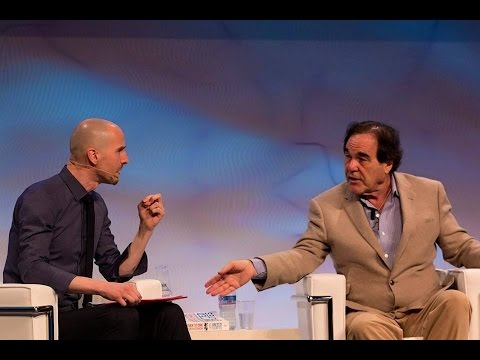
but Oliver Stone, whom I recently interviewed at the Iab Forum
He really impressed me.
The reason is that, regardless of whether it is closed like an oyster
and that makes you feel at ease like a doormat in the ocean,
however it is extremely intense
has his point of view that you may like or dislike,
but with which you must compare
and it is one that has undeniably made the history of cinema.
And he has great experience, great ideas, great competence,
on the theme of communication, of story telling.
Five things that impressed me in particular:
the first is attention to detail.
He sat on stage and the first thing he noticed is
the nuance of the color of the ceiling lights.
I had been there for two days, I confess and I did not even notice
that there were colored lights on the ceiling.
Details, details, in an hour that we spent together
he kept noticing details.
Number two the ability to go very deep.
For example, the documentary he did, a couple of years ago
“The Untold History of the United States”
wrote a 750-page book,
he made a ten-hour documentary where he condensed
110 years of American history from his point of view,
to be broadcast on television, it had to pass
through three legal and fact checks,
check to see if there were written bullshit or not.
It does not stop at the first interpretation,
digs, digs, digs, digs, digs.
The other related aspect is the sources of information.
Its sources of information are not traditional media.
Oliver Stone does not watch the news.
If you want to know something about terrorism, you read
what do I know, Pepe Escobar.
If you go on his twitter profile you will find some reported
of these authors that he believes give interesting information
for example of politics.
It does not follow what are the sources of information for all
but its sources are created.
Attention to users’ experience.
Rightly said that watching a movie on the phone
it’s ridiculous.
And you will say: “Mountains, but damn it last night …
you just saw Ronaldo’s documentary on your phone. “
Yes, it’s true, but you can also look at it on the Nintendo DS viewer
and it’s the exact same thing because the shit!
But if you really want to build an important experience
for your consumers, for the people you sell a product or service to,
the experience in which your product and service live
is critical.
And then the key to creating a story telling that functions:
the tension.
At one point on the stage he tells me:
“See, to create the tension, I could tell you for example
that I have something in my pocket and I want to give it to you,
But I do not give it right away, I’ll give it to you in a while. “
And so he keeps talking, while I was talking I thought
“but who has Oliver Stone in his pocket”?
The ability, when you tell a story, that it is
at the cinema, whether it’s online or dictated when you’re at school,
to manage the expectation, to manage the emotion
moving the levers of tension.
Five little things so on the fly,
there would be many others,
but I must say, Oliver Stone has left his mark on me
and above all Oliver, what the fuck was in your jacket?
Please follow and like us: