
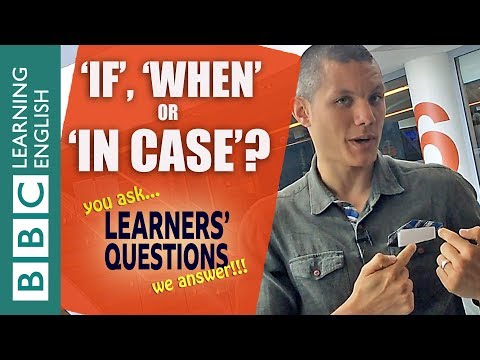
Hi guys! Dan for BBC Learning English here with this week’s Learner Question. Find out
what it is after this.
OK! This week’s Learner Question comes from Honza from the Czech Republic, who writes:
what is the difference between the use of when and if in all types of conditional sentences?
And Trung from Vietnam, who writes: would you please explain to me the differences in
use between in case and if? It’s a double learner question. you’re getting value for
money now aren’t you? OK, guys – pay attention.
So, we use when for things that are certain to happen in the future. For example, I’ll
give you a ring when I get home from work. Now note that although the time reference
is clearly in the future, we use the present tense in the when clause.
We use if for things that may or may not happen, or that we’re not certain about. For example,
if I decide to come to London this year, I’ll give you a call.
Now in all of these examples we’re talking about future conditions and whether we use
when or if depends upon the certainty of things happening in our opinion. However, when and
if are interchangeable when we’re talking about things in general. And in this case
if can mean whenever. For example, I keep the air-conditioning on at night if, when,
or whenever the temperature goes above 30 degrees. Did you get it?
We use in case to talk about taking precautions. That means doing something because something
else might happen. For example, I’ve brought some candles in case there’s a power cut.
When we use in case, we’re describing possible future situations, but when we use if, we’re
talking about conditions that might apply. Compare the difference: I’ll fill up the
car with petrol in case you need to go to Brighton. That means, I’ll fill up the car
now and you might go later. However, I’ll fill up the car with petrol if you need to
go to Brighton means tell me that you’re going to Brighton and then I’ll fill up
the car.
Honza, Trung I hope that answers your question. Thank you very much for writing to us. If
anybody else out there has a question for Learners’ Questions, you can email us on:
learning.english@bbc.co.uk. Please remember to put Learners’ Questions in the subject
box and your name and where you’re writing from. We get a lot of emails, guys, and I’m
afraid we can’t answer every single one because there are just too many, but we do
read them all. And for more information, go to our website: bbclearningenglish.com. That’s
it for this week’s Learners’ Questions. I’ll see you next time. Bye!
what it is after this.
OK! This week’s Learner Question comes from Honza from the Czech Republic, who writes:
what is the difference between the use of when and if in all types of conditional sentences?
And Trung from Vietnam, who writes: would you please explain to me the differences in
use between in case and if? It’s a double learner question. you’re getting value for
money now aren’t you? OK, guys – pay attention.
So, we use when for things that are certain to happen in the future. For example, I’ll
give you a ring when I get home from work. Now note that although the time reference
is clearly in the future, we use the present tense in the when clause.
We use if for things that may or may not happen, or that we’re not certain about. For example,
if I decide to come to London this year, I’ll give you a call.
Now in all of these examples we’re talking about future conditions and whether we use
when or if depends upon the certainty of things happening in our opinion. However, when and
if are interchangeable when we’re talking about things in general. And in this case
if can mean whenever. For example, I keep the air-conditioning on at night if, when,
or whenever the temperature goes above 30 degrees. Did you get it?
We use in case to talk about taking precautions. That means doing something because something
else might happen. For example, I’ve brought some candles in case there’s a power cut.
When we use in case, we’re describing possible future situations, but when we use if, we’re
talking about conditions that might apply. Compare the difference: I’ll fill up the
car with petrol in case you need to go to Brighton. That means, I’ll fill up the car
now and you might go later. However, I’ll fill up the car with petrol if you need to
go to Brighton means tell me that you’re going to Brighton and then I’ll fill up
the car.
Honza, Trung I hope that answers your question. Thank you very much for writing to us. If
anybody else out there has a question for Learners’ Questions, you can email us on:
learning.english@bbc.co.uk. Please remember to put Learners’ Questions in the subject
box and your name and where you’re writing from. We get a lot of emails, guys, and I’m
afraid we can’t answer every single one because there are just too many, but we do
read them all. And for more information, go to our website: bbclearningenglish.com. That’s
it for this week’s Learners’ Questions. I’ll see you next time. Bye!
Please follow and like us: