
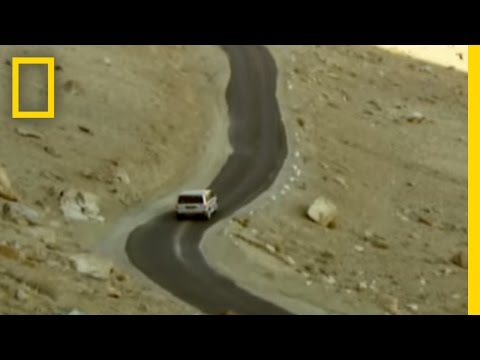
I’ll travel 15 miles and 3,800 feet in
elevation from my starting point in the
city of leh to my first destination the
Indian Army’s South Pole Oh check point
with the tensions between India and
Pakistan authorities require all
vehicles to stop and register before
proceeding northward as my companion
Harish Kohli and I climb into the
mountains the dangers we face become
more real Harish points out the type of
terrain that generates avalanches and
landslides you can see the size of those
boulders just hanging over this road
here it wouldn’t take much to knock one
of those often I guess they would come
down like cannonballs yeah
on this cliff here that is easily a
thousand feet to the right here
keep an eye on the road now I’ll try to
keep an eye on the road I’m not making
you nervous am i I’ve always knows all
these voters I’d rather walk it rather
than this and this is coming from a man
who’s skied across the entire Hema
layers like I’m fine when I walk it oh
when you’re on your own two feet
60-degree drop-offs are bad enough but
there’s a man-made danger to military
traffic as you see behind me the army
uses this road is a vital lifeline to
the nubra valley caravans of transport
vehicles dominate the road on occasion
the military even closes the route to
civilian traffic to accommodate the
convoys in 1947 when India gained
independence from Great Britain the
country was partitioned into Islamic
Pakistan and Hindu India the new
countries argued over the exact border
in 1984 each moved troops onto the sea
ash and glacier which is on the other
side of the Cardin pass both countries
have nuclear weapons and as recently as
the year 2000 u.s. President Bill
Clinton called the region the most
dangerous place in the world today
Harish Kohli served more than 30 years
as an army officer and he still knows
people fighting on the glacier today
getting caught up in the conflict is an
ever-present risk
as we continue our push up the winding
south face of the Cardin pass I find
myself in awe of the travelers and
traders who have made this trek along
what is known as the Silk Road on foot
the Silk Road entered the Western
imagination around 1300 ad when Venetian
trader and explorer Marco Polo wrote an
account of his travels to China
Cyrus before the invention of things
like cars and helicopters and more nice
technological advancements that we have
people used to track this yeah on camel
on foot with donkey yeah back then
getting stranded on the mountain with no
food or shelter was a death sentence
there was a time when the whole area was
littered with OPS’s of horses and camels
and there were dead bodies soon all over
and even today it is littered with bones
so the the also road was kind of a road
of bones hey close quarry Oh rolled-up
bones yeah and it’s nearly as risky
today
Please follow and like us: