
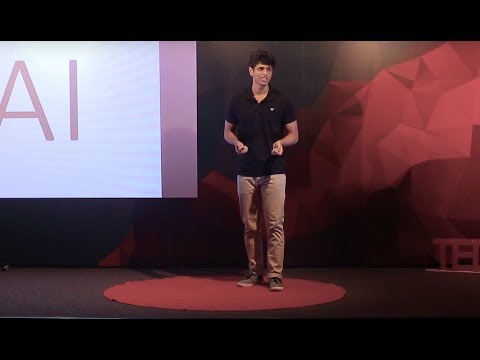
[Music]
so when I say AI what’s the first thing
that comes to your mind
Terminator iRobot any of those
science-fiction movies and humanoid
robots maybe well if it did that’s
actually not too far from what I thought
if AI when I joined college about
two-and-a-half years ago so at that time
I had this amazing dream that I’m going
to make a perfect robot of perfect AI
that can be just like any of you or me
so it could be standing here giving the
speech and you wouldn’t even know it but
well you could save my understanding of
AI was fairly limited to the movies I
was watching at that time but if you
don’t think of any of these movies
that’s actually great because you’re
already where I stand today and that’s
after I’ve worked in the field for about
a year so if it’s not what the science
fiction movies show us then what is AI
most of us use AI literally all the time
interestingly though many of us are
actually unaware that we’re interacting
with it but if you think about it that
is the point
an AI is any algorithm or machine that’s
designed to do a particular task but
without letting us know that it’s a
machine that’s calling the shots so if
you’ve ever done a Google search or use
Netflix movie suggestions or let’s say
city on your iPhone for that matter
you’ve already interacted with an AI yes
agree it is more visible in larger
machines like self-driven cars or
automated industrial robots but we see
that AI is actually not limited to just
the movies it’s got a wide range and a
wide range of applications so back at
college I was part of a team called
Project – and we were a bunch of
undergrads really trying hard to get
cars to drive themselves and not crash
of course so we’re taking part in the
challenge organized by Mahindra to build
India’s first self-driving car and I was
part of the AI division and
my job was to make the car perceive the
environment like a human so I’d like to
share a small incident from back this
summer when I was working over there so
quick fact about me I did not know how
to ride a cycle till this summer so for
20 years I’ve been doing nothing and so
I finally decided okay enough is enough
it’s high time I learned cycling I can’t
have people laughing at me anymore so I
borrowed my friends cycle and I told him
you know teach me you really need to
teach me right now
so he told me some things namely I okay
whatever because I was thinking okay
this stuff seems simple I mean I’m
working in the lab trying to make a car
see like a human so what is this task
but I learned the hard way that it
actually wasn’t so several failures I
injured my toe severely and I only
learned small paths
I was absolutely unable to apply them
together so I just couldn’t cycle but
after an hour or so I actually started
cycling and at that point in the lab I
was working on a few AI algorithms now
when we use these algorithms when we
train them we use something known as a
loss function now it’s similar it’s very
very simple to understand
so as the loss decreases you realize
that the machine is learning when the
loss falls below a certain threshold you
realize that okay now it’s started doing
what it’s intended to and I thought to
myself you know the way I learned
cycling is actually quite similar to the
way I’m training these algorithms so
after a lot of thinking I came to the
conclusion that you know maybe AI can be
used to understand the human brain and
that is exactly what I wish to share
with you today so our brain is made up
of these cells called neurons and they
have hundreds of billions of them now
these neurons are connected to each
other and the form of a complex network
in the brain they receive input from
organs like our eyes in yours and this
could be anything so in a mid seen by
the eye a sound heard by the earth or
anything else now each neuron processes
the information in a certain way and
passes it on to the other new
that it’s connected to now when we learn
something there are some noodle
connections that are created in the
brain and as we practice it or do
something repeatedly these connections
some of them are broken some are made
stronger and new connections are created
so basically what I mean is when the
brain learns to do anything it simply
creates connections between neurons
passes messages between them and that’s
how it learns now the root of AI is
something known as the artificial neural
network it is inspired by the brain and
hence works very similarly so it’s
simply multiple layers of neurons
connected to each other you give it the
input from one side so this could again
be imaged text whatever input it may be
each of the neurons process them in a
certain manner and you get the output
from the last layer now just like we
learn by experience so we do something
repeatedly and then become good at it we
train these networks similarly we train
them repeatedly on thousands of data
items to actually make them good at what
they’re doing essentially strengthening
the neural connections so if you think
about it the fundamentals of AI systems
and the brain are actually very similar
but let’s take an example to get a
clearer understanding so when you see
this picture I’m sure most of us can
recognize it as Jim Carrey now why do we
do this how is it working in the brain
so when the image from when this image
first reaches our eye it’s broken up
into several pieces and we’ve got these
things known as receptors in the eye
which do some sort of processing on them
now this processing could be something
as simple as finding the most important
edges in the image and essentially they
create a representation from what they
find it could look something like this
now this information is passed into the
neural connections that I mentioned
earlier and they try to make sense of
the information that they are supplied
to ultimately they come up with the
result now since we have seen Jim Carrey
before these noodle connections already
exist in our brain
they’ve already been created before so
essentially when we see this picture we
are only you
lysing the connections to actually come
to the conclusion that yeah is Jim
Carrey in the picture now AI systems
actually work very similarly we use
something known as the convolutional
neural network or CNN in short it’s
something like this now as you can see
from the animation it uses a sort of a
sliding window so you can consider the
blue as the original image and the green
as a representation created by the CNN
so essentially if you think about it
when this window is sliding it’s
actually focusing on small parts of the
image so it’s sort of breaking it up
into small parts just like the eye does
it and then it processes these various
parts to actually come up with some
valuable information now this is the
first layer the output of the first
layer of a CNN and something that I
design the network does a very simple
task it’s just supposed to identify if
Jim Carrey is there in a picture or not
and as you see from this representation
although it might not exactly match in
the representation in case of di both
the systems follow fundamentally the
same rule your first breaking it up into
small parts then you’re processing them
creating representations and encoding
them with various information and
finally trying to make sense of this so
till now what I explained were examples
of how AI was inspired by the brain so
now that we’ve established the
similarity between the two let’s dive
into the actual interesting part that’s
how a I can be used to decode the brain
so today we use MRI scans to actually
understand a lot about the brain and
doctors and neuroscientists all over the
world are using this this method to
actually find out various things
one example is something known as the
brain age now the brain age is
essentially just the level of maturity
that your brain has reached and this can
often differ from your actual physical
age and that is essential because the
difference between the brain age and
your physical age can actually explain
the onset of several medical conditions
in the brain
like dementia so I was recently reading
a research paper on this and I’d like to
share its findings with you
so traditionally if you analyze these
scans they need to be first pre
processed very heavily and when I say
pre process I mean remove all non brain
tissue so we can focus just on the brain
then they are analyzed by scientists
neuroscientists doctors and we finally
arrive at a result but with the advent
of AI there’s actually a simpler method
so you just take the raw scan throw it
into an artificial neural network and
you get the same result and the main
point to be noted here is the first
method takes about 24 hours the AI
method takes a few seconds so
essentially if you see what’s happening
over here is AI is enabling us to easily
extract information from the brain not
go into all that hassle ultimately come
up with the same result and allowing us
to focus on more important problems like
understanding the brain another
interesting use of AI can be understood
by considering the work of a
psychologist so what is he doing he’s
using AI to create a model of the brain
he’s teaching this model how to read and
what he intends to do is learn from the
model how it is understanding the
various characters making sense out of
it and use this finding on people who
have dyslexia so essentially he’s trying
to solve the problem in humans by doing
experiments on an AI model and this can
be applied to any field what I mean is
AI can be used as a modeling tool for
the brain and we can conduct our own
experiments to find out the various
problems that occur now I come to the
most exciting example of AI actually
helping human brain development and that
is an algorithm called alphago alphago
was an algorithm designed by a company
called deep mind now this was designed
to play the game of Go Go is a very very
complex Chinese board game now when I
say complex I mean at any point of time
it has more number of legal
than the number of atoms in the universe
so if the universe has about 10 to the
power of 8 the atoms which is 1 followed
by 80 zeroes go at any point of time has
a maximum of 10 to the power of 10,000
170 moves which is 1 followed by 10,000
170 zeroes so I’m sure we understand why
it’s going to be unreasonable to design
an algorithm that will try out all
possible moves and then pick the best
out of it
hence deepmind designed alphago to play
just like a human and that is very
essential because now that it works like
a human we can actually analyze the
decision pathways to understand how
decision-making goes on in our own
brains now when this algorithm was put
up against the world champion lee sedol
it beat him four out of five times in
fact in one of the games in the 37th
move that was played by alphago it
completely baffled lee and he had no
idea what to do however let’s focus on
the one game that lee actually won so in
this game in the 78th move lee played
such a move that he in turn confused
alphago and mind you he confused an AI
algorithm which is a great
accomplishment so after the tournament
he expressed that through this through
playing alphago he had actually been
opened to new ideas to be able to think
creatively and had a new insight into
the game and ever since then he’s never
lost a single game and go so one could
consider the 4 out of 5 losses as an
early sign of machines asserting their
superiority but I believe it needs to be
looked at differently I believe that
without the thirty-seventh move there
would have never been the 70th move what
I mean is what is AI enabling us to do
it’s enabling us to think more
creatively to improve the way we think
and hence providing a path to augment
our own natural intelligence at the end
of the day now I still believe that the
human brain is the most elegant
intelligent system to ever exist
yes AI does is superior than us in a
certain tasks currently but our brain is
far more superior in various other tasks
and our objective is to take this
natural intelligence to its pinnacle to
take it to its absolute height and AI
proves a very very promising path to
that point so what we want to establish
is a symbiotic relation between man and
machine so we make machine smarter make
them explore domains that we can’t and
then we take the information learnt by
them to improve what we are best at
thinking and inventing so we don’t want
a situation where it’s man versus
machine what’s ideal is man plus machine
versus problems so if you think about it
when you invest in AI you’re technically
investing in yourself thank you
[Applause]
Please follow and like us: