
well thank you Angus are you know it’s
really my great pleasure to be a more
fantastic talks we’ve heard today it’s
kind of hard to follow the last one
everyone’s tired home so I I thought for
my talk I would try and be as enormous
ly+ as I could and I want to talk about
biotechnology and I want to show you
that we are living in a golden age where
everything is really really good it’s
fantastic and I want to teach you Krusty
academic I want to teach you something
about well teach you something about
biotechnology so you appreciate how
important it is for your life and we
talked about future proofing the reason
we’re in this amazing position is
because we’re standing on the back of 50
a hundred hundred now 150 years of
outstanding scientific research which
has now come to fruition and put our
society in this amazing position okay so
when I started thinking about this talk
I guess I thought about you know
everyone always says you know we don’t
make anything anymore we need to make
stuff you know we speak white
manufacturing economy let’s stop making
stuff again we make loads of stuff we
make brilliant stuff but make stuff like
planes and things we go into space and
you know energy and we’re in
construction we’re doing all these
amazing things and they’re high-tech
industries I guess you could call them
that we make a lot of stuff and we can
do really really well the stuff I’ve
highlighted there I guess is where
biotechnology actually is really
important and really underpinning I’m
not construction up there I put that one
in a bit cheeky simply because we have
research going on the University of Bath
with colleagues of mine who are working
on self-healing concrete so there you
guys it’s all going on but really I
think the interesting thing about
biotechnology is that it’s so powerful
is so sustainable it’s kind of easy to
do it makes this really adaptable to the
future and it’s kind of future proofing
us right now I guess you know like I
said I can’t resist an opportunity to
teach something and
when I talk about biotechnology I guess
those of us of a certain age will think
maybe of genetic modification of crops
and of plants and that’s been going on
for a very long time now it’s been
really successful for breeding in
drought tolerance or higher yields
so actually we can start to feed the
world it’s really important endeavor and
it’s really safe and sometimes it’s
really really good with appropriate
caveats
well not talk about biotechnology all
when I think about making stuff okay and
when we make things in the biotechnology
well we actually look to biology how we
can do that we look to cells to make
things so cells are really good at
making things they’re really good at
making chemistry okay things like drugs
we use them all the time to make things
like drugs they’re really good at making
proteins and Angus alluded to this
proteins make up pretty much all of your
body and they do all of the jobs and
they can be like little molecular
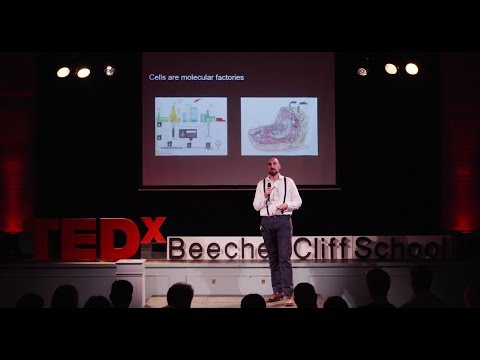
machines that do stuff so cells are a
bit like a factory if you want to make
something in a factory about normal
Factory on the left you have a control
center that’s kind of like the DNA in
your cells that controls everything you
have a production line there’s machinery
in the cell that produces the chemicals
and the proteins that we want to use and
then you have all your waste management
and cells do that and they’re very
efficient and recycling what’s in them
so it’s really sustainable kind of
technology biotechnology I guess I think
it’s important to get a sense of scale
angers can swing into action and click
that for me it’s important to get a
sense of scale for me to impress you I’m
going to impress you I want to other
things great will impress you so if we
think about the scale of what we’ve got
we’ve got things up here like coffee
beans and grains of rice and even sesame
seeds amazing so we can zoom in we won’t
wear our there we go and if we zoom in
we can see what the scale of things
we’re talking about so we’ve got grains
of salt right in the middle of there we
kind of got cells so cells are kind of
small maybe really big one so the size
of a grain of salt human eggs are huge
they’re really really big ok if you zoom
in even more skin cells red blood cells
they’re kind of normally sizes remember
this is much smaller than a grain of
salt now even more we got things like
and bacteria yeasts and bacteria are the
workhorses the cells were used to make
the chemistry and the proteins that we
actually care about if we zoom in even
more discus sense a scale we’ve got
viruses viruses are really small which
makes them so nasty and hard to deal
with and now if we get to this point
we’ve got the stuff really it’s inside
cells proteins and small molecules bits
of chemistry how small is that well if
we zoom in even more from that we can
see right in the middle the scale of
atoms so right in the center that dot
that is a carbon atom that’s a smallest
thing you can get yeah and that’s kind
of how big proteins are that’s kind of
how big the scale we’re talking about
really Micro but really powerful
technology what is biotechnology let me
impress you me tell you how great is
this washing powder you have proteins
called enzymes in your washing powder
which are little molecular machines
there’s one of my machines moving this
where my students made that and they
chomp away all the food and they break
down with the fats and the food and the
blood and whatever else you got in your
clothes and they do a great job of
cleaning your clothes we make things we
got here penicillin here we go got
Peniston that’s kind of important like
that that’s made by biotechnology that’s
old technology now but antibacterials
we’re all pretty much here because of
them here we’ve got antibodies we’re
going to come back to antibodies they’re
kind of protein that cells make a really
important what about beer
everyone likes beer alcohol we’ve been
making alcohol by biotechnology for
thousands of years brewers yeast they
for thousands of years alcohol fine you
can put it in beer what about in fuel
it’s an amazing fuel ten percent of your
fuel now has to have been made by
ethanol okay and that’s made by yeast –
biotechnology it’s really sustainable
it’s really really good it’s not all
about things we can make it’s about
sensing these molecules as well glucose
if you’re diabetic you have to monitor
your glucose very very carefully and
we’ve got bio technologies we’ve got
technologies for monitoring blood
glucose level all of these things I
think you’ll agree with me are kind of
amazing and we kind of said them for
granted but they pushed their bio
technologies that are built on a long
history of future-proofing to give us
kind of an amazing society an amazing
healthy productive society
I want to talk about now antibodies
antibodies are amazingly amazingly
amazing they’re really new we’ve got
antibodies in our body and they protect
your body from infection we’re now using
them as drugs they’re really good at
finding specific cells in your body so
what you can do is put a drug molecule
it’s Hatchett to your antibody and it
will find just the right cells to
deliver the drug to and they’re called
therapeutic antibodies and there’s some
of the biggest now they are the biggest
drugs in the whole world and they’re
relatively new and they’re so important
and they’re so amazing and they’re such
good drugs that by 2020 we did a bit of
work I had say in conjunction with the
Iuh in bath they helped us a lot we’ve
worked out that by 2020 the NHS will be
spending 2% of its total budget on
antibodies for therapeutic purposes even
more money in America even more money in
China so developed economies are going
crazy on these things because they’re
keeping us all alive they’re curing us
from cancer and sorting out our
arthritis they’re really kind of wonder
drugs in many respects I guess
antibodies and the challenge with them
is that ok take care of suitable aspirin
it’s in your bedside table it’s there
for years gosh you don’t want out the
other day that’s I don’t know how long
and it will just solve the problem it
will work the way it was meant to work
years down the line antibodies are
proteins and they’re kind of floppy and
floppy proteins are really unstable what
that means is they tend to break down
and degrade but when antibodies break
down or degrade they aggregate and they
clump together and in proteins that’s
kind of you’re familiar with that when
you have an egg it’s translucent and
when you cook it it goes all the pake
and that’s the proteins in the egg
because it’s really protein rich
aggregating together now with antibodies
actually if they start to aggregate even
a little bit they become really toxic so
these amazing drugs which are really
really good become toxic if they are
mishandled this is not a problem you
don’t need to worry in developed
countries you’ve got the factory over
here we’ve got the truck that’s got a
fridge in it just keep it cold it will
be fine and the truck with the fridge in
goes to the hospital and they’ve got a
fridge too and that works really well
and it goes into the fridge and then
goes up to the patient and it gets
administered and we know exactly when
it’s getting can I go from here and it’s
going to get up to the patient so it’s
completely safe completely safe and the
fantastic drugs we’re lucky what a time
to live in I really promise you these
are great drugs what about if you’ve no
idea how long it will take you to get
from here and to the patient what about
if you don’t have a fridge or your
powers so intermittent that the fridge
only sometimes works how can you
guarantee that when you administer that
drug it won’t kill the person
therapeutic antibodies which are one the
drugs are hardly used outside of the
developing world of the developed world
hardly used at all and there are a bunch
of reasons for that
one of those reasons is because they are
so relatively unstable compared to
paracetamol than aspirin you cannot
guarantee that the drug that you hopes
to deliver on day X or get there on day
wrecks all that it would have been cold
all the time and so you can’t administer
it you don’t know if it will be safe we
have great partners in Kenya peace of
Korea and Francis macoco from Mount
Kenya University and we’re trying to
think about this problem with so here’s
Kenya and Kenya has got an interesting
problem because there’s no Roby in the
middle and it’s got a bunch of hospitals
all the people kind of don’t live there
they live all over the country and some
people live more than a thousand
kilometres from a hospital so that’s the
kind of scale of problem they’re facing
so they can’t just nip to the hospital
to get their treatment really you have
to have local treatment but that’s a
problem for antibodies because this is
going to degrade in the back of the
truck we did some work with Maria Vitara
she’s in the school of management and
she thought well what if we just put
hospitals in more locations can we solve
the problem of getting people to a
hospital
and unfortunately the logistics in Kenya
mean that just doesn’t seem to quite
work so we do have to take the drugs to
the people how are we going to get them
there and make sure that they’re safe I
think well I was excited about today and
thinking about this problem is we could
share some of our really recent work
with you and hope show you and the idea
is to inspire you to think that we can
solve these problems if we think
creatively maybe the black ground
background wasn’t such a great mover
that’s fine we developed a way to shine
light on antibodies and we look at the
way they absorb that light and they
changed that light to tell us about the
health of the antibody and it gives us a
fingerprint and it gives us a kind of a
nice spot and if that spot moves from
our measurement we know that the
antibody is going to become in probably
tending towards aggregating unsafe toxic
okay so we can potentially now give you
an instrument at the point of
administration that can check to show
your antibody is safe to administer and
we developed this kind of little
portable instrument it’s kind of goes in
a suitcase it’s really cute and we’re
going to send that out to our great
collaborators in Kenya and they’re going
to test that for us in a few weeks so
that’s fine if you kind of know how long
it’s going to take to get somewhere you
can check and make sure your drug is
safe but what about you’ve got to go a
long way some of these places are a
thousand or more kilometers away from
where you might ship your drug out you
just really can’t guarantee that it’s
going to be any good over that period
time and he just won’t be it will
definitely be not a minute you won’t got
to give it well with acyl survivor in
bath she’s in chemistry she’s developed
a way to wrap proteins in glass and by
wrapping those proteins in glass those
antibodies in glass you massively
stabilized them and stop them from
aggregating it’s a bit like she always
likes to use this load I stole it it’s
Han Solo from Star Wars he was wrapped
in carbonite you doubtless will remember
and he was frozen in time and when he
was released from the Carbonite he was
all tickety-boo that’s the idea here and
it works really well so we wrap around
he bodies in glass and then we check
with our finger printing approach if it
looks the same if it’s safe to
administer and they are and these are
real antibodies and they’ve been left
out for months in the heat this works
really really well this is an early
stage of something but I hope he goes to
show that we have to think creatively
about solutions to solve problems and we
mustn’t be greedy and gluttonous about
the amazing technologies that we take
for granted every day in our developed
world that’s why I wanted to think about
how do we empower the use of this most
impressive of technologies I think we
need to make sure it’s a regulatory
level and a personal level we have fair
access of these technologies we work out
ways to put these technologies in
people’s hands
that’s about miniaturization and
portability and rugged izing our
approaches to getting technologies to
people it’s about collaborating with
governments and NGOs to try and find
good routes forward it’s a really
complex problem I think if we think
creatively we can solve it thank you
very much
[Applause]
Please follow and like us: