
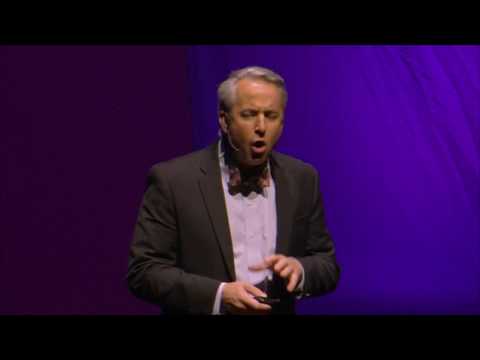
I wanted to tie a bowtie
I figured this is a cool skill right so
I learned by taking this bowtie and
crossing it over like this pushing this
piece back following everyone adjusting
all along the way that’s the tough part
right and you have a bowtie how do I
look well
this crazy little thing that I wanted to
learn was because I was thinking about
all the things that happen online all
the ways that you can learn outside of
your traditional classroom
so this bowtie came to me wrapped in a
cardboard instruction manual it didn’t
work for me really didn’t work for me so
after many tries I did what many of you
would do I got online and a couple
clicks later I found the video how to
tie a bowtie and that video took me on a
journey a journey I’d like to share with
you a little bit each year there is a
hundred million hours of how-to videos
produced ok pause and think about that
for a minute
that’s 4.1 million days of continuously
played video just what we need right
that’s per year think about that for a
second our world is changing in ways we
probably never expected and when we
think about learning and I want you to
think about learning we can almost find
anything that we possibly wanted to
learn and we can find it in so many
different places so now I’ve got a
question for you what is that one thing
that you really wanted to learn that one
thing
that may change our life or your career
or even change someone else’s life and I
want you to put it in your head this is
the interactive part put it in your head
hold on to it and think about it we’re
gonna come back to this later
a person who is autodidactic that word
is a person who has learned a subject
without the benefit of a teacher or
formal education a self-taught
individual how many of you are that self
taught individual most of you in the
room have taught yourself something at
one point in time but I want you to
think about those people who have done
amazing things of the things that
they’ve taught themselves well Leonardo
da Vinci and Thomas Edison the great
inventors taught themselves frida kahlo
and Frank Lloyd Wright the architect
taught themselves and even Frederick
Douglas who taught himself how to read
and write to become the first
african-american to be nominated for
vice president or Caroline Herschel who
built and designed her own telescope and
was the first woman to receive the gold
medal from the Royal Society these
individuals had a special formula and
that formula looks something like this
first interest ya gotta have passion you
have to have some interest in what you
want to do second is the content it has
to be rich and viable content important
and critical to the learning process and
then third is design how is it
structured in its design what were the
components for me that cardboard just
didn’t work but the video did the place
where these three intersect that spot
that special spot is the secret place
for learning these three things come
together you can applaud go ahead
I’ll let you well it’ll get better so as
I think about this in my career my
career has been over 25 years in this
business of informal learning I started
at the Shedd Aquarium in Chicago and
then became a zoo director at John Ball
zoo and Grand Rapids Michigan
and now as the head of the st. Louis
Science Center we ignite passion every
day for kids that walk through our doors
and it’s really important to understand
that our exhibits and our opportunities
that people experience it’s on their own
it’s a free choice learning experience
they can wander wherever they go and
figure out whatever they want that’s an
important part and we do it all to
create wonder imagination and discovery
and we do it without grades or judgment
but probably the coolest part about my
job is I have super cool employees I
mean some of the coolest employees they
are really spectacular and I’m going to
show you one this is one of my favorite
employees he is never late for work I
will tell you that and this employee
though can instill the fear in our
youngest children it’s a rite of passage
to pass by the dyno but for others
they’re not intimidated they come in
with eyes wide open minds ready to learn
and thinking about the opportunities
that may exist beyond the doors we have
these Dino kids that drag their plastic
dinosaurs and backpacks filled full of
all the things Dino
these Dino kids come to our place to
teach us as much as we teach them it’s a
great opportunity for us to expand their
knowledge and their love for learning
but they’re not alone 1.3 billion people
a year visit places like science centers
museums aquariums zoos and national
parks 1.3 billion people a year
libraries and community centers are also
hundreds of millions of people visit
them each year and of course all of you
are here tonight these experiences of
learning outside of the classroom are
both special and memorable for many
people they think of learning taking
place only in the classroom and between
the grades of first and 12th grade we
spend less than 20% of our waking hours
in school 20% of our waking hours in
school leaving 80% of our time to learn
outside of school I’m not bashing
schools I went to one I was a teacher I
understand the importance of those
experiences and facilitated classroom
environments I understand the importance
of the world of teaching and in colleges
and universities if you’re advancing or
building a career colleges are often
essential but adults between the age 25
and 54 spend less than one hour per day
on educational activities one hour per
day I think we need to think about it a
little bit different I think we have to
think of a world that’s slightly
different than the way it is now and 19
years ago
there is one word that changed our lives
I see that you’re familiar with it this
word changed our lives forever content
became available 24 hours a day seven
days a week and through multiple devices
you can sit on your couch and find
anything you want these three college
dropouts change the way we communicate
the devices we work on and the way we
work and they are very familiar names
Jack Dorsey Steve Jobs and Bill Gates
but this woman Masako wakka Maya is not
a familiar name to most of you
a retired banker at the age young age of
81 years old from Japan found that there
were no games for seniors out there on
the Internet she became frustrated by
this so she reached out to developers
and programmers and didn’t find any
success so she taught herself how to
program she taught herself how to build
an app and it’s available on the App
Store right now the Internet is an
amazing thing and we think about it
every day these technology tools are
incredible you and I both know how it’s
changed our lives but I also think
there’s some big risks some big
challenges you know the idea of biased
and false information on the web is
really clear right just go try to Google
the idea of is the world flat believe it
or not there’s a lot of information that
tells you it is watch teenagers at a
social outing are they talking to each
other they’re texting each other verbal
communication is out of our world if
you’re a teenager we’ve become slightly
lazy because this tool has become such a
rich and valuable opportunity
for us neuroscientists say that the
distractions from our devices everyday
are actually affecting the way our brain
functions negatively and I’ll ask you
how many have you have ever ordered a
meal from your couch because you didn’t
want to go out and get it okay I see
every hand so that opportunity I want
you to think about as both a positive
and a negative and I want you to think
about a world that’s a little bit
different
we’ll set the internet aside and let’s
talk about experiential learning
Kelvin doe a 14 year old boy from Sierra
Leone wanted to build his own radio
station but in Sierra loan in his
neighborhood there was very limited
amount of power so he had to invent and
become his own engineer and when he did
this he did it all on his own a
self-taught engineer and he’s amazed
some of the brightest minds at MIT
through his actions well what did he do
Kelvin forged for everything he could
find to build a lot of trial and error
hands-on activities that made him create
different things matter of fact he
created a battery a generator and a
transistor radio from things that he
found he’s the youngest recipient of the
visiting professionals at MIT this young
man had built his dream the radio
station and he performs today under the
moniker DJ focus this young man has done
amazing things including creating
batteries for his neighborhood so that
they have electricity
misako and kelvin inspire me they remind
me that life long learning
doesn’t require age or resources that
it’s a part of who we are it’s the
University of me what does that look
like and feel like as a lifelong learner
myself I continue to learn I want to be
in a place that I can continue my
journey and as a ski patroller I help
people who have been injured on the ski
hill or experiences on the Theodore
Roosevelt aircraft carrier watching
hundreds of people scurry around the
deck at this little city out in the
ocean but I’m still not done these are
just the start
I want a captain a vessel around the
world especially on nights like tonight
I want to fly a plane I want to become a
chef
each of these opportunities I have to
get on the boat or in a plane or off the
couch and go buy my food this world of
learning is all so available so I go
back to the question I asked you early
and on the count of three I want you to
yell it out
ready what is that one thing remember it
we’re gonna pull it out ready one two
three
I heard a lot I’m not sure what exactly
I heard but I heard a lot there’s lots
of content there and there’s amazing
opportunities for design we can no
longer sit back and watch we have to
grow and learn every day to keep up and
that is what makes learning so special
so now you have no excuses I hope I’ve
inspired you just a little bit to get
off your couch and think a little bit
differently and to build the University
of you thank you very much
[Applause]
Please follow and like us: