
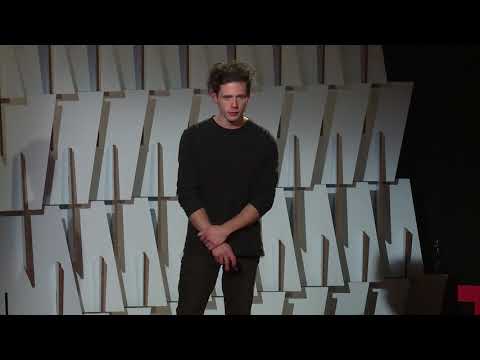
I’m Tim this is hibiscus syriacus or you
might know it as Rose of Sharon this is
a Brassica oleracea or better known as
broccoli it’s the flower of a broccoli
plant it’s the part we eat and the
flashes are from Lights changing inside
of an indoor farm so I have somewhat of
a unique relationship with these plants
and I suppose plants in general I’m a
biology researcher and an engineer and
the work that I do with them might best
be described as decoding plants or if I
could borrow the the title of this block
decoding how plants express themselves
so before I dive into that work I just
want to thank everybody at Ted for
giving me another opportunity to wear a
microphone along my ear it was precisely
five years ago that I dressed is uh
Justin Bieber as for Halloween and it’s
just such a great look for me I just
appreciate it so thank you Ted but back
to plants
so my professional relationship with
plants started a few years ago when I
was doing research as part of dr. Lizzi
wool kovitch is temporal ecology lab at
Harvard just across the river and our
group was deeply interested in a topic
called phenology now phenology is simply
the study of an organism’s life events
you and I have life events like birth
and graduation and marriage and
potentially but hopefully not divorce
plants also have life events but they’re
morphological it’s their change in their
form so for instance we’re in the midst
of one right now false in essence is a
phenological event but our lab group was
mostly interested in the spring
corollary to that event which is
budburst and I can walk you through what
that looks like this is when the the
leaves emerge from their winter dormancy
this is a white ash bud
during dormancy later too it’s swelling
stage onto it breaking open its chute
elongating and as spring continues its
leaves forming now there are two
distinct biochemical cues for the plant
to go through that morphological change
or cues for it to actually express that
leaf one is the spring times extended
day length so the photo period and the
second is spring times warming
temperatures now which of those two
variables is the main driver of that
expression of a leaf is a huge
ecological question that’s yet
unanswered so that’s the one my group
went after answering and we did it by
setting up a few experiments as
scientists do we collected hundreds of
twigs literally just cuttings off of
trees between here in Montreal of about
30 different woody tree species or woody
species
say these are my old colleagues Jehan
and Dan as we are scavenging for our
species and we would take those cuttings
or twigs back to our lab and put them in
just a splash of water in a flask and
then enter them into a growth chamber
where we could incubate them in these
different spring environments or
different simulations of spring so we
could really parse out whether photo
period or temperature was that driver of
leaf expression now critical to that
work was having some sort of standard
way of deciphering my subjective
observations and turning them into
objective data points so I need so I
needed a rubric that could tell me what
what was I looking at and what stage
should I record that plant so I used a
rubric like this and I would enter my
chamber and for example I would record
that white ash as a stage 10 where it’s
chute is elongated so I’m effectively
decoding these morphological status
stages into data points and data
collection ensued and there was quite a
lot of it I had about 250 twigs in each
of four growth chambers and I took data
points or collected data twice a week
for 10 weeks for a total of 20,000
measurements that’s a lot of data and if
that’s not enough I actually did it two
years in a row so that’s 40,000
measurements that I took and it nearly
drove me insane
it was it was difficult it turns out
science is very hard if you do it right
and I salvage the experience because
each time I went in to measure this
expression of a leaf I I began to admire
it more and more these are really just
amazing organisms it seemed like they
were designed almost architectural II
the way their leaves unfolded and
unpacked from the buds and it spurred me
to deploy my camera and attempt to make
a different visual rubric or dataset
because these weren’t quite capturing
the beauty that I was seeing in the buds
and in my species so I started doing
computational photography or time-lapse
photography like this shot of a lilac
flower inside of one of the growth
chambers this is several weeks of
photography happening here spoiler alert
it dies
I showed you a a white ash this is a
black ash bud there’s a little bit of a
delay at the beginning of this so this
is the the bud breaking open and the
leaf emerging it’s just really cool to
watch we’re at least a photograph so as
I was taking these measurements and
doing these photos I added mechanical
engineering onto the project and started
fabricating my own actuators for my
camera so this is a rail that I built to
take more cinematic shots with movement
like this shot of a Heyman maelys leaf
opening so the camera is actually
traversing along a rail so what happened
here is is that I noticed a you know a
change in my own form right I went from
a biologist to a computational
photographer to a mechanical engineer
and I’m still not sure how my dad feels
about this but an artist as well and I
very gratefully have the privilege of
wearing all of those hats simultaneously
at MIT Media Lab now where I am decoding
plants in a different way and I’m also a
farmer for that cause so in the work I
just described I was really using
computation and engineering to to decode
how plants express their morphology or
their form really how we see plants and
at the Media Lab we’re doing work to
decode their flavor or how we taste
plants and I’d love to show you what
that looks like I’m a part of the open
agriculture initiative at MIT Media Lab
where we are building open source
hardware and software to sort of
reinvasion the future of agriculture
this is a piece of hardware we built
called the food computer and the groups
led by caleb harper
before I get into what a food computer
does I’d appreciate it if the members of
this audience could potentially think of
a flavor memory you have a taste maybe
when you were young of a piece of fruit
or tomato that you wish you could have
saved or captured or at least you still
remember I I have one my grandfather’s
blueberry bushes we used to pick
blueberries in my grandfather’s backyard
and if only I could have saved what
those tasted like and and how does that
flavor come about well you have a seed
that has certain set of genetics in it
right and those genetics or that genome
determines how the plant will express
its flavor but also you have something
called the phenome which is the whole
suite of environmental variables that
the plant experiences while it’s growing
that go on to express or not express
those genetics and subsequent flavor so
you have a seed right but you also have
how much co2 is in the air when the
plants growing the temperature and
humidity of the air in which it grows
the schedule of water and rainfall or
the microbiome of the soil as wine
growers know or just the color of light
that it experiences while it’s growing
that all add up to the phenome which
causes this blue berry to express a
particular flavor now what if we could
decode the phenome of a particular
flavor what if we could figure out which
variables produce bitterness or
sweetness well we would certainly need
some sort of tool for that right we
would need a growth chamber like the
ones I was using the control photo
period and temperature but what if what
if we built one that had more knobs you
could turn for each of those variables
well we’re at MIT so yeah we’re doing
that and it’s it’s called the food
computer this is our our young version
of the personal food computer a sort of
desktop size
and I like to think about this as sort
of presets almost like the your car seat
right imagine if you could take that
flavor memory figure out the environment
that produced it save that as data
almost as a data file and mail it or
email it to a friend who has a food
computer and has the same seed as you
and they could grow the precisely the
same flavor tomato or flavor blueberry
as you not merely just the same plant
and we call this environment recipes and
we think this is going to change the way
we grow food in the future so that was
the personal food computer this is our
next generation of food computer it’s
called the food server and I’d like to
actually just show you the inside I just
harvested our first plants and data this
is an experiment I’m running on basil to
see how UV light creates a tastier basil
these are seedlings that I just
germinated I’m still somewhat
reluctantly manually collecting data and
this is a new food computer we just
built it’s called a tree computer and
we’re building it for a candy company
but I’ll save that for next year and
what I love about this work is that I’m
not merely just collecting data but I’m
actually building and designing the
tools to do the science and to collect
the data and as much as this talk has
been about how plants express themselves
it’s also been about how I express
myself through my work and if we go back
to form and taste there was a transition
in the form of my work right when you
start off with this sort of sterile
rubric of these growth stages and I
changed that form to something more
compelling and engaging like this
time-lapse and with that change in form
was a change in taste where you have
or there was a change in taste or
whereby I went I went from merely a
biologist to having a more robust
constellation of pursuits in engineering
and design but it’s still rooted in
science because I would argue that
that’s this time-lapse is actually just
as scientifically rigorous and data rich
as the rubric it was born from so if I
could offer some advice to any young
folks in the audience just embarking on
this work of decoding how they want to
express themselves there are so many
entry points into science science and
research need photographers and farmers
and I encourage you to continue this
work that I hope shows that science and
art aren’t just two disciplines that
play well together but can often be the
same thing and if you have as look as
much luck as I have had you will go from
having an interest in ecology to
arriving at an ecology between your
interests so thanks for your time I
appreciate it
[Applause]
you
Please follow and like us: