
[Music]
my stories begin with an arrest my own
I’m afraid and a hand-painted sign
outside of a jail in the South Seas it
was December 1977 very hot day I had the
day off from teaching at the farm school
where I was employed to off of farm
school to offer in Tongan means
wilderness we were out in the middle of
nowhere I was a long-distance runner at
the time out on a hot day sweating took
my t-shirt off stranded by just a sea of
coconut palms nothing else when I heard
a siren behind me on this dirt road in
the middle of nowhere I turned around
flashing lights white Jeep coming a
Tongan policeman got out of his white
Jeep and he said you’re arrested now his
Tongan was good but his English was not
my Tongan was not good my English was
fine we drove 15 miles to the capital
village of Nayef on the island of Abajo
the Kingdom of Tonga is about 850 miles
northwest of New Zealand to place it for
you and on the 15 mile trip I gathered
through our broken language
understanding that I was being arrested
for two reasons one was exerting myself
on the Sabbath and the other was running
around topless anyway we got to the jail
and that sign that hand-painted sign
outside the jail was the first thing
that I read now we’re here today to
learn about lessons having to do with
beginnings and I’m going to begin with
lessons about learning and what I
learned from that sign well here’s what
the sign said hand painted black on
white it said prisoners not back
prisoners not back by six o’clock we’ll
be locked out overnight
well it’s the lesson this sign was a
teacher this talk is about teachers and
what they teach us especially about
learning I learned something from that
sign I learned that we don’t see the
world the same way our biggest
assumption is that we do that the way I
see the world is the same way you see
the world we know that’s not true when
we’re traveling in foreign countries we
know it’s not true in our own country
especially these days we know it’s not
true in this very room we all have a
different lens through which we see the
world because we have different
experiences but the issue of seeing is a
very important issue I think to all of
us they say after all there are three
tasks in life seeing being and doing and
there a hierarchy what you choose to do
is a function of the kind of person you
are or the kind of person you want to be
the person you are is a function of how
you see the world
it’s the glass half empty is it half
full there are many other perspectives
of course but the way we see the world
is a function of how we learn of what we
learn and from whom we learn and that
brings us to great teachers I want you
to think about your own favorite
teachers in your own life I’m going to
tell you about a few of mine this is
Margaret Farini
she’s in room 118 of Hamilton original
high school up in the North Shore of
Massachusetts where I was a student she
was my English junior year teacher she
loved Moby Dick she loved New Bedford
she came from Gloucester she’s buried in
Gloucester
she was very short maybe five feet tall
she was very unattractive you can’t see
her face here very well she had warts on
her face she had facial hairs I won’t
don’t want to go into that because we
loved mrs. Franny we called her MA she
called us by her last names by our last
names one day I was in class she asked
me a question
I gave a glib answer I don’t remember
what it was and she sighed she was
sitting at her desk she stood up she
walked over to me and she looked right
at my eyes and she said nurse is that
how you really think not too long after
she gave us an assignment one of my
favorite Simon’s I became an English
teacher because of MA free the
assignment was choose your two favorite
songs play them in class in a five
minute oral presentation interpret the
lyrics we loved that unit so in two
weeks 24 of us gave our five minutes on
our favorite songs mine were Simon and
Garfunkel the boxer and Simon and
Garfunkel the dangling conversation the
end of the unit she looked at us and she
said we’ve done a really good job
everybody loved doing it I mean playing
your favorite music it was all rock and
rolling back in those days but she said
it’s clear to me that you all really
like rhyme you really like rhythm you
really like lyrics now she said today we
can begin our unit on poetry and we did
the lesson from Mafra knee will is two
lessons one when she read moby-dick she
told us I read it every year and every
year I learned something new the lesson
was there’s no such thing as reading she
said only rereading we all have favorite
books they become great teachers of ours
but we forget the lessons of them and ma
was saying it’s important to fight the
great forgetting it’s important to
remember the important things in life
and rereading allows us to do that the
second lesson was that subjects in
school don’t come from school they come
from the real world poetry is not a
textbook poetry comes from poets
flesh-and-blood people arms and legs and
it seemed to me that she was also saying
what you all really want is to get into
the real world you want to learn about
the real world you want to learn about
your place in it I’m going to give you a
chance
and I’ve thought through my teaching
career yeah it’s pretty much what we all
want most of our lives
to learn about the world around us and
our place in it
at any rate I moved on to college and
the guy on the right is a guy named
Whitney Stoddard he taught us history of
architecture it was the first class
literally I took in college it was
Monday morning eight o’clock the lights
went out the slides came up he talked
about Gothic cathedrals in France and so
forth and so on his last lecture cuz it
was all a lecture we didn’t say it
though the thing his last lecture was
about his favorite residents on a hill
in the south of France he finished with
a flourish all at once a hundred and
twelve twenty five of us in the in the
classroom stood up and gave him a
standing ovation I was a rookie freshman
I’d never once in my life thought about
clapping for a teacher thirty seconds or
so I thought went by I looked at my
watch I said how long is this gonna last
three and a half minutes later you’ve
never been in the three and a half
minute standing ovation I don’t think
maybe you have it’s exhilarating three
and a half minutes later we sat down the
same time next year I took a seminar
course this was a lecture course I took
a seminar course guy named Fred Rudolph
the subject was the history of American
education totally different approach he
sat down the first day around a seminar
table there were 30 of us around the
table he said this is the first class
and the only class that I will start by
saying something sure enough next
session we come in he sits down shuts up
we look at each other
everyone’s awkward fidgeting looking at
their notebooks finally some brave
upperclassman opens his mouth off we go
a semester later standing ovations
unbelievable like-minded people talking
about matters of first importance what’s
the lesson of these two professors these
two great teachers of mine I think one
is that there is no best way of teaching
lecture seminar very different but I
think we found at least in our work
filming teachers in the last six years
that the best teachers share one thing
a passion for their subject a passion
for learning and most importantly that
passion rubs off on their teachers
my only regret with regard to my
relationship to Ma Ferrini was that I
never thanked her this really bothered
me she died in 1992 she’s buried as I
said up in Gloucester I owe everything
to her and I never thanked her this lady
a Latvian teacher who taught me how to
write English my freshman year in high
school her name is Geeta
Vova Greenberg’s this is what she looked
like in 1968 this is what she looked
like
three months ago when I met her for
breakfast in a coffee shop on the coast
of Maine and I thanked her there’s no
real lesson here except that maybe the
best things are the most enduring things
and some of the best enduring things are
learning relationships and here I just
taken it a little aside and urge you
think about your favorite teachers
through the course of your life the ones
that made a big difference
find them and thank them of course
teachers school classroom teachers are
one kind of the teacher books authors
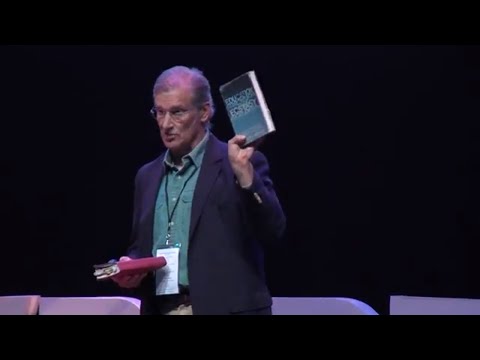
are another kind my friend gave me this
book the original cover looks like this
when I was a senior in high school this
is the reason I’m a teacher it’s called
education in ecstasy the lesson is
pretty clear I’m pretty straightforward
George Leonard who founded the so called
human potential movement about which
you’ll hear later this evening
back in the 1960s world’s but in
California he wrote a book about
education and ecstasy called it
education and ecstasy and his claim was
that learning fundamentally is a process
that changes us and at its best delights
us and when I decided years later to
dabble in architecture I design and
built two-and-a-half houses with the
help of this teacher a guy named
Christopher Alexander chairman of the
architecture department California
Berkeley
by training his philosophy was good
architecture good design should create
spaces for events or situations that
bring the most and the best out of
people make them feel the most alive and
I noticed that in those hi Eureka
moments which I’ve had the good fortune
of having many of my life
those are the moments in which I feel
most alive that seems to be the point of
it all
now there’s another book the dictionary
which can teach you about teaching and
learning and when I was in my late 40s
not till then much too late I looked up
the route I was teaching English after
all I looked up the route of the word
learning the etymology of it and turns
out it’s an old English word
Lior nian le o are n ia and Lee or nian
you’ll never guess what it means so I’ll
just tell you straight out
it means last footprint or last furrow
you know in a field that you’re
ploughing the last furrow that you’ve
overturned the implication the lesson of
this is really interesting very
important for this those of us who are
teachers and the implication is you
can’t teach somebody new unless you look
back at the last place they’ve stepped
unless you connect previous knowledge to
the future knowledge that you want to
impart after all we can’t understand
anything
brand-new except in context it’s really
interesting if you take this image a
little bit further the last furrow image
you know you’re plowing this furrow you
turn the corner at the end of the field
you’re gonna plow the next field you
look back at where you’ve been but you
know if you look back and you find
yourself still in that furrow
stuck not moving forward not making that
connection to where you’ve been where
you’re going you get in the rut and you
can wither and you can die I don’t think
many of us want to wither now movies of
course I’m a filmmaker now education
documentarian in movies I love and
movies are great teachers in character
movies are wonderful teachers here’s the
late great Irish actor Richard Harris
who plays the abbe Faria the priest in
The Count of Monte Cristo just to set
you up for this if you read Alexandre
Dumas you know wonderful classic you
know that the hero is Edmond Dantes
simple sailor innocent kind of guy
unpretentious illiterate because of
treachery he winds up in a dungeon in
the Chateau d’If where he’s supposed to
rot for the rest of his life has to do
with Napoleon it has to do with the
treachery of a good friend of his is an
aristocrat who’s jealous anyway he gives
up on his life he wants to kill himself
in this dungeon he gives up on God he’s
at pit of despair when one day he hears
a noise in the cell floor and up through
the cell floor pops the head of a very
dirty tunneling and learned priest yabby
Faria and the Abhi’s been taking for
eight years in one direction hoping to
get to the outer walls you may remember
if you’ve read the book have seen the
movie and here he comes up he’s in the
wrong place because he chose the wrong
direction so he says to Edmond if you
only help me we dig the other way where
you can do it in four years and get out
of here here’s the scene everything I’ve
learned I will teach you economics
mathematics philosophy science dream
right of course now the issue here is is
learning really that precious and what
he’s saying is well yeah because we can
lose things but nobody can take learning
away from us
here’s a quick scene from a more recent
film phenomenon with John Travolta
please George another simple not ill
alert but innocent unpretentious kind of
guy who’s an auto mechanic he gets
struck by this beam of light and his
brain goes into overdrive and he starts
learning like crazy George two or three
books a day at least about what about
everything you know all the things I’ve
wanted to know about and learn like what
he’d tell me Raj and what have you
always wanted to know about and learn
hmm think about it so then I ran into
trouble because I read a book called
Siddhartha which has a little bit of a
problematic passage in it about teaching
and the problematic passing patches says
slowly the thinker went on his way and
asked himself what is it that you wanted
to learn from teaching and teachers and
although they taught you much much why
was it that they could not teach you
after a while we’re on our own or past
teachers and in this clip right here who
was taxing them
what stays constant I mean part of what
stays constant is
me I remain in the the learning
continues she made you feel like you
were gonna be somebody no matter what
she was there she was throughout my life
she has been there what what what do
your mom and me and other people and you
and you buy stuff sometimes at the store
you pay sales tax what is the government
do with that and the positive cycle of
learning continues because you had an
influence on that as an educator so amy
was is rather a great teacher veteran
teacher she lives out in northwestern
Connecticut and we’ve picked her because
we were interested in the self and
learning and self-directed learning we
made this movie called passion to teach
it’s mostly about learning by doing
instead of sitting receiving it puts the
learner in the front and center seat it
puts the responsibility on him or her
mirror mirror I’m not interested in the
story but the title of mirror mirror
brings me to my conclusion mirror mirror
on the wall who’s the best teacher of
them all I think when you look into the
mirror the person looking back at you is
your best teacher after all you’re the
only companion who stays with you all
your life and as you try to find out
your place in the world you’re your own
best coach and the best coaches is Bill
Belichick would say put their players in
positions to win I urge you to put
yourself as your own coach in a position
to learn choose to be your own best
teacher Thank You teachers Thank You
veterans thank you all for the listening
year
you
Please follow and like us: