
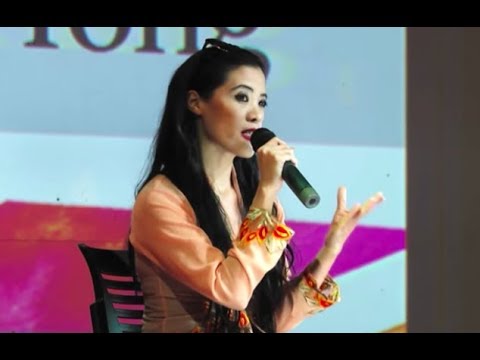
um thank you so much for having me I’m
it’s a privilege to be here to speak to
all of you today as mentioned by our
lovely and see I am the creative
director of Osaka and boo Sokka is in an
organization that works very closely
with traditional Performing Arts in
Malaysia and we work basically to
support the viability of the traditional
Performing Arts we work closely with
communities throughout Malaysia or the
Peninsular Malaysia from Kelantan to
Johor and all the way to Penang I’m
going to speak to you today about mainly
three traditions the mark young
tradition of Kelantan the why uncle it
tradition also of Kelantan and the khuda
kay Punk tradition of Johor but I’m also
going to talk to you mainly about the
way in which young people of these
communities are involved in not just
preserving and safeguarding their
traditions but also transforming their
traditions and making them relevant for
today now I wonder how many of you even
have seen any of these performing arts
if you’ve ever seen among young you’ve
ever seen my uncle it’s or could I keep
on tradition and I wonder how many of
you have even know some of the stories
and that are involved if you’ve ever
heard
for example of the story of day amudha
they were muda who is a young demigod
prince who once saw in a dream a face of
a beautiful princess one put three Ratna
mas and was told by an old sage in his
dream that if he wants to meet this
princess he must go in search of a
golden deer in a clearing of a forest
and so the younger that the young
demigod Prince de amudha goes in search
of the golden deer finds the golden deer
but is unable to capture her I mean the
clearing of the forest he finds a lake
he goes to the lake and finds a
beautiful flower and this flower a water
lily of some kind or a Lotus inscribed
in the petals of this flower is a
message from the princess in his dream
who tells him if you want to meet me you
must fly up to the realm of kyang on now
kion is the celestial realm between the
heavens and the earth and with the abode
of the princess so dear amudha because
he has fallen so deeply in love with
this princess of his dreams embarks on a
journey on a big kite the Wulin and
ancient kite in Sakai hang on to meet
his princess now this is just one of the
many stories of the Mak young and really
it is a homegrown fairy tale it’s one of
the fairy tales just as Cinderella or
Snow White or some of the epic tales
like the Ramayana but somehow we’re not
familiar with these stories and as
Malaysians
or as people living in Malaysia
sometimes I wonder why we know stories
from other parts of the world much
better than our own and this is
something this is one of the questions
that I asked myself when I started work
with boo Sokka I started working with
posaga
15 years ago and to be honest I knew
absolutely nothing about any of these
traditions my first I was I had studied
literature philosophy history I’m at New
York University
that was my first degree I had come back
and you know I thought I was worldly and
in some way as I was in terms of having
read many books haven’t been exposed to
many different narratives but to be
honest I didn’t know that much about my
own country and the opportunity to work
and to experience a completely different
reality about which was something of my
own country was a great opportunity for
me and something I embraced and so when
I first was brought up to Kelantan
actually to koala pursuit witches on the
border of Turin Ghana and Kelantan to
witness among young performance it was a
life-changing experience for me it was
really something I had never this is the
mutt young at the back smart young
dances and these dances they are not
what we think of as professional dancers
in terms of they have not been educated
in a kind of or trained professionally
in an academy or anything like that they
are completely nurtured in their
communities and what they perform and
the stories they tell and the traditions
that they perform in their communities
is not just a form of entertainment
there are elements of entertainment but
there are also elements of healing there
elements of ritual and it’s really a
total experience and besides just the
performance many almost the whole
community gets involved really in a
community performance from making the
stage which is a big closest because
they have makeshift theaters that are
constructed from bamboo and atop and
wood from the decorations to the
costumes to the preparing of the feast I
mean really is a total experience in a
community it’s not something I had
experienced before
even more so what interests me the first
time I experienced my young was also the
conditions in which they lived I mean
these communities that we work with this
particular community they live in a very
small fishing village in kala pursuit
most of them work in a corporate Factory
little fish cracker factory in which
they earn very little money hardly
enough to sustain themselves many of
them the Miyoung is a woman centre
tradition it is a tradition in which the
women claimed the main roles in which
the the men play minor roles and
musician roles but really even the
narratives they go back to the sort of
mythology of
Tan and southern Thailand ppattani which
have very very strong women’s women
leaders women heroes heroines and so
forth and so this too was a kind of
changing of my perception of what the
rural Malay community was like sometimes
from the outside we tend to think you
know that everything outside of kale is
somehow slightly backward or somehow
slightly conservative which in some ways
it is but in other ways there are worlds
out there and communities and world
views that are completely open and
imaginative and alive that we actually
are not familiar with now this young
lady actually behind me
Johanna Abdul Qadeer she is the
granddaughter of a very great legendary
Mott young actress and tightening and
chanting in this night in the 1970s and
80s she ran a mahjong troupe which used
to travel around Kelantan around to
garner a kind of itinerant troupe and
she was she had this kind of charisma
incredible charisma that her reputation
just preceded her everywhere you go
people know the name of chitling as the
great Mong actress and of course now
this her persona and her her aura has
been passed down to her granddaughters
three of them who are now taking on this
tradition and so we had boo Sokka
some of what we do is actually to try to
support the passing down of this
knowledge it’s not easy because there
are many challenges that face these
communities not simply economic I mean
there are also changing perceptions in
society sometimes you do find that
there’s there are misunderstandings and
misperceptions about the traditional
arts some of which sometimes there seem
to be incongruent with present-day
reality some people think they’re
obsolete but also some people think that
there’s some how to fit into the the
right way of practice and culture so all
those are challenges we try to do as
much as we can just
caught them now another one of our the
traditions that we work with is the why
uncle it which why uncle it probably you
know something of it it is the shadow
puppetry tradition where characters are
projected onto a screen with leather
puppets now the why uncle a tradition as
well we work with a community in
Kelantan and they are the inheritors of
a very great day long thought that long
de Labarre Jumeirah which also has there
are many many challenges in which they
face in their community there used to be
hundreds of darlings performing in
Kelantan at one time there are now just
a handful but we have tries to train the
younger generation some of the boys that
we work with they’ve been trained by
their fathers by their uncles and by the
older men in their community but they’ve
now from the age they’ve started maybe
when they were five or eight to learn
how to play the musical instruments and
they’re now masters of those instruments
I mean it’s quite an amazing thing to
experience and the why young itself
again it’s another world if you see a
why uncle it most of the time you know
that there are shadows the shadow play
that is then they perform ancient epics
it’s like the Ramayana but one of the
things that is conveyed I think in a
subtle way is that the world is not
black and white
so what you see in front of the screen
is not necessarily what’s happening at
the back and even all of the characters
what we think of as hero or villain or
antihero all those lines are somewhat
blurred so you can’t always tell who is
good who is bad in there there’s the
protagonist but sometimes the hero is a
flawed character and there’s a lot of
complexity and what is really conveyed I
think in a community setting they play
out things like the narratives of power
the narratives of social interaction all
those things are played out in those
ancient stories and one element of
traditional theatre that I think you
experience
all these them or these different
traditions is that even sometimes our
understanding of what is traditional is
also called into question because the
huge element of what they do is actually
improvisation and sometimes we tend to
think of the traditional as being in
opposition to the contemporary or in
opposition to the modern so we think
this is modern theater this is
traditional theater when in fact the
lines are not that clear and what I
really experience working with these
people is that in these traditions these
traditional masters you will only really
are considered a master once you can
improvise and improvisation as you know
from jazz music it is being in the
moment it is knowing how to respond to
the moment to your audience to the
people around you to the situation and
to the mood to the mood of the of the
space and all these traditional
performance are masters of that of
improvisation and that’s something that
was quite eye-opening and none of them
actually see themselves as being
traditional or doing something old
they’ve inherited a certain tradition
yes but they are recreating it at every
stage in which they perform and by
retelling by participating it is a
creative act at every step of the way
something that engages all the senses
something that engages the mind the
memory and influences really the entire
social social interactions of the
community yes I hope we can actually
speed up the slides a little um the
third the third community who I want to
speak to you about is the CUDA coupon
community and this is something this is
a tradition that you find mostly in
Johor it originated from Java and there
is a community in Johor we work with a
community in Parratt rajanbabu / hot
many of them are descendants of
japanese and they’ve brought this
tradition with them and the kuda kept on
as a trance dance tradition mostly male
young males who are involved in this but
there are females as well but the
interesting thing about the kuda kept on
community we work with i find is that
all these young men are participating in
this tradition and this is also a
tradition that has been sometimes
discouraged by authorities and by
elements in the community but these
young men are participating in this
tradition with the consciousness that it
is maybe preventing young people from
getting involved in destructive behavior
for example many of them gather in a
parking lot at night and they go and
they play this could a kept on for hours
they go into trance it’s a kind of
ecstatic experience for them and it
releases a lot of energy now if they
weren’t doing this many of the boys in
this community would probably be racing
motorcycles they would become muttering
bits many of them were at some point in
their life a modern bit racing
motorcycles killing themselves on the
road probably getting into drugs and
become basically getting involved in
social vices and so these boys are
really consciously using the Karaka
power to also transform their
communities in a positive way and to say
look we are going to rather than get
involved in those social ills we are
going to nurture our tradition we are
going to somehow do something to
safeguard our heritage and also educate
the community about how to how to not be
destructive to do something creative
with their energy and also and but in a
creative way so that one thing I think
they find when they perform also for an
urban audience we bring them out to
Kuala Lumpur quite a lot to perform so
that they can engage with the new
audience I think for them sometimes they
feel that they have a new kind of
sexiness
so most some of these boys they’ve said
to me I feel very sexy doing this it’s
something that’s traditional yes
it’s something that’s maybe old
something inherited from the
grandfather’s but they feel a sense of
attractiveness when they do this because
it brings out their charisma it brings
out their personality actually yes this
is the coup de que pong you can see
behind many of these boys
many of these boys go into they go into
a trance and what I call almost
metaphorical shape-shifting obviously
they don’t physically transform but they
metaphorically transform into their
spirit animal which is something like
either a tiger or an eagle or a peacock
you can see some of them this is the
peacock trance at the back and it’s
extremely beautiful it’s extremely
beautiful and something that we don’t
see really in the same way with the same
intensity in much of contemporary
theatre in Kuala Lumpur now for all of
you I think some of you are involved in
things like drama in music for sure what
I think we can learn from engaging with
these communities is that one they might
be different they might be somehow
strange and unfamiliar but I think if
you find a chance to somehow engage and
learn a little bit more about these
traditions you will find that there’s a
very deep connection and that you can
communicate very well with them you can
learn from each other they love to
interact so come and talk to me later or
come and follow our posaga page we have
a lot of events sometimes that we bring
out community masters of tradition to
perform in Kuala Lumpur please do come
many of our events are free for the
public come and experience the beauty
and the diversity of Malaysian
traditions and I urge you all also this
is a way of kind of rediscovering
ourselves it’s rediscovering not just
aspects of our community but also
aspects of the self as all of them do in
these traditional arts commemorate and
go back to something that is more
essential and I think that’s something
we can all learn in our creative lives
thank you very much
you
[Applause]
Please follow and like us: