
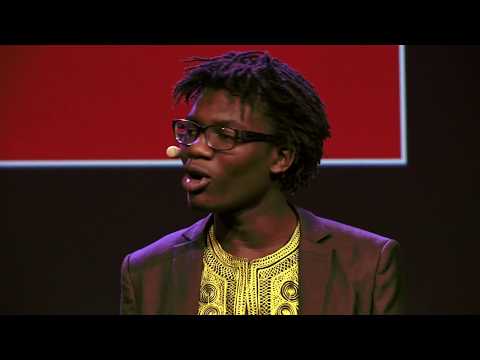
so I was born and raised in rural Kenya
in a small town literally in the middle
of a sugarcane farm so my dad owns a
sugarcane farm so obviously the Kalima
farmer though I wonder why they call my
dad a farmer
cause it’s my mom there’s the actual
farming but that is a story for another
day
a few years later when I was 18 I left
my small town in Kenya and I went to New
York you know and you may be wondering
you know why why did he leave my town
and go to New York so it’s New York for
a social entrepreneurship competition
so the 100 people from all over the
world young old who are competing for
seed funding for their social
enterprises I actually felt really out
of place when I was really young my
roommate for example was a PhD degree
from Harvard he was studying
astrophysics you know some of the people
who are competing for this seed funding
included a professor from Stanford
German engineers all the designers from
Italy and I was wondering what I was
doing with my high school diploma from
Kenya and I remember that night before
we were presenting when my roommate
asked me to rehearse with him it was
like okay so let’s rehearse and all of a
sudden he was talking about things that
I never had before talking about his you
know business model is a theory of
change a value proposition
sustainability like a question mark says
what’s happening so I was wondering what
was happening I was talking about all
these things they’re all foreign to me
but for some very strange reasons the
judges decided to give me the seed
funding and not my roommate and that’s
how he raised seed funding for my social
enterprise grincher so when I found it
Granger my idea of social innovation was
that social innovation and social
entrepreneurship was a tool through
which local solutions to local problems
in communities co-signer voice to be
amplified I thought that by solving this
problem that it
within my community by solving this
problem but I witness so many people in
my country you know I’m struggling with
I was actually a social engineer no but
I realized that my idea of you know
problem solution Eureka wasn’t how
social entrepreneurship work it doesn’t
work that way
you know I really the social
entrepreneurship was even way more
complicated than I imagined you know
things that my roommate was saying like
value proposition theory of change
fundraising were actually very very
important and here I was an 18 year old
boy from Kenya struggling to speak this
language struggling to understand what
all of this meant and especially in an
ecosystem where only those who can learn
how to speak this language most likely
have access to the resources that they
need to succeed and as I continued with
my journey as a social entrepreneur it
strike me just how this space was
misunderstood it’s misunderstood to the
extent that even we who consider
ourselves social entrepreneurs don’t
know what social entrepreneurship is all
about another result you get a wide
spectrum of thinking when once idea of
people who think about social
entrepreneurship and the imagine small
micro enterprises run by local
communities which are trying to solve a
problem is the kind of communities for
example you imagine you know a farmer in
rural Cameroon who’s trying to you know
buy one extra cow to increase his
livelihood then on the other side we
have people who think about social
entrepreneurship as a way for like
foreign mainly experts and organizations
that are coming in into some of these
communities and trying to create change
using business solutions and while this
kind of thinking gives us a framework
through which we can think about social
entrepreneurship I think this kind of
thinking is what is wrong you know with
social entrepreneurship because the
small local run enterprises they’re
great yes they’re very great but we’re
only giving them small amount of money
like if you go to Kiev or a dog you
donate $20 to someone in Cameroon you
feel so good about yourself but $20 is
not going to be enough
to create transformative social
experiences for this community and even
if they have enough money they don’t
have the skill sets and have the
capacity to grow and scale the
organizations and large run
unlike foreign join organization have
much higher chance of success but
they’re not close enough to the problem
to truly understand the dynamics within
these communities and it would let you
realize that this was maybe one of the
reasons why I got the money my roommate
dint was because I was much more close
to the problem and make even matters
much more interesting some of us look at
social entrepreneurship as a new form of
charity we think about it is 21st
century charity another result most
social ventures are actually funded by
grant money philanthropic money donor
money etc but through research and
through experience we know that what
this kind of philanthropic thinking does
either it just perpetuates this vicious
cycle that continues to create
dependency and something that we who are
thinking about making the world much
more sustainable and much more better
cannot continue to support and just
assume it’s business as usual so we may
wonder then what can we do so today I’m
here to propose that by finding and
empowering local grassroot movements we
have a chance to use social
entrepreneurship as a way of actually
making the world a better place and the
four things that I want to say today and
the first one is local local solutions
to local problems
it was Germans who solved some of the
most pressing issues in German similarly
Kenyans will solve some of the most
pressing issues in Kenya but just as in
other parts of the world not everyone
has the capacity to be a leader to be a
problem solver so we need to find and
identify people who are talented huelva
skillsets well the capacity to actually
leave their communities and once we find
these people natalia talented but also
dreaming big enough big bold ideas that
can actually be skilled we
to provide them with an ecosystem that
he needs to succeed and the ecosystem
still includes financial support
kilink leaves a you know giving people
financial resources in crates and all
the typical traditional financial
resources that we have been used to in
the era of aid it’s not $20 or $50 or
$100 that’s going to make a difference
in the large scale of things we need to
think big we need to think about making
much larger investments we’d think about
writing much bigger checks to actually
have the potential to do something
massively come and think about it I
think that one one entrepreneur who’s
building a milk processing farm with a
thousand with a hundred thousand dollars
has a much higher chance of a child’s
chance of success when a thousand
different small formals with a hundred
dollars and we need to provide these
leaders with the mentorship and the
support that they need to succeed we
need to engage in transferring of skills
because you know some of us are skilled
you know in areas like your design
thinking in financial management we need
to transfer these skills to make sure
that these leaders have the holistic
ability to actually leave their
communities into the right direction and
just once in awhile you know moral
support and like saying you’re doing a
good job you know comes in very handy
and very strongly make the world a
better place and it’s a buzz word you
know we’ve been using the odd for the
last 10 20 years that some of us has
lost meaning but for some of us we truly
want to end global poverty we still
really want to build strong inclusive
communities which really wants to
protect for climate and environment for
future generations and yes we have made
a lot of progress in the last five to
six beacons but if you’re to build on
the progress that we have made then we
have to switch from very high-level
abstract thinking to local grassroots
thinking and social entrepreneurship
provides us with a path through which we
can do
but if we continue thinking of social
entrepreneurship just another feel-good
factor that maxes you know go to bed and
think that we’re doing good in the world
then maybe we need to rethink our
mindset they say that those closest to
the problem are closer to the solution
but not everyone who leaves with a
problem can’t find the solution let us
identify the local people who have a
solution to their problem let us provide
them the support that they need to pull
their communities on a path to success
on the path out of poverty collide is
one way that we can truly truly in the
21st century Maxwell a better place
thank you
[Applause]
[Music]
Please follow and like us: