
resound some bells at 10 o’clock at
night this may be just the right way to
initiate this last lecture and managing
a place like this
inviting you here tonight and we are
very happy that you came such a such a
big crowd may this thing that may be
talking about something that we are so
used to which is music which is
listening that we might not know what we
are doing
maybe we know what sounds are but maybe
we do not know what listening is now why
did I start with bells these bells are a
part of a composition made by a British
20th century composer Jonathan Harvey
maybe some of you know him maybe some
don’t doesn’t matter actually he’s an
important composer of classical music in
the 20th century but he uses bells and
we all know bells for me as a kid bells
were everywhere in the town where I grew
up
bells church bells that would say the
time bells in Korean that would play
tunes they would played on fixed dates
they would play played on fixed days in
the week they would play it in concerts
but anyway those bells were there
everywhere and I think from for all
those here in the room and especially in
this part of Europe bells are part of
our life that we don’t know we are not
listening to them but if you listen
carefully and if you did listen
carefully to the excerpt of the piece
there was a small voice coming up
Oh
[Applause]
and the value is coming in actually what
is happening there that is where
contemporary music gets a certain form
that’s where in a certain moment the
sound we are used to turns into
something that is a construction of the
mind of the heart that is responding to
an idea to something that somebody needs
to express that is in a way what I would
like to go through with you tonight
making this path a little bit more soft
very often when we reconstruct Hall and
we don’t know where piece and we did not
rehearsed it but you could you play
Waldo this is our pianist Waldo could
you play the Sinatra sealed by Mozart
just a few first bars is that possible
for you though miss Osie do IDO
[Music]
thank you he really plays everything
this piece we all know it yes please
this was really not rehearsed this is a
piece we all know when we all like but
actually is it natural the bells were
much more natural they are something if
you listen well carefully to these bells
they have some spectrum as we call it
when you listen to a bell and too many
bells together that was the sound you
heard you have all kind of rhythms all
kind of tunes all kind of notes and
although they started the bells all on
the same movement they never resound on
the same moment why because they have
their own life they have their own shape
they have their own sound they have
their own tune and you just can’t stop
that
once it starts it gets its own life now
what is important is to accept that the
sounds that they are part of this
surrounding you are living in so in a
way the first path you could take to go
through a new listening to an avoidance
of fear maybe the word fear we just is
hurt a very interesting story about fear
and about what we can do with it and how
it can move us the fear of new sounds we
can make it disappear actually if you
just think if you would be afraid of new
sounds that means you would be afraid of
progress
can you imagine that you would always
read the same book that Balzac novel
19th century there is 150 years of
literature written after and in a way we
are listening we want to read new books
but when it’s about new music suddenly
there is something that we feel
awkward about so the first path is to
know that you and your own feelings are
in the center of the capturing of
capturing these sounds of hearing what
it is about and of capturing these
sounds that are surrounding you a second
path could be a total different one
there is a surrounding about us around
us that is one that we talked a lot
about we talked about it tonight it’s
the environment its nature nature was
there a long time before us it makes it
own sounds it has its own ways of
presenting music in a way and one of the
most interesting animals that we know
that is making music before we did our
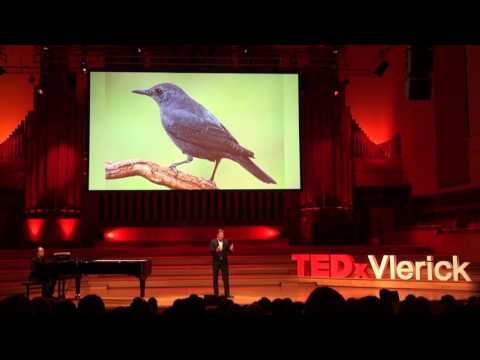
birds and that is Jonathan Harvey but
actually that is Olivier Messi on an
Olivier Messiaen
was one of these huge composers of the
20th century who was inspired by two
things he was inspired by religion but
most of all he was inspired by birds and
you see in this very sexy outfit he went
a lot through mountains to meadows
through woods and he would listen to
birds he would see he was an Oni tal
against and he would write down in music
scales the singing of a bird and I think
we should listen to one of these singing
he did four times achoo none of the four
times were identical they were different
there are different rhythmical patterns
sometimes more nodes sometimes less but
in the end there is some kind of
thematic thing in the middle that is
always the same and it makes that he is
a Marilyn why a messy ano knew exactly
about all the birds he has heard but not
only in Europe but he traveled all
around the world and he made a catalog
catalog his wazoo
he made a catalog of birds with all
these bird songs and then he used these
birds songs in his compositions and it
is very very strange when we hear this
when we’re taking having breakfast we
are on holiday we’re having breakfast we
hear these birds we think it’s perfectly
natural we think it’s fantastic
we don’t run away from the hall the
concert hall way we might be sitting at
in after later on the day because messia
made a composition of it using the same
[Music]
[Applause]
[Music]
thank you very much of course there are
more nodes here than the bird that is
singing there are very high nodes or are
lower notes that’s Messier is making a
story with it
he’s also talking about the trees about
the winds about the water he heard in
the woods where he was walking he takes
all these elements and makes one big
thick picture of it but in the end this
kind of little little song it is there
it is always coming back with a little
variation with a little imagination of
the composer so nature is a real
powerful power station for the
imagination of composers and it should
be for us because we know this power
station and we know these elements but
with maybe one element that we know best
and it’s the third path that gives us
information about what we are listening
at and it’s silence and I take you to
after this bird to another country
Estonia
then in Estonia you have this huge huge
parks you have these huge lakes
huge woods
actually have them everywhere in
and there is a French writer Margaret of
Sanaa and she says that actually music
is the water that comes out of the well
silence is the fume for the imagination
of the composer what you hear now is a
composition by alphabet alphabet he is
one of the eldest composers still live
in Europe one of the most original one
of the most powerful and he just he grew
up with all kinds of aesthetics in the
20th century but at a certain moment he
just wanted to go back and express the
things around him
[Music]
and if you’ve been traveling to Nordic
countries one of the most powerful
things you see or you hear or you don’t
hear is silence so he expresses this
and in a certain way by expressing the
unexpressable by mating making
audibility inaudible he brings you to an
aisle level
for some he will bring you to a god or
maybe to God it depends on what you
believe in but in a way it sure it’s a
religious experience but it is
contemporary music
it is modern music it is a new music so
in the end when listening to all this
music when we know what it is about
we need a path
and when I think about the parts that
you might know in contemporary arts the
visual arts is Picasso we know about
Picasso we know about the way he made
abstractions of things and the path for
listening should be the same path as for
him as for Picasso
drawing a bull you know this bull and
look how he is going to change it it
gets a structure it get lines it gets
less colors and in the end it becomes
this maybe it’s a bull maybe it’s a bike
so maybe listening better is just
turning the bull in your head in a bike thank you very much